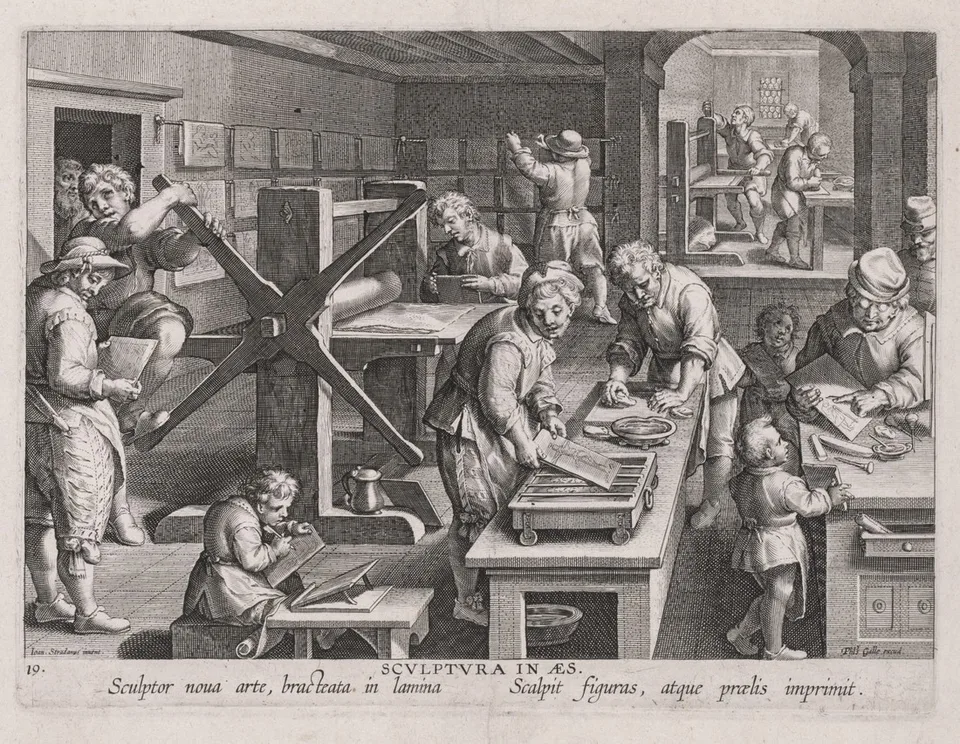
Follow the workshop from right to left and a printed image begins to reveal the many hands behind its production.
The scene is crowded with different tasks rather than a single artist at an easel. On the right, a seated worker concentrates on a plate. Across the center, others prepare and handle surfaces at benches. The large wheel and press dominate the left, while sheets hang at the back. The picture makes a production sequence visible by distributing it across a shared interior.
Stradanus designed this image for a series about important inventions; Philip Galle engraved and published it. The museum reads the process from right to left, from cutting a plate through inking, wiping, and pressing to drying the finished sheets. It also identifies a worker using an acid bath, introducing etching within an image principally concerned with engraving. That mixture is important: the print is an informative representation, not a perfectly isolated technical diagram. Its many participants challenge the assumption that every historical print records the labor of one maker alone.
The workshop combines engraving and an etching acid bath within one scene. It should not be treated as an exact operational manual or a documented portrait of a single named establishment.
What complicates treating this as a diagram of engraving alone?
Practise looking at Sculptura in Aes, The Workshop of an Engraver →