Read the
Picture
An open collection
A guided journey · 4 works

Spaces full of people

Crowds become legible through boundaries and repeated actions. A circus ring separates performers from viewers, a harbor square spreads people below an elevated viewpoint, a bistro compresses overlapping exchanges, and a workshop distributes production across several stations. Follow how each image lets us understand collective activity while leaving most individual identities unknown.

Begin the journey ↓
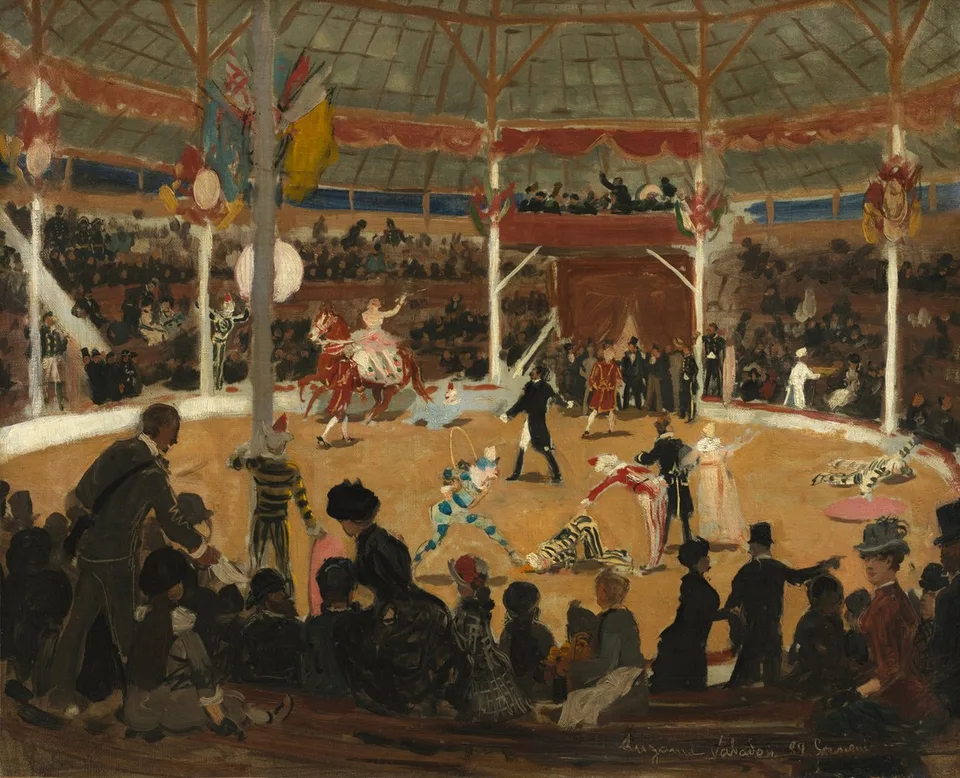
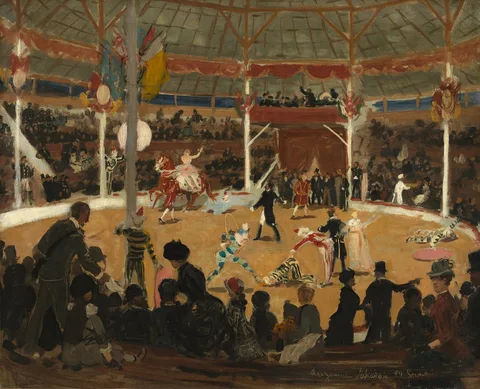
Inside a round circus building, performers and horses occupy a bright ring surrounded by densely packed spectators. Tall columns rise toward a latticed roof. Dark figures fill the near seating area, including a standing man on the left. Pale costumes, red hangings, and a harlequin pattern punctuate the arena.
01Inside a round circus building, performers and horses occupy a bright ring surrounded by densely packed spectators. Tall columns rise toward a latticed roof. Dark figures fill the near seating area, including a standing man on the left. Pale costumes, red hangings, and a harlequin pattern punctuate the arena.
The Circus · 1889

The near audience

Dark foreground spectators place us inside a partial view of the ring. The scene’s organization is secure visual evidence even though its attribution to Valadon remains disputed.

Carry this question: Which bodies prevent you from seeing the arena completely?

Open the artwork ↗
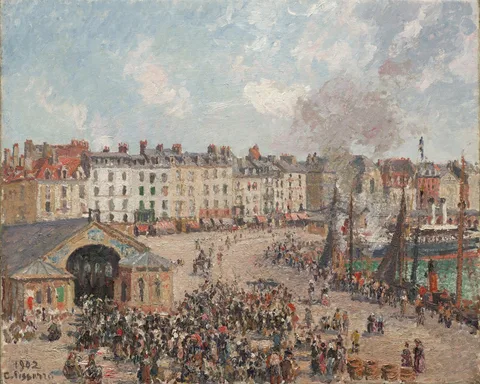
02A busy waterfront square lies below the viewer, filled with tiny people and carts. A market building with a large arched entrance occupies the left foreground. Pale multistory houses line the distance, while boats, masts, and dark funnels cluster at the right. Broken blue, pink, and white strokes fill a broad cloudy sky.
Fishmarket · 1902

A crowd made of marks

The high viewpoint turns the market crowd into small energetic marks. Buildings and harbor equipment give those marks a practical setting while steam joins the changing sky.

Carry this question: Where does the crowd become densest, and why might that matter?

Open the artwork ↗
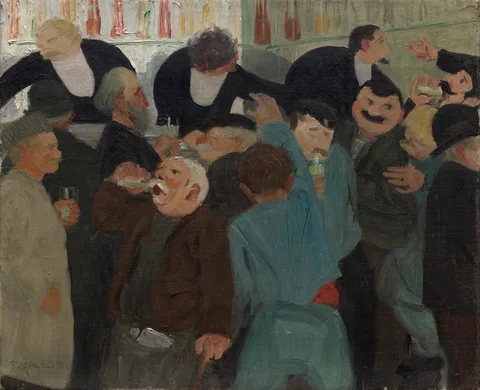
03Men in dark and blue jackets crowd tightly around a bar, drinking, gesturing, and turning toward one another. Servers in dark clothing with pale shirtfronts lean over the counter behind them. Bottles line shelves at the top. Red cheeks, small glasses, and overlapping hands interrupt the broad dark shapes throughout the cramped interior.
The Bistro · c. 1895

A back turned toward us

The blue-jacketed back blocks other patrons and places us at the crowd’s edge. Overlap conveys simultaneous activity without supplying a transcript of the apparent noise.

Carry this question: How much uninterrupted space remains between the bodies?

Open the artwork ↗
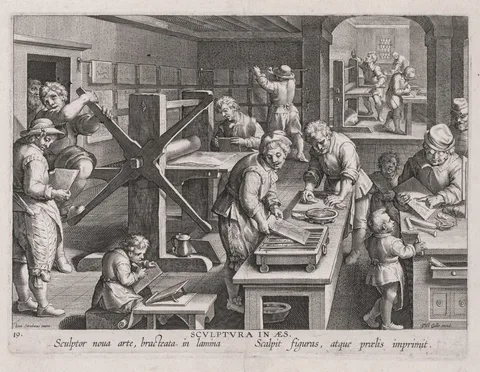
04A busy black-and-white workshop contains seated and standing men working at benches. A large star-shaped wheel and roller press dominate the left side. At right, a man bends over a small metal plate; central workers handle plates and tools. Finished sheets hang along the back wall, while another room opens through an arch.
Sculptura in Aes, The Workshop of an Engraver · c. 1591

The large roller press

A large press organizes one stage of a collaborative process. Follow the workers across the room to distinguish cutting, preparing, printing, and drying.

Carry this question: Which tasks depend on tools too large for one seated worker?

Open the artwork ↗
Take this with you

Look for the structure organizing the crowd before inventing personal stories for its small or overlapping figures.

Try an exercise with the first work →

Find another journey →

Read with the sources

Historical context follows the individual museum records linked on each artwork page. These routes make original comparisons of visible form; resemblance alone is not evidence of shared meaning or direct influence.