Read the
Picture
An open collection
Side by side

Some things appear between pictures.

Two works. A shared question. Look for the connection, then notice where the comparison stops.
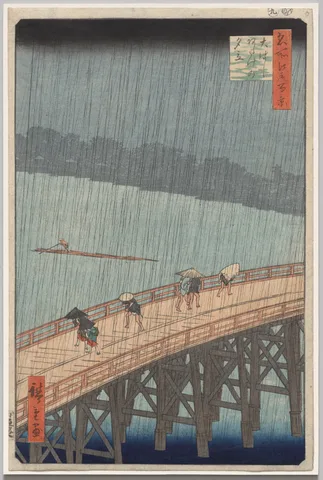
Fine dark rain lines cut across a vertical colour print. Small pedestrians huddle beneath umbrellas or coverings on a wooden bridge that runs diagonally across the lower half. A lone figure poles a long, low craft on the broad blue-green river beyond. The distant shore is a muted dark band, and a deep cloud hangs across the top.Orange and yellow flames billow across a blue-gray sky above a broad river. Their reflections stretch down the water. A pale bridge runs across the middle distance, small crowds line the lower left bank, and boats with tiny figures move across the lower right toward the fire.
A closer comparison

Making atmosphere visible ↗

Hiroshige’s rain and Turner’s fire-lit atmosphere
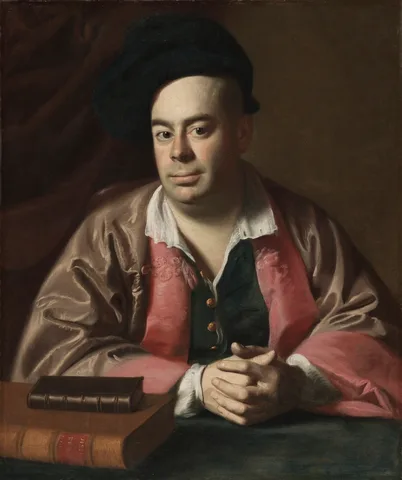
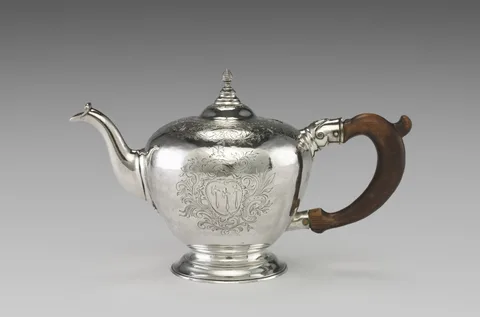
A man in a dark cap sits behind a table, looking outward with a slight smile. His white shirt is open at the neck beneath a glossy brown robe with a pink lining. His hands rest together on the tabletop beside two stacked books, against a dark brown background.A polished silver teapot stands on a circular foot against a gray background. Its curving spout extends to the left and a dark wooden handle loops to the right. A small stacked finial tops the lid. Fine engraved scrollwork and a central coat of arms decorate the rounded body.
A closer comparison

A maker beside his work ↗

Nathaniel Hurd’s portrait and silver teapot
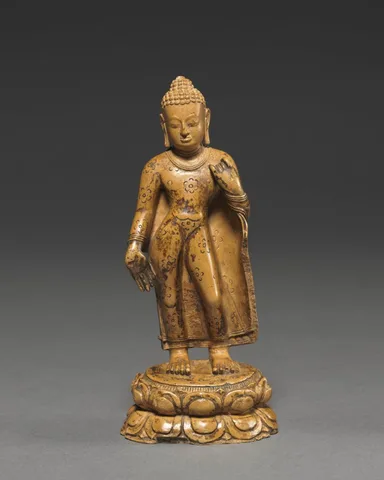
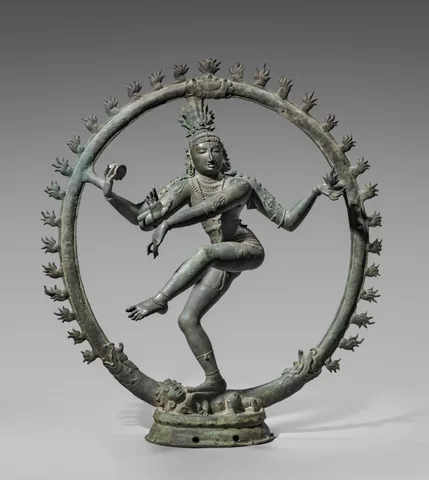
A small tan sculpture of the Buddha stands on a two-tiered lotus pedestal against a dark background. One hand reaches downward with its palm outward; the other is raised near the shoulder. Repeated dark flowers cover the long robe. The head has small curls and a rounded top, and the eyes look downward.A bronze Shiva dances inside a ring edged with flames. Four arms extend in different directions, and one leg lifts across the body. The other foot presses onto a small figure above the base. Small objects sit in the raised hands. The hair spreads outward, while the face remains comparatively still.
A closer comparison

Stillness and movement ↗

A standing Buddha and Shiva in dance
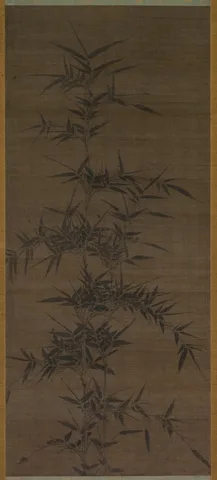
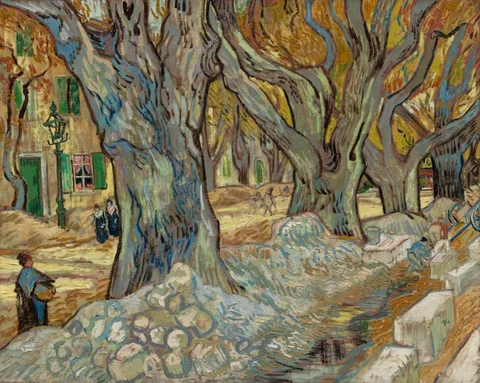
Two dark bamboo stalks rise through a narrow brown silk field. Clusters of pointed leaves spread to either side, alternately sparse and dense. Some leaves are dark, while others are lighter or edged with pale gaps. The composition has little surrounding scenery, concentrating attention on stems, joints, leaves, and the tone of the support.Massive branching trees line a village road in a painting filled with short blue, yellow, green, and brown strokes. Piles of pale stones cover the foreground. Small people stand or work between the trunks; green doors, windows, and a hanging streetlamp appear on the buildings at left.
A closer comparison

Plants and the marks that make them ↗

Ink bamboo and Van Gogh’s plane trees
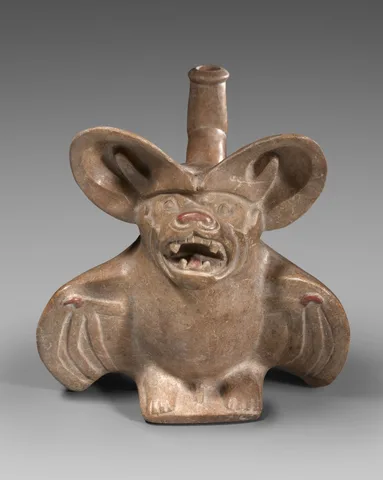
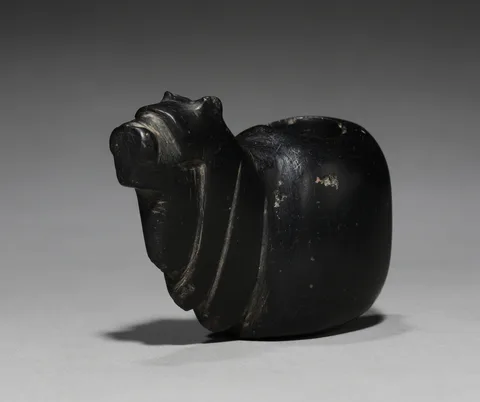
A brown ceramic vessel takes the form of a bat facing forward. Very large rounded ears extend sideways above an open mouth with pointed teeth. Short, partially extended wings flank the body and show incised finger-like supports. A narrow tubular spout rises behind the head. Reddish slip highlights the nose and parts of the wings.A compact dark stone camelid has a short upright neck, small ears and a rounded, almost block-like body. Curving grooves separate the neck and chest. A cavity is visible on the top of the back. The polished surface catches narrow highlights, while the animal rests directly on its flattened underside.
A closer comparison

When an animal becomes an object ↗

A Moche bat vessel and an Inka alpaca canopa
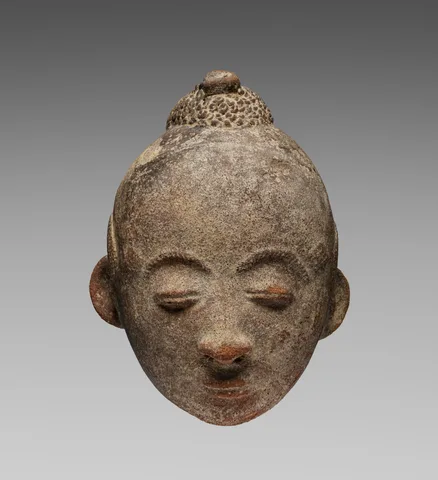
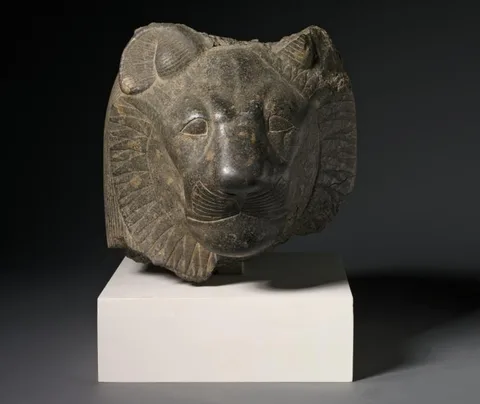
A terracotta head is shown from the front against gray. A high rounded forehead leads to closed-looking, lowered eyelids and a small mouth. Rounded ears project at either side. The hair forms a textured mound ending in a topknot. The surface is mottled brown-gray, with reddish areas at the nose and eyelids.A dark stone lioness head faces forward, broken off below the neck. Rounded ears rise above a modeled feline muzzle and almond-shaped eyes. Grooved shapes radiate around the face like a stylized ruff, with wig sections behind. The head rests on a modern pale rectangular support, distinct from the ancient sculpture.
A closer comparison

How a face holds attention ↗

An Akan memorial head and a head of Sekhmet
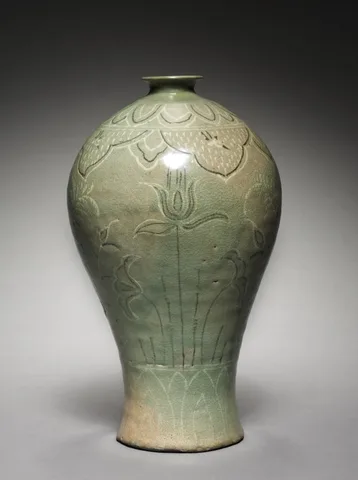
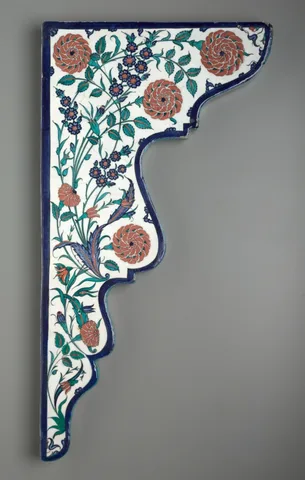
A tall green-glazed vase has rounded shoulders, a very small mouth, and a body narrowing before widening slightly at the foot. Pale and dark plant designs run down its front, including a large lotus blossom above long stems. Decorative bands encircle the shoulder and base. The glaze has fine surface cracks and uneven tones.A tall, irregular ceramic panel has a straight left edge and an inward-curving, scalloped right edge. Red rosette-like flowers, blue blossoms, and green leaves spread across a white ground. Dark blue edging follows the curved outline. Its upper part is broad, while the lower section tapers into a narrow point.
A closer comparison

Flowers find a surface ↗

A prunus vase and an Iznik floral spandrel
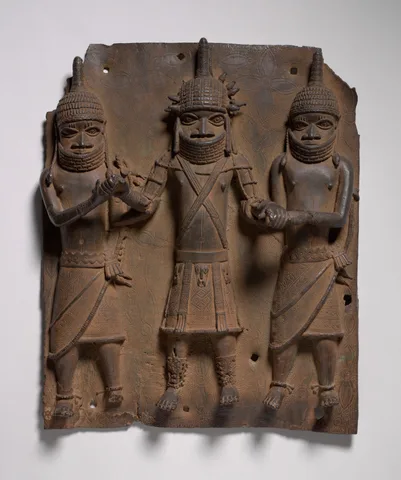
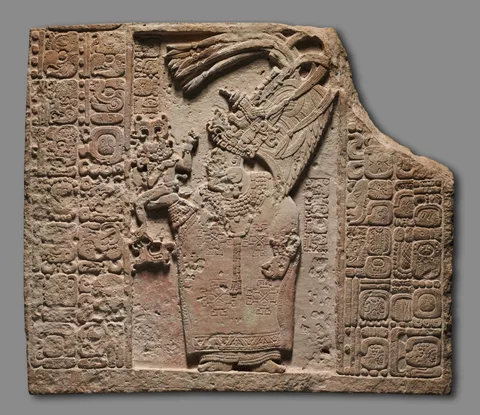
A rectangular copper-alloy relief shows three standing figures facing forward. The central figure is larger and wears an elaborate tall cap, layered neck ornaments and a patterned garment. Smaller attendants flank him and support his arms. All three have prominently modeled faces and feet; floral patterns fill the shallow background.A limestone relief shows a royal woman standing in profile within columns of carved Maya writing. Her tall feathered headdress curves above her, and she wears a broad necklace and a long patterned garment. She holds a small lively figure with an elaborate head. Broken stone edges and areas of wear interrupt parts of the carving.
A closer comparison

Status raised from a surface ↗

A Benin royal plaque and a Maya royal woman
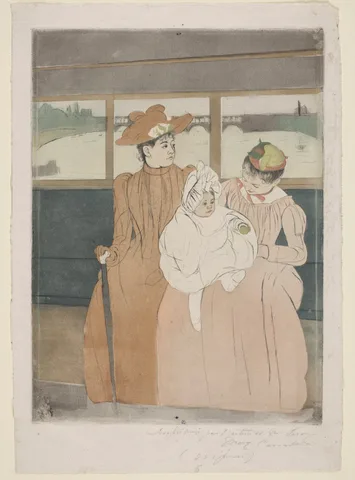
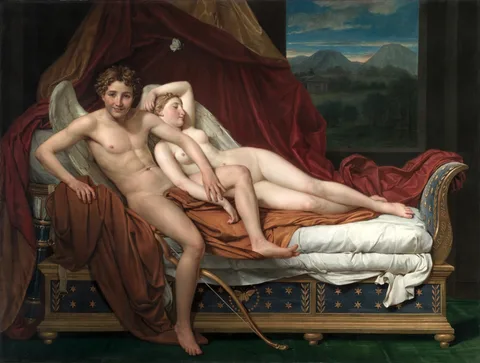
A softly colored print shows two seated women and a child inside a public carriage. The woman at left wears a warm orange dress and broad hat and looks sideways. At right, a woman in pink looks down at the white-clad child on her lap. Broad windows behind them reveal a pale river scene.Two nude figures recline on a richly upholstered bed beneath deep red curtains. A winged young man at left looks toward the viewer while a young woman lies asleep beside him. A bow rests against the bed, a pale butterfly floats above, and a distant blue landscape is visible through an opening.
A closer comparison

Together in a small space ↗

Cassatt’s omnibus and David’s Cupid and Psyche
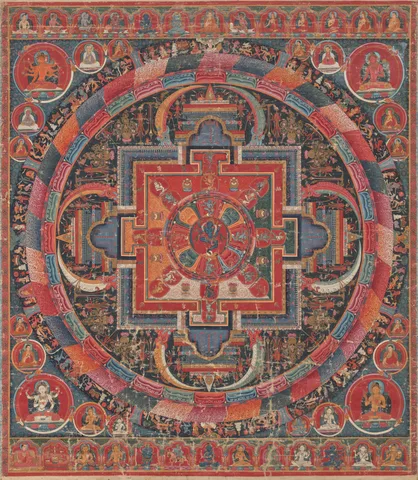
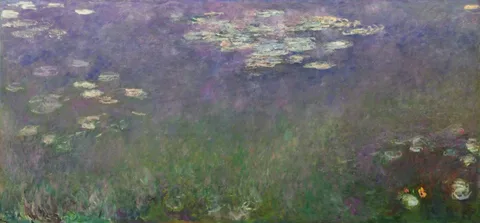
A densely painted rectangular cloth contains concentric coloured rings around a square palace-like plan with projecting gateways. A small dancing blue figure occupies the centre, surrounded by other figures. The outer ring contains many tiny scenes. Rows of seated teachers or sacred figures run along the top and bottom borders.A very wide painting shows a pond in soft violet, blue, and green. Pale lily pads and flowers cluster toward the upper left and middle. Long green strokes descend through the lower water, with several pink and yellow accents at the lower right. No bank, horizon, or sky is directly visible.
A closer comparison

Two ways to organise attention ↗

A Nairatma mandala and Monet’s Water Lilies
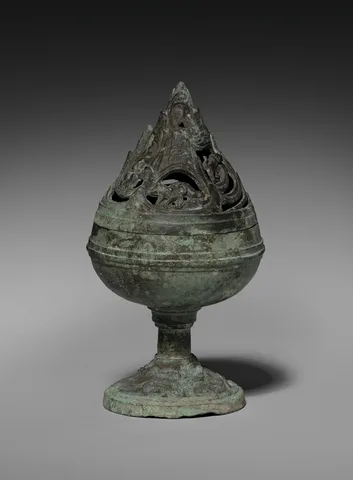
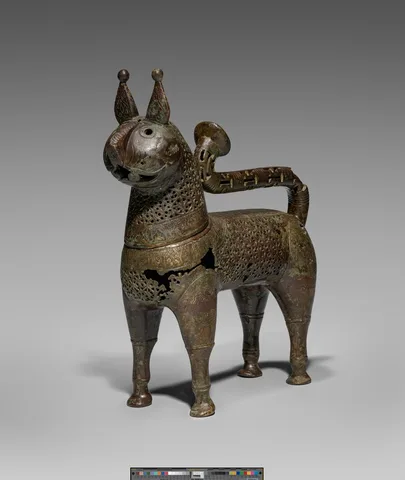
A green-patinated bronze incense burner stands on a short stem and circular foot. A rounded bowl supports a tall conical cover formed as rugged peaks. Openings cut through the mountain among small raised figures and animals; horizontal bands separate the lid from the lower vessel.A dark copper-alloy feline stands on four sturdy legs, with a rounded head, tall pointed ears and a raised tail curving along its back. Small patterned openings cover its neck and flank. Engraved bands encircle the chest, where a larger irregular break interrupts the metal. A photographic colour scale remains below the feet.
A closer comparison

Smoke from a mountain and a feline ↗

Two bodies designed to release incense
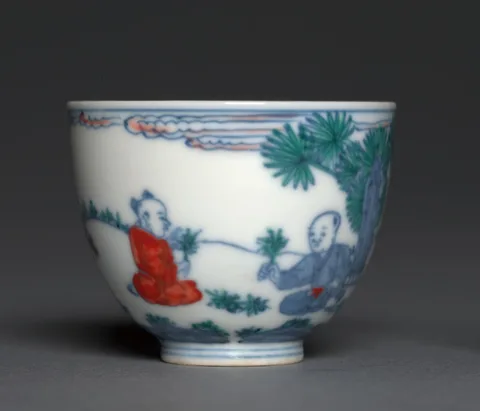
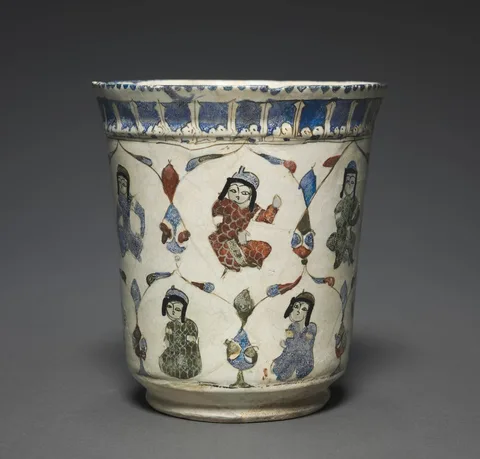
A small white porcelain cup widens toward a straight circular rim. Two children sit beneath a tree on its curved side, one wearing bright red and the other blue-grey. Blue-outlined clouds run near the rim; green leaves and plants punctuate the pale ground above a narrow foot.A cream-coloured ceramic beaker widens slightly toward its blue-edged rim. Rows of small seated figures in red, blue and muted green occupy the sides, separated by looping stems and multicoloured leaf-like shapes. Black lines define faces, hair and clothing patterns. A narrow foot supports the vessel, and fine cracks cross the glazed surface.
A closer comparison

Two ways to colour a small scene ↗

Blue outlines and enamel scenes in China and Iran
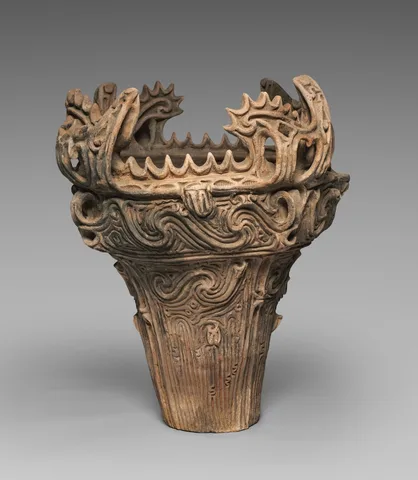
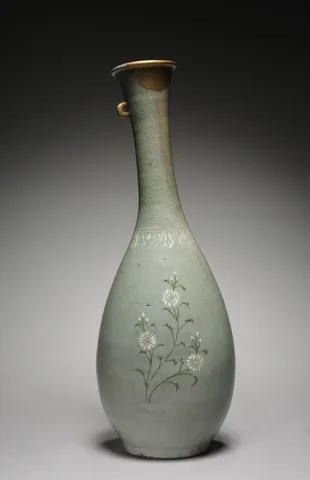
A tall brown earthenware vessel narrows toward a flat base. Its upper rim rises into four elaborate projections surrounded by smaller pointed scallops. Raised spirals and curling ridges cover the shoulder, while denser vertical grooves run down the tapering lower wall.A pale grey-green bottle has a swelling pear-shaped body and a very long narrow neck. White inlaid chrysanthemums rise on dark branching stems across the front. Fine crackle covers the glaze. Gold-coloured repair fills part of the flared lip, and a small loop projects from the side of the neck.
A closer comparison

Repair, reconstruction and original form ↗

Two ceramic histories with different consequences
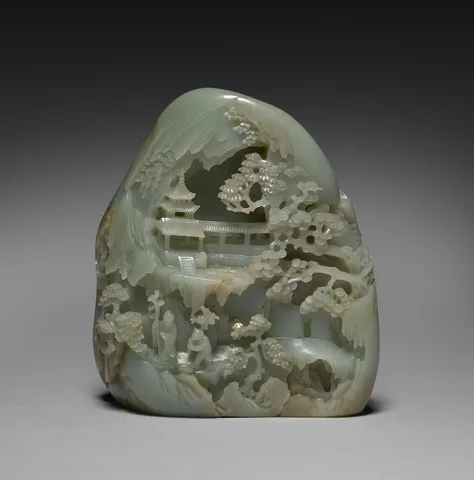
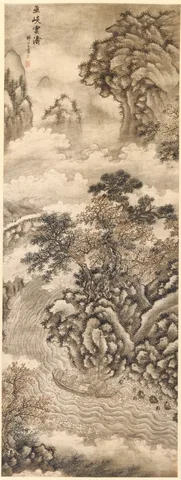
A pale green jade boulder has been carved into a miniature mountain. Openings and projecting ledges surround a central roofed pavilion. Rounded trees cluster around the rocks, and small human figures stand near the lower left. The original rounded outer shape remains visible around the intricately cut scene.A narrow vertical landscape stacks rocky cliffs, trees and pale misty intervals above a river filled with tightly drawn curving waves. A small boat appears among the lower water passages. Dark trees occupy ledges between angular rock masses, and vertical writing marks the upper left edge.
A closer comparison

Mountains to enter or negotiate ↗

A carved paradise and a perilous river view
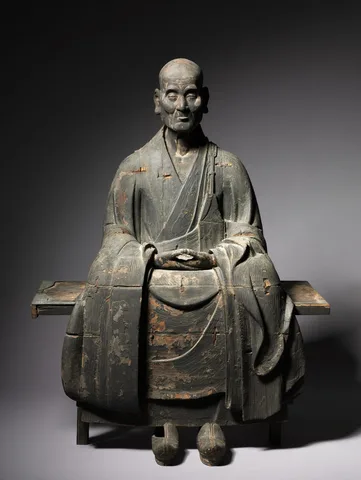
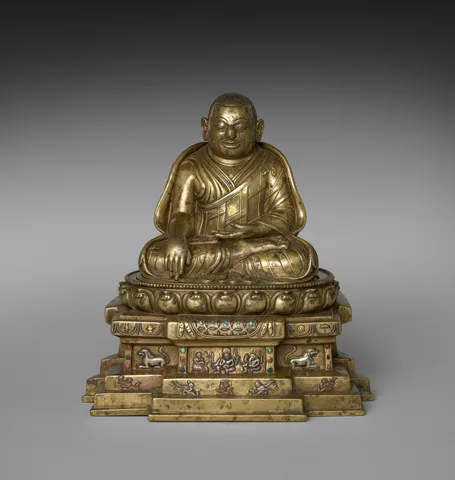
A dark seated wooden monk faces forward on a low chair. His shaved head has strongly modelled brows, cheeks and a closed mouth. Broad layered robes cover the body and arms; the hands meet at the centre. Two shoes rest below, and worn patches reveal changes in the surface.A golden-toned seated monk rests cross-legged on a lotus cushion above an elaborate rectangular throne. One hand lowers toward the knee while the other lies near the lap. Broad robe folds cross the torso. Small lions and figures decorate the stepped base below the large central portrait.
A closer comparison

Two monastic portraits ↗

Specific teachers within different sculptural conventions
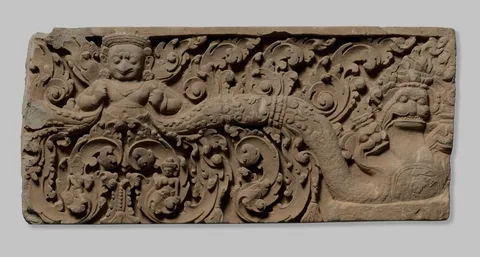
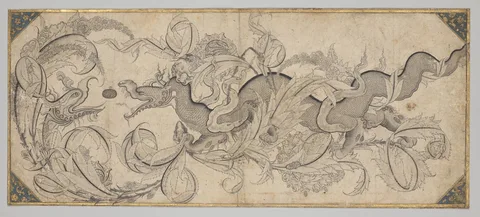
A long rectangular sandstone relief shows a crowned human-like figure toward the left, with bent arms and broad forms extending to either side. Deeply carved leaves curl across the panel and around a small female figure below. At the right, the vegetation meets a large serpent head with an open mouth. The upper edge is worn and uneven.A long horizontal drawing shows a scaled dragon stretching from right to left through curling foliage. Its open mouth faces a small dark oval and a bird-like head at the left. A smaller lion-like head presses against the dragon’s neck. Large pointed leaves, buds and fine curling stems fill the paper inside a narrow decorated border.
A closer comparison

When foliage becomes a creature ↗

A Khmer lintel and an Ottoman drawing
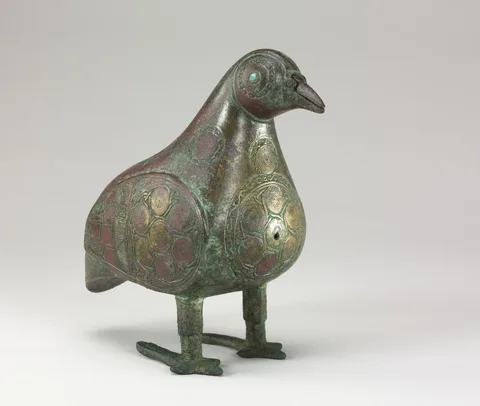
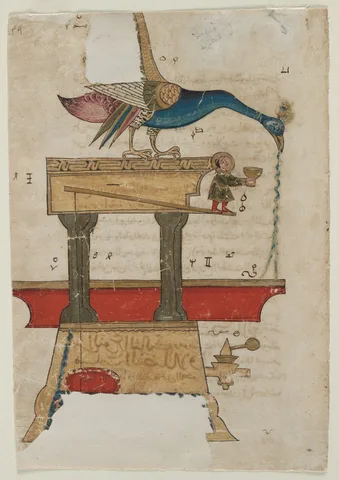
A compact bronze bird stands on two straight legs with broad flat feet. Its rounded body narrows toward a short tail, while an upright neck supports a small head and pointed beak. Circular engraved patterns decorate the flank and breast. One eye has a bright blue-green centre, and a small opening pierces the chest.A manuscript illustration shows a long-necked blue peacock standing above a golden rectangular mechanism supported on two dark columns. A small figure holds a bowl at the right. A thin blue stream descends from the bird’s beak toward a red basin. Letters, lines and partly visible writing surround and underlie the painted structure on worn pale paper.
A closer comparison

Birds and the pouring of water ↗

A surviving vessel and a proposed machine
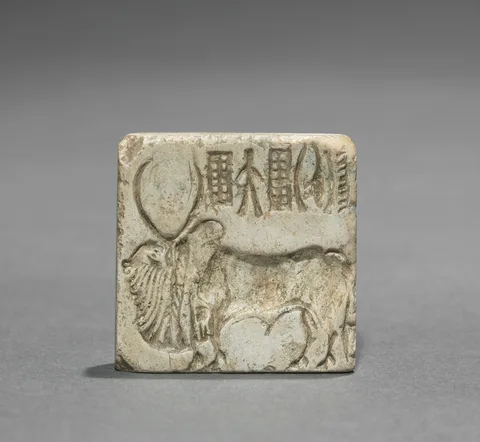
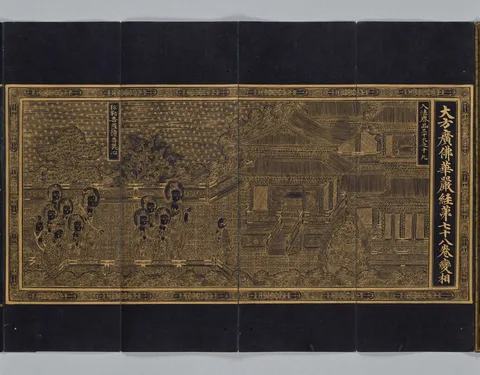
A small pale square stone seal shows a bull in profile facing left, with two long upward-curving horns, a pronounced shoulder and a hanging fold at the neck. A row of deeply incised signs occupies the upper right. The animal nearly fills the lower field. Worn corners and uneven surface colour remain visible against a grey background.An opened section of a dark blue folding manuscript is decorated in fine gold lines. Haloed figures gather at the left, while an elaborate roofed building fills the right. Trees, clouds and patterned borders surround them. A tall vertical title panel stands near the right edge, and fold lines cross the sheet.
A closer comparison

Images beside readable and unread signs ↗

An Indus seal and a Korean sacred opening
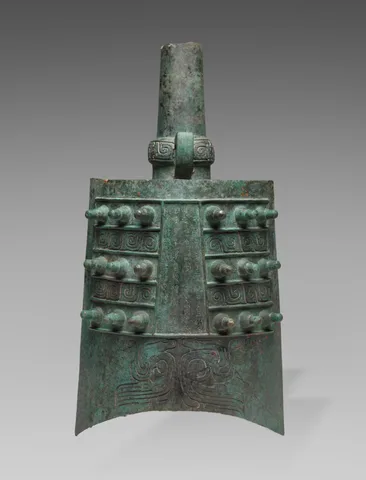
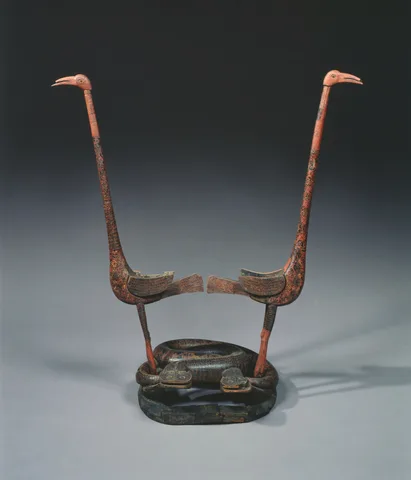
A large green-patinated bronze bell has a tall cylindrical upper stem and a broad body ending in a curved lower edge. Rows of rounded projecting bosses flank a central panel. Fine curled designs cover horizontal bands and the lower face. The object is shown alone, with no striking tool or suspension frame beside it.Two long-necked wooden birds face outward from a low base of intertwined serpents. Their slender necks rise high above small horizontal bodies and thin legs. Dark lacquer carries red and yellow painted patterns, with brighter red heads. The two upper bodies leave a gap between them, and the base contains several rounded snake coils.
A closer comparison

Sound and its support ↗

A bronze bell and a probable wooden drum stand
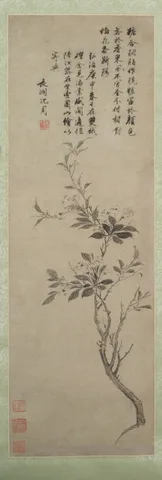
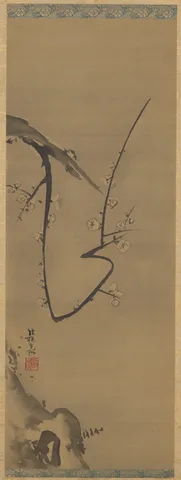
A narrow hanging scroll shows a flowering branch in black and grey ink. The stem rises in a loose S curve, carrying dark pointed leaves and clusters of lightly outlined blossoms. Several columns of calligraphy fill the upper section. Red seals appear beside the writing and along the lower left edge.A narrow scroll shows an old plum trunk entering from the left and twisting partly out of view. A thin branch returns into the open centre, bearing small pale blossoms. Darker ink describes the old wood, while a grey-brown wash covers much of the ground. Writing and a red seal sit near the lower left.
A closer comparison

Two ways to make a pale blossom ↗

Shen Zhou’s outlines and Kōrin’s reserved silk
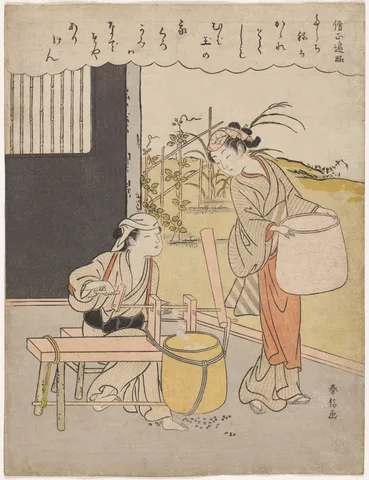
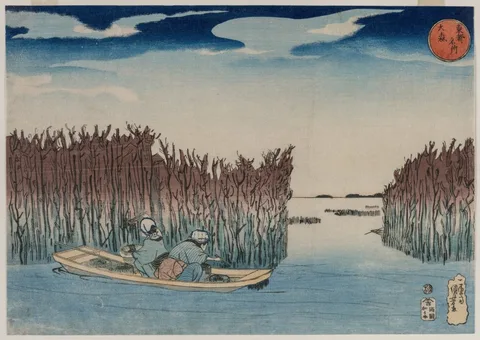
Two women work beside a low cotton-ginning device. One sits with her hands at the wooden mechanism, while the other stands holding a large basket. Pale cotton lies near the rollers and in a container below. Small dark seeds scatter on the ground. A band of calligraphy runs across the top of the print.Two women work from a narrow boat in calm blue water. Dense upright seaweed-growing structures rise on either side and continue into the distance. The women bend toward baskets and the plants, wearing patterned clothes and head coverings. Broad pale clouds cross a dark blue upper sky, and a red circular title cartouche sits at upper right.
A closer comparison

Work makes a landscape ↗

Cotton ginning and nori gathering in Japanese prints
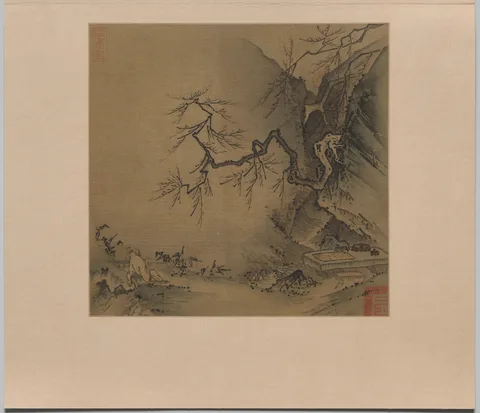
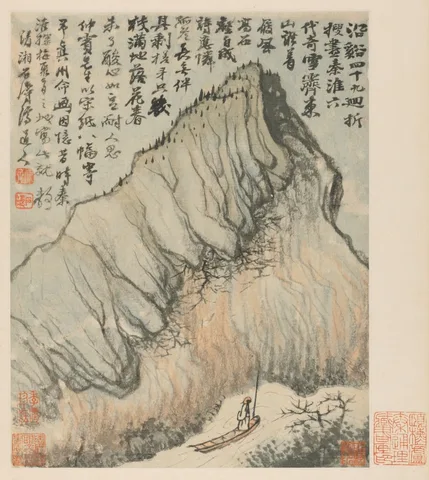
A small ink painting sits within a broad mount. A reclining man occupies the lower left beside plants and rocks. A gnarled tree extends from a rocky bank at the right, above a low table bearing small implements. Pale open space and a faint moon contrast with the dense angular branches.An album leaf places a tiny standing figure in a narrow boat near the bottom of a towering pale cliff. Dark strokes trace folds and vegetation across the rock. Broad columns of vigorous calligraphy occupy the upper and left areas. Several red seals sit along the edges and near the water below.
A closer comparison

How small can a figure become? ↗

Leisure beneath a tree and a boat below a cliff
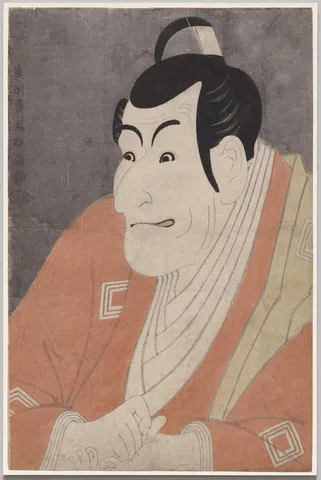
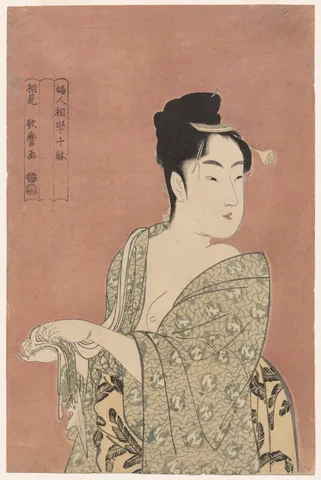
A close-up colour print shows a man with sharply arched eyebrows, wide eyes, and a tense mouth. His dark hair rises into a high tied form. Red and pale robes fill the lower sheet, with nested-square crests on the fabric. His hands press together near the bottom against a plain dark grey background.A woman is shown from the waist upward against a muted pink ground. She turns her head to the right, with dark swept-up hair and a pale face. Her hands hold a light folded material near the left edge. A loosely arranged patterned robe crosses her shoulders and arms, while vertical title panels appear at upper left.
A closer comparison

A role is not a personality ↗

Sharaku’s actor and Utamaro’s classified beauty
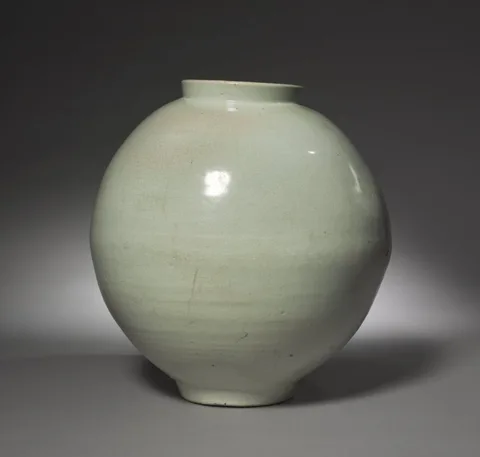
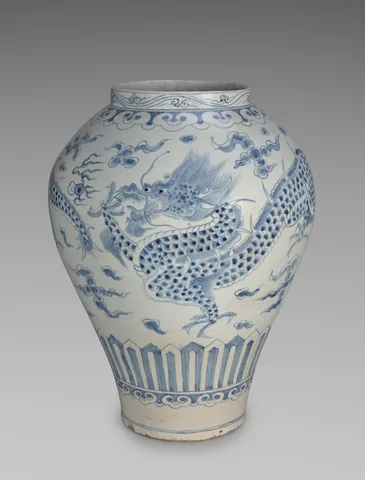
A large pale porcelain jar stands against a dark background. Its rounded body swells broadly below a short neck, then narrows to a small foot. The surface has slight tonal changes and fine lines rather than painted blue decoration. Light catches the left shoulder, while the silhouette is subtly uneven from side to side.A tall white porcelain jar has broad shoulders, a short neck, and a narrowing lower body. A large cobalt-blue dragon coils across its surface among clouds, with an open mouth, pointed claws, and many scales. Repeated upright border shapes encircle the lower part, while scrolling bands frame the shoulder and foot.
A closer comparison

When a jar has no picture ↗

Two Joseon porcelain surfaces
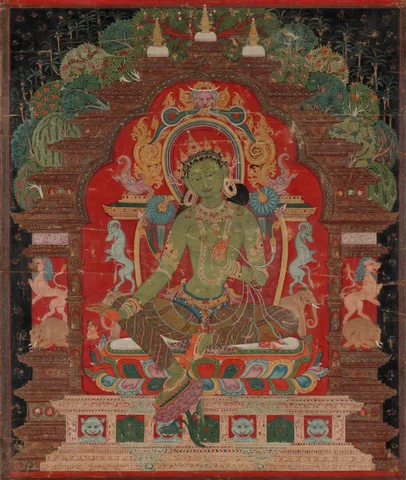
A richly ornamented green figure sits within a red arch on a lotus throne. One leg extends downward while the other is folded. Blue flowers rise beside her shoulders, and jewellery crosses the torso. Small figures, animals, architectural forms, and plants surround the central image, with a tiny monastic figure near the lower-left side of the throne.A small bronze woman stands on a lotus-petal base. She wears an elaborate tall headdress, layered jewellery, a pleated skirt, and a long cloth falling behind her. One hand holds a small object close to the torso, while the other extends outward. Dark patina contrasts with brighter worn or gilded-looking areas on the hands and face.
A closer comparison

Giving the donor a place ↗

A tiny commissioner and a possible royal donor in bronze
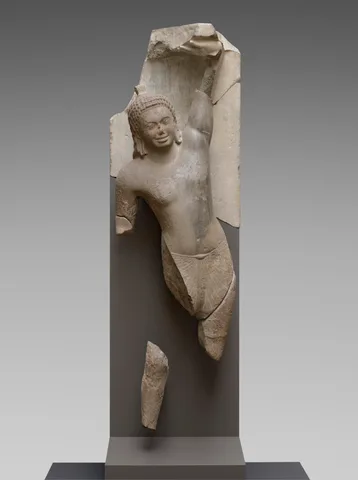
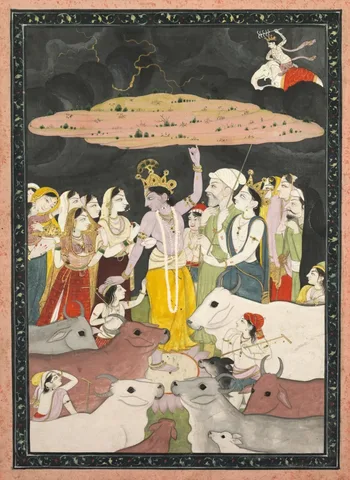
A fragmentary sandstone figure leans slightly with one arm raised beside the head toward a surviving mass of stone above. The opposite arm and much of the lower body are missing. A wrapped garment crosses the hips, and a separate lower-leg fragment is displayed below. A dark modern support holds the surviving pieces in place.Krishna stands among brightly dressed villagers and a dense group of cattle, holding a broad mountain above them with a raised finger. Dark storm clouds fill the upper area. A pale figure with a staff stands nearby, and a deity rides a white elephant in the upper right. A decorated border encloses the tall painting.
A closer comparison

One mountain, two ways of telling ↗

A Cambodian sculpture and a Kangra painting
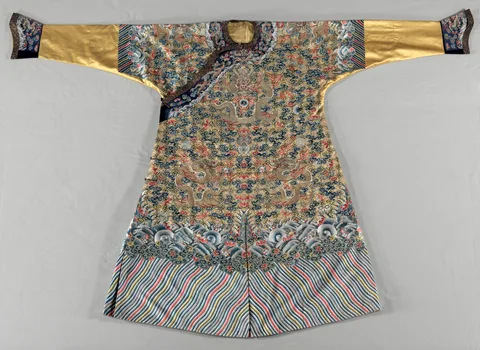
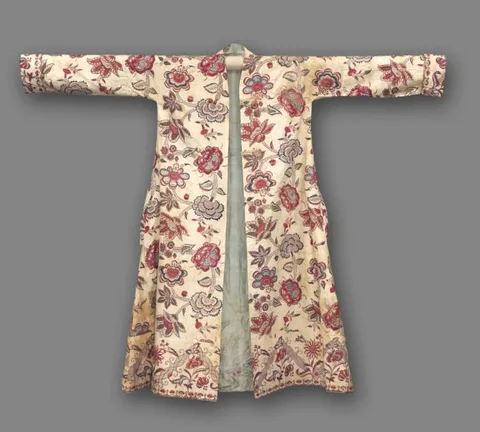
A yellow silk robe is displayed flat with its long sleeves extended. Dense embroidered dragons and clouds fill the body, while dark edging follows the diagonal opening and collar. Repeated wave forms and striped bands occupy the lower hem. The sleeve ends carry contrasting dark cuffs with smaller embroidered motifs.A long cream-coloured coat is displayed flat against grey, with straight sleeves extended horizontally. Curling stems, leaves and red, pink and purple flowers cover its surface. A narrow opening runs down the centre, revealing part of the pale lining. The lower panels widen slightly and end in patterned borders.
A closer comparison

Wearing a patterned world ↗

A Qing court robe and an Indian export coat
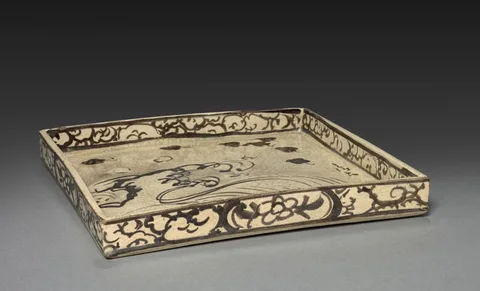
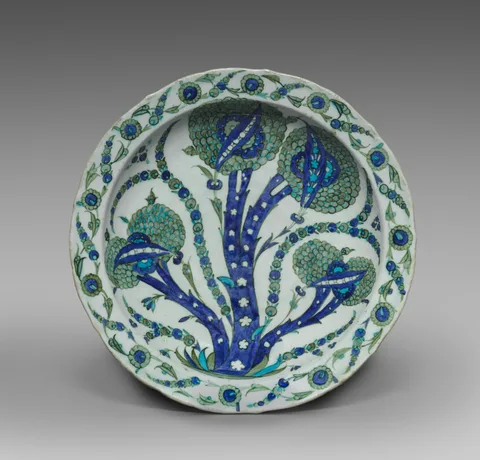
A low square ceramic dish is shown obliquely, with shallow raised sides. Dark iron-coloured birds fly across a pale interior above curling wave lines. Dense scrolling ornament covers the rim and outer walls. A short signature appears beside the central design, while the worn light surface remains visible between the brush marks.A circular ceramic dish is photographed at an angle against grey. Four large green-blue artichoke-like buds rise from branching dark-blue stems in the centre. Curving serrated leaves and small rosettes fill the intervening spaces. A separate garland of blue-green flowers circles the pale rim, which has an uneven surviving edge.
A closer comparison

A dish organises a design ↗

Japanese plovers and Ottoman artichoke-like forms
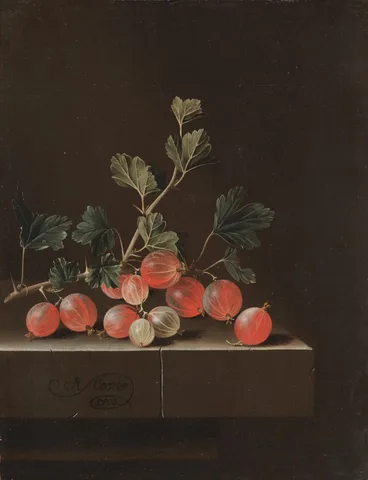
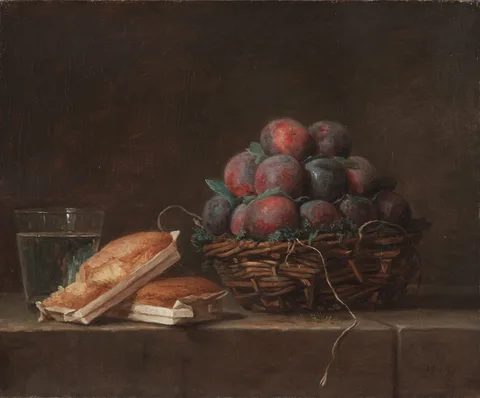
Red and pale green gooseberries rest on a stone ledge beneath a branching stem with lobed green leaves. Fine pale stripes run across the translucent fruit. The background is almost black. A crack descends through the ledge near the center, and a small signature appears on its dark front face.A shallow wicker basket piled with red and purple plums sits on a stone table. Green moss or foliage nestles around the fruit. Two small cakes in folded paper cases lie to the left beside a clear glass of water. A loose strand hangs down from the basket into the dark space below the tabletop.
A closer comparison

Fruit, light, and table edges ↗

Coorte’s gooseberries and Vallayer-Coster’s plums
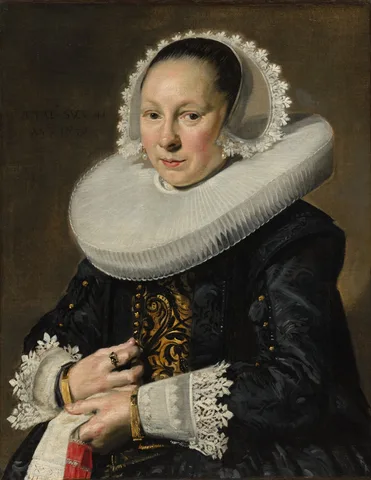
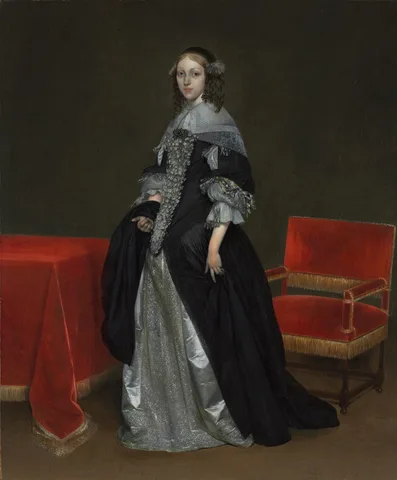
A seated woman in a black dress faces the viewer, her head framed by a white cap and a large pleated ruff. Lace cuffs surround her hands, which rest near a small pale cloth. Gold-colored embroidery brightens the bodice. Her cheeks are flushed, and the dark neutral background contains a faint inscription to the left.A woman stands in an empty brown room between a red-covered table and a red upholstered chair. Her black outer dress opens to reveal a long silver-white satin skirt. Lace, ribbons, and jewelry decorate her bodice and sleeves. One hand gathers the dark fabric, while the other hangs at her side.
A closer comparison

Dress and the uncertain sitter ↗

Hals’s probable Aeltje Pater and Ter Borch’s unidentified woman
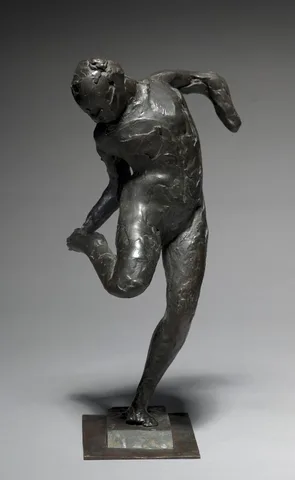
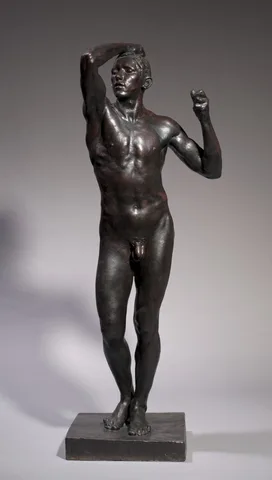
A dark bronze nude balances on one planted leg while lifting the other behind her and grasping its foot. Her torso tilts forward and her head bends down. The opposite arm curls backward. Uneven ridges catch highlights across the body, which stands on a small rectangular base against a neutral background.A nude bronze man stands on a low rectangular base, one arm raised over his head and the other bent upward with a loosely closed hand. His eyes appear nearly shut, and his weight shifts through slightly bent legs. Smooth muscular surfaces catch highlights against a neutral background, with darker reddish-brown tones in the recesses.
A closer comparison

Bronze and the earlier model ↗

Degas’s inspecting dancer and Rodin’s standing figure
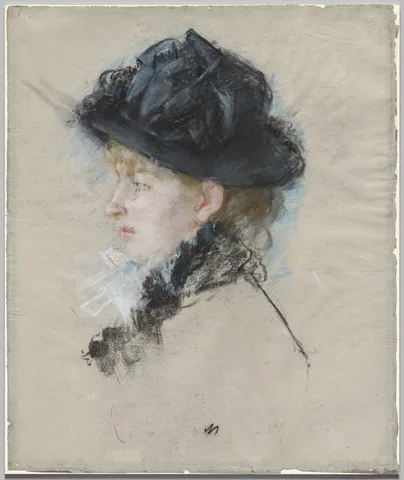
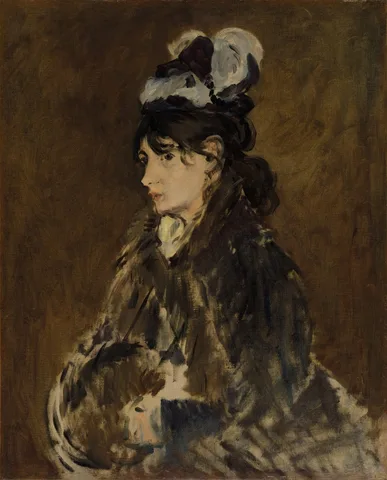
A woman faces left in profile, wearing a tall dark hat with folds and featherlike decorations. Pale strokes describe her face and the white ties at her throat. Her black collar is densely marked, while the shoulder and lower body dissolve into outlines against exposed pale paper.A woman turns left in three-quarter profile, wearing a dark winter coat, a large pale feathered hat, and a muff held in front of her. Her face and small white collar stand out against brown tones. Broad strokes and crossed dark marks describe the clothing, with loose unfinished-looking areas near the lower edge.
A closer comparison

Morisot as maker and model ↗

Louise Riesener’s hat and Berthe Morisot’s muff
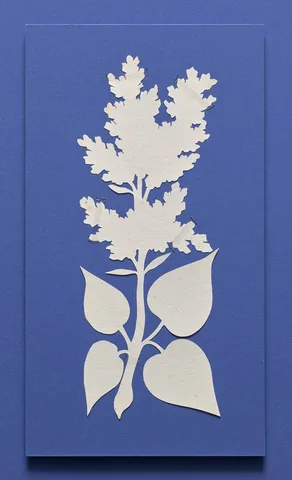
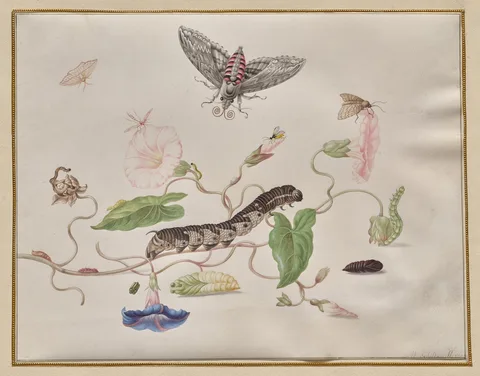
An off-white paper silhouette of a lilac sprig is mounted against deep blue paper. A thin stem branches into four large heart-shaped leaves and several clusters of tiny irregular blossoms. The flower edges are intricately cut, while the leaf surfaces remain plain. A raised rectangular blue mount casts a small shadow below.A large moth with patterned gray wings hovers above curling morning-glory stems on a pale background. Pink and blue flowers, green leaves, several caterpillars, and a dark pupa are spread across the sheet. A long striped caterpillar crosses the center. Smaller flying insects and a dried blossom occupy the open spaces around the plant.
A closer comparison

Plants cut and studied ↗

Runge’s lilac silhouette and Merian’s moth sheet
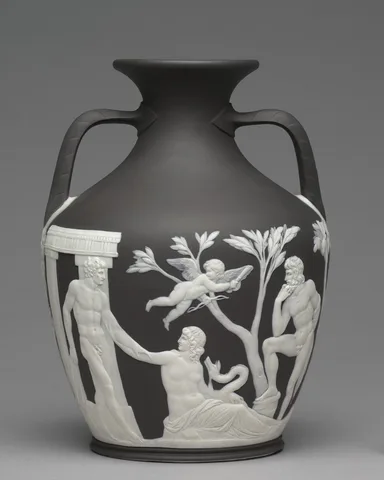
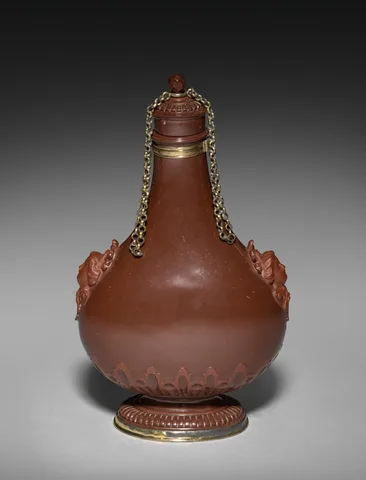
A dark vase with two high handles carries white raised figures and trees around its rounded body. A seated woman reaches toward a standing man beneath a small architectural element, while a winged child flies above. Another seated figure appears at the right. The upper neck remains plain, and a low circular foot supports the vessel.A reddish-brown bottle has a rounded flattened body, a long tapering neck, and a fitted decorated stopper. Gilt chains descend from the neck to sculpted side attachments. Molded ornament circles the lower body above a fluted foot with a gold-colored rim. The polished surface catches a broad soft highlight against the dark photographic background.
A closer comparison

Ceramic answers to distant models ↗

Wedgwood’s Portland Vase and Meissen’s red bottle
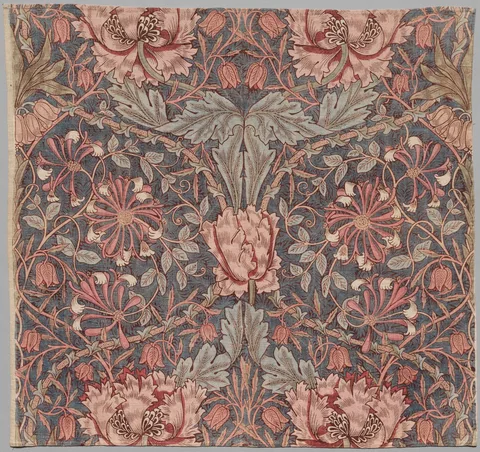
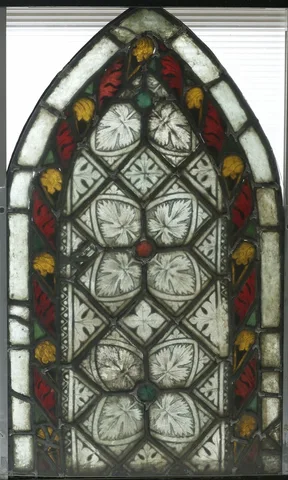
Large pale and pink blossoms, blue-green leaves, and slender pink curling stems cover a nearly square textile. A central downward-facing flower anchors a mirrored arrangement, while open honeysuckle blooms spread to either side. Partial blossoms are cut by the upper and lower edges, making the design appear to continue beyond the cloth.A pointed stained-glass panel contains paired pale leaf shapes inside dark geometric divisions. Small floral or cross-like motifs fill the intervening spaces. Red, green, and yellow glass forms a narrow inner border, while pale rectangular pieces follow the outer arch. Dark leading and painted veins create a strong lattice across the surface.
A closer comparison

Leaves, pattern, and restraint ↗

Morris’s Honeysuckle and medieval aconite glass
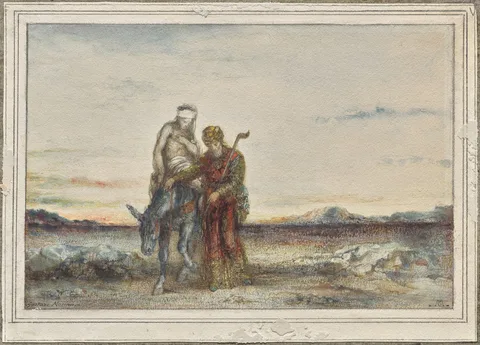
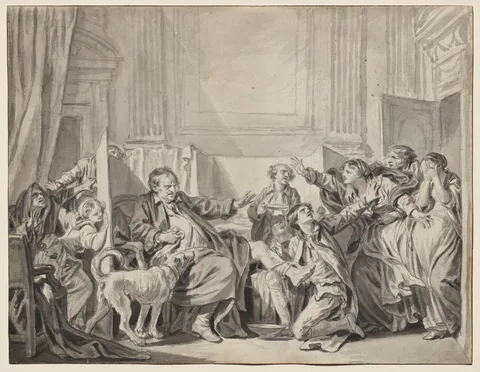
Two figures and a horse stand in a sparse rocky landscape beneath a large pale sky. A wounded, partly unclothed man sits on the animal while a richly colored standing figure supports him. The horse lowers its head. Fine red, blue, and gold-toned marks enrich the figures, with distant low mountains across the horizon.In a pale monochrome interior, an older seated man extends one hand toward a group entering from the right. A younger man kneels before him and raises an arm. Women gather on both sides, one covering her face. A dog stands near the chair, and tall architectural columns enclose the crowded scene.
A closer comparison

Support and accusation ↗

Moreau’s roadside aid and Greuze’s family crisis
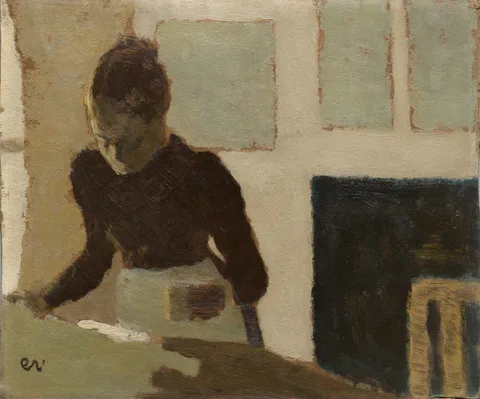
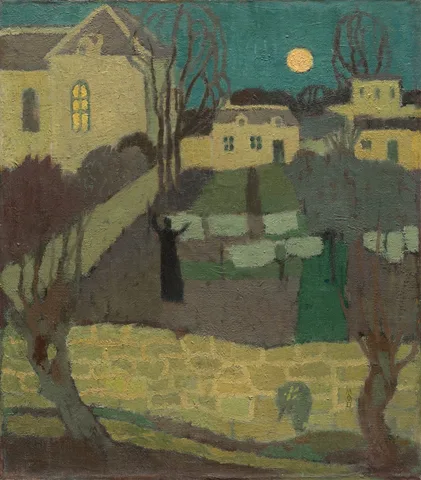
A woman in a dark blouse and pale apron stands behind a diagonal work surface, her head lowered. One hand reaches toward a small pale garment while the other holds a cup near her waist. Light touches one side of her face. Pale rectangular wall panels and a large dark opening form the background.A dark-clothed woman hangs pale linens across a walled garden beneath a round yellow moon. Leafless trees rise at both sides, and yellow buildings enclose the background. Broad green and purple areas divide the ground. The sheets form several light rectangular bands, and a small animal-shaped silhouette appears near the lower center.
A closer comparison

Domestic work in light ↗

Vuillard’s ironing and Denis’s moonlit laundry
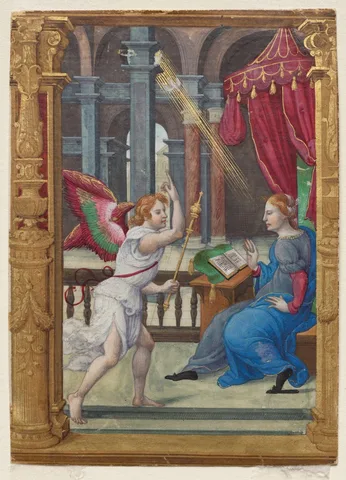
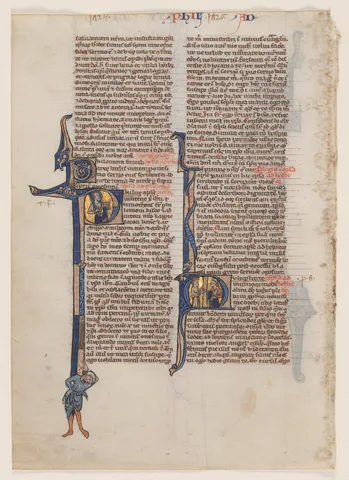
Within a gilded architectural border, a winged angel advances from the left before a seated woman in blue. An open book rests on a green-covered stand between them. Pink curtains hang behind the woman, and golden rays descend diagonally from a small white bird above. Tall columns and rounded arches structure the chamber.A vellum page contains two narrow columns of dense Latin writing with red and blue marks. A large decorated blue-and-gold initial extends down the left column, enclosing a small standing saint and ending in a contorted human figure below the text. Another inhabited initial appears lower in the right column. Pale margins surround the writing.
A closer comparison

Pages for prayer and study ↗

A Paris Annunciation and an Oxford Bible leaf
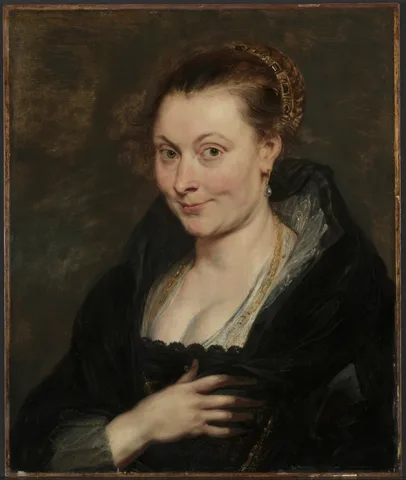
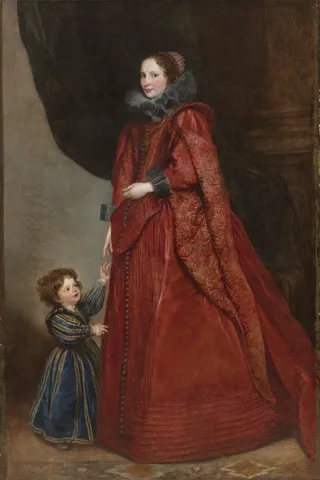
A woman with swept-back brown hair and a pearl earring turns toward the viewer against a dark background. Her pale face has a slight smile. A gray translucent collar and gold chain frame her neckline, while black clothing wraps the body. One illuminated hand crosses the chest and gathers the dark fabric.A tall woman in a rich red patterned gown stands before dark drapery and a column. Her small child in blue and gold reaches upward beside her lowered hand. A broad gray ruff surrounds the woman’s head. The long skirt spreads across the lower picture, dwarfing the child while warm faces interrupt the formal setting.
A closer comparison

Intimacy inside a formal portrait ↗

Rubens’s Isabella Brant and Van Dyck’s Genoese woman
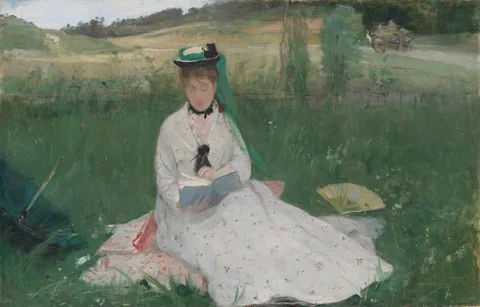
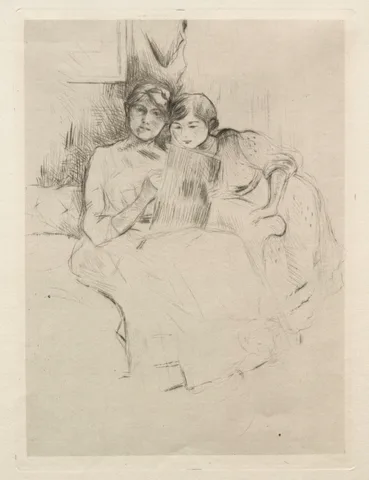
A woman in a pale flowered dress sits on a pink shawl in a green meadow, looking down at an open book. A small dark hat has green trim and a trailing veil. A fan lies to her right and a closed parasol to her left; pale fields and a distant cart extend behind her.A lightly printed image shows two figures close together in a chair. The adult at left looks outward while the younger figure leans toward her from the right. A rectangular drawing support rises between their bodies. Fine scratched lines describe faces and hands; loose curved outlines and sparse hatching suggest clothing and the room.
A closer comparison

Where attention goes ↗

Morisot’s reader and her drawing lesson
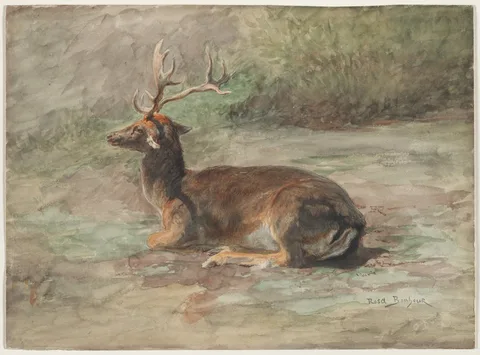
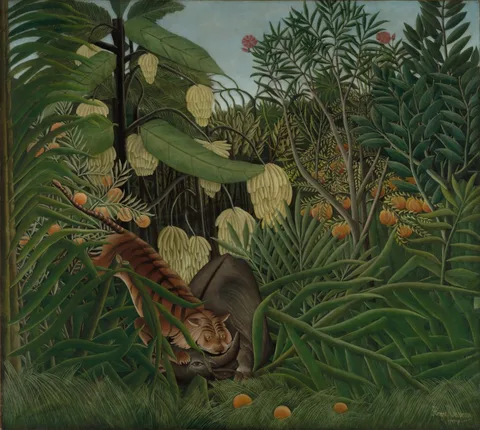
A stag lies on the ground with its legs folded beneath its brown body. Its head rises and turns left, with branching antlers standing against a soft gray-green background. Lighter strokes pick out the chest, flank, and muzzle. Broad watery patches describe the ground and vegetation, which remain much less distinct than the animal.Dense, sharply outlined tropical foliage fills a nearly square painting. A tiger lunges down toward a dark buffalo in the lower center, partly hidden by crossing leaves. Oversized leaves, hanging pale fruit, orange fruit, and thin branching plants crowd the space. Very little open sky remains above the animal struggle.
A closer comparison

Animals and their surroundings ↗

Bonheur’s resting stag and Rousseau’s jungle struggle
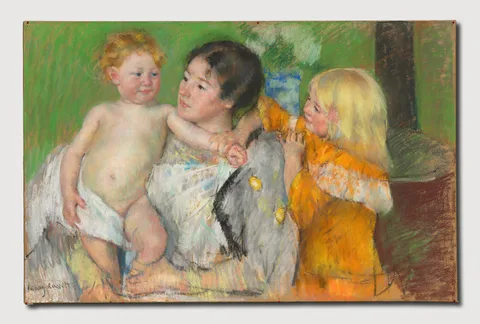
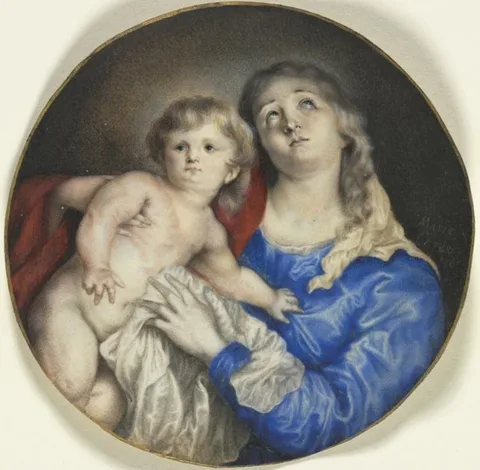
A woman supports a nude small child at the left while another fair-haired young figure leans toward them from the right. Their faces and hands are closely grouped. Pale cloth surrounds the child, orange clothing brightens the right side, and green fills much of the background. Exposed pastel strokes remain especially visible in garments and setting.A small circular painting shows a woman in brilliant blue holding a pale child against a dark background. Her eyes turn upward while the child looks left and stretches one arm outward. Light sleeves and pale cloth gather around their hands. A narrow gold-colored edge encloses the closely cropped pair.
A closer comparison

What holding makes visible ↗

Cassatt’s After the Bath and Carew’s Virgin and Child
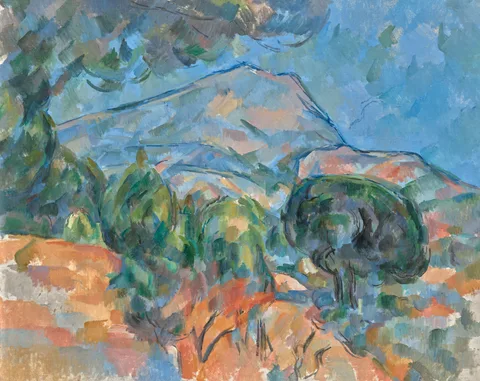
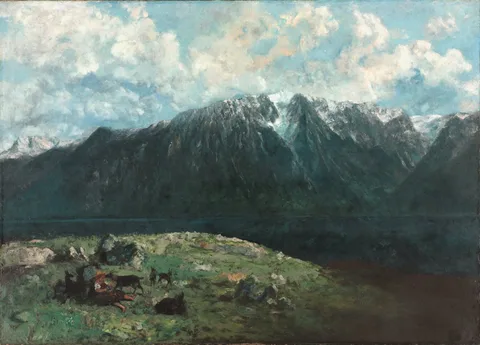
A pale blue and pink mountain rises behind a patchwork of green trees and orange earth. Dark blue contours trace parts of the ridge. A branch crosses the upper left, while a rounded umbrella pine fills the right foreground. Exposed light areas and separate angular strokes keep the landscape’s painted structure visible.A jagged, partly snow-covered mountain range fills the middle of a wide landscape below bright clouds. A dark band of lake separates it from a green foreground slope with small grazing animals. The lower right is broadly brown and loosely worked, while thick pale marks distinguish clouds and snow near the peaks.
A closer comparison

A mountain and the work of painting ↗

Cézanne’s Sainte-Victoire and Courbet’s Alpine panorama
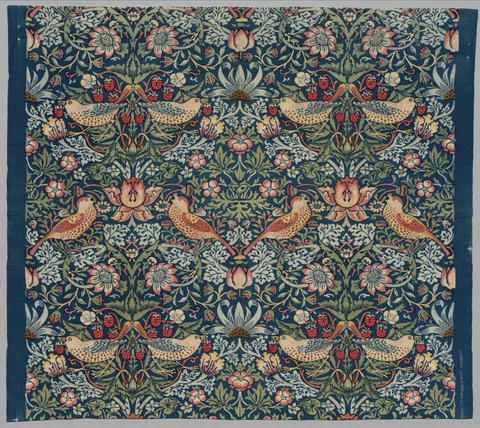
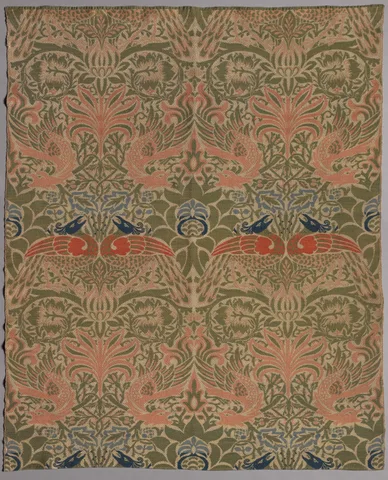
A square cotton textile has a deep blue ground densely filled with curling pale green stems, flowers, strawberries, and paired birds. Some birds face outward with fruit near their beaks, while others bend inward among the branches. The motifs repeat in balanced rows, with narrow blue side borders visible at the edges.A tall wool textile repeats paired red and blue birds, red winged creatures, and dense curling green plants on a muted pale ground. Large flower forms divide the mirrored animals into horizontal bands. The surface appears soft and woven, with slight irregularities and a narrow dark edge visible along the left.
A closer comparison

Nature becomes a repeat ↗

Strawberry Thief and Peacock and Dragon
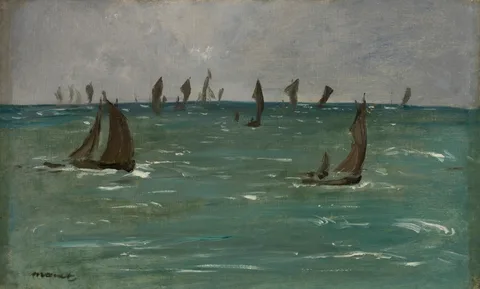
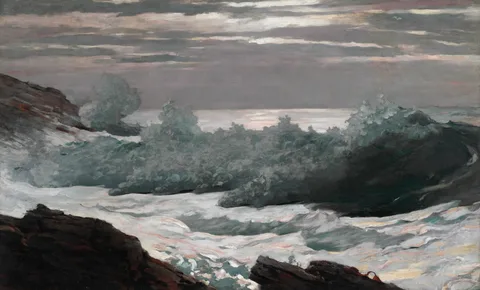
Dark triangular sails scatter across a blue-green sea beneath a broad gray sky. Two larger boats occupy the foreground, while a loose line of smaller sails approaches the horizon. Short white strokes mark choppy water, especially around the nearer hulls. The low horizon rises in a slight curve through the center.A large dark-green wave breaks between jagged coastal rocks beneath a layered gray sky. White foam churns across the foreground and sprays upward in several bursts. A pale strip of distant water glows below the clouds. No people or boats appear; the image concentrates on the meeting of surf, rock, and changing light.
A closer comparison

Water with and without boats ↗

Manet at Berck and Homer at Prouts Neck
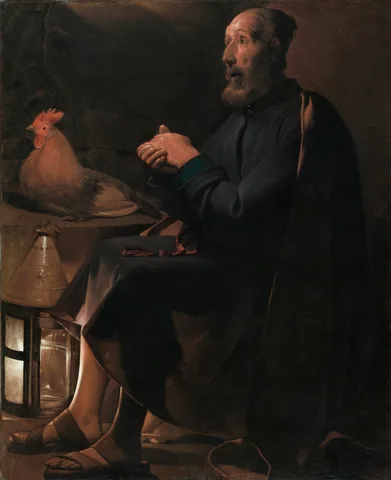
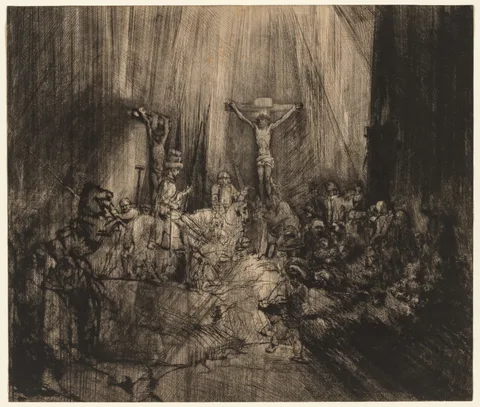
An older bearded man sits in darkness with hands clasped and eyes lifted toward the left. A rooster rests beside him on a ledge. A lantern near his sandaled feet provides a low warm light, while the dark blue-gray cloak covers most of his body. Broad shadows simplify the setting around the three main forms.A dense black-and-white print shows Christ on a central cross beneath a pale shaft of light, with two other crucified figures flanking him. Spectators and mounted figures gather below, many partly obscured by sweeping dark lines. Heavy inked passages press in from both sides, while bright paper opens around the central body.
A closer comparison

What darkness lets us see ↗

La Tour’s Peter and Rembrandt’s Three Crosses
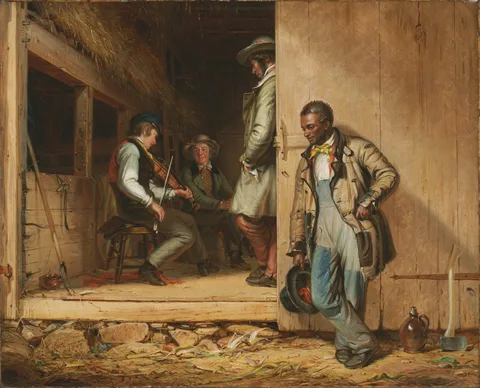
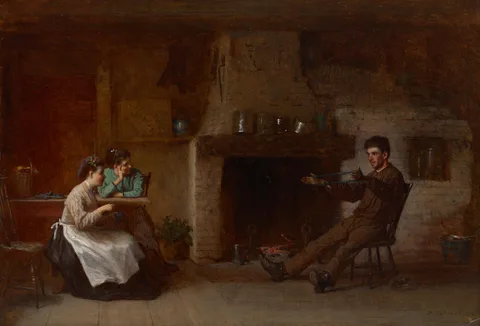
Inside a barn, a white fiddler sits playing for two white listeners. Outside the large wooden door, a Black laborer leans with his hat in one hand and listens separately. Straw and tools lie around the threshold. Warm light emphasizes the outside figure and the door’s broad boards, while the interior group occupies deeper shadow.In a dim rustic kitchen, a seated woman at the left winds yarn while a man across the hearth holds a loop between his outstretched hands. Another woman watches from behind the first. The man leans back with legs extended and a hat near his feet. A broad fireplace and sparse household objects occupy the center.
A closer comparison

Who shares the room? ↗

Mount’s music and Johnson’s yarn-winding
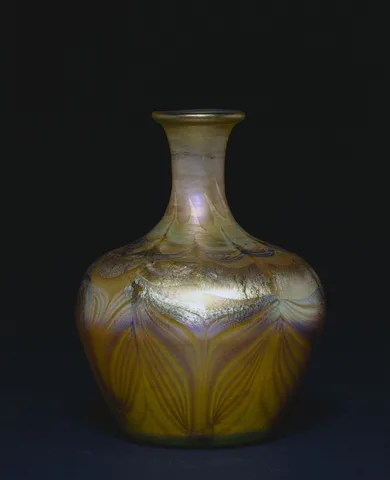
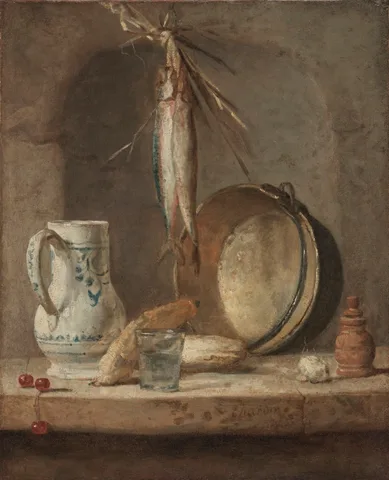
A small glass vase has a rounded body, long narrow neck, and flared rim. Its gold-green surface shifts into violet and silver highlights under the light. Repeated featherlike lines rise from the lower body and curl around the shoulder. The object stands against a dark photographic background that intensifies its reflective color.A few fish hang vertically above a pantry shelf holding a pale blue-and-white jug, a clear glass, bread, a large leaning dish, and small containers. Three cherries sit near the left edge. Warm brown walls and soft shadows surround the objects, while small highlights distinguish glazed ceramic, glass, fish skin, and metal.
A closer comparison

A surface and its painted image ↗

Tiffany’s Favrile vase and Chardin’s pantry shelf
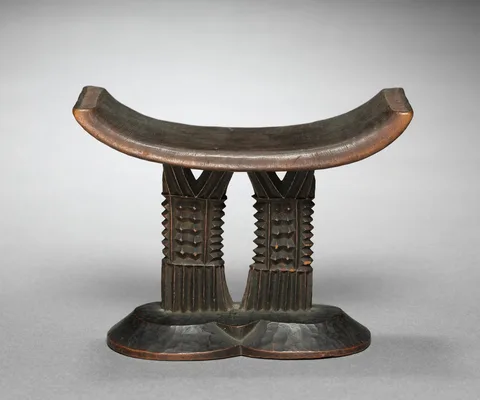
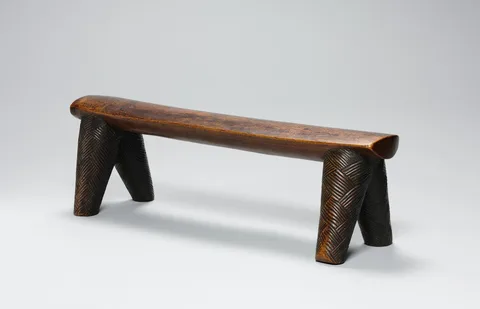
A dark wooden headrest has a long concave top with raised ends. Two upright supports rise from a broad double-lobed base. Each support is carved with vertical grooves and rows of small projecting points. The upper surface has a smooth sheen, while the lower carved areas remain visibly textured.A low wooden headrest has a long slightly concave top supported by four splayed legs. The upper surface is smooth and warm brown. Dense diagonal cuts form herringbone-like textures on the darker legs. The ends of the top lift slightly, and open space separates the two pairs of supports.
A closer comparison

Two ways to support rest ↗

Two southern African headrests organize contact, ornament and support differently.
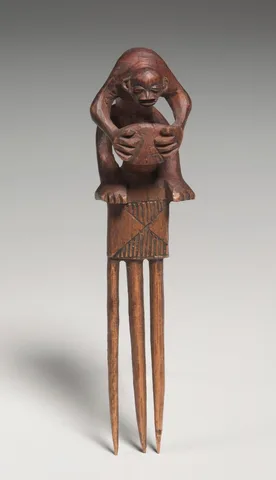
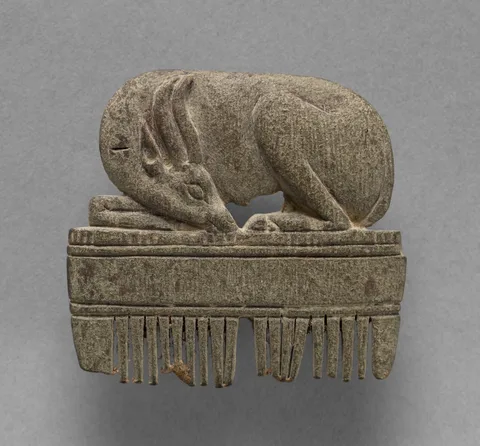
A brown wooden comb is topped by a seated or crouching figure leaning forward over a rounded drum. Both hands reach around the drum’s sides. Broad feet rest on the upper edge of a rectangular panel carved with diagonal lines. Three long narrow teeth descend from the panel, tapering to points.A weathered wooden comb has a broad rectangular crossbar and a row of closely spaced teeth, several broken. Above the bar, a crouching gazelle bends its head downward toward folded forelegs. Long horns curve backward beside the neck, and the rounded hindquarters fill the upper right corner. Fine parallel lines border the crossbar.
A closer comparison

Figures above the teeth ↗

A Chokwe drummer and an Egyptian gazelle animate two carved combs.
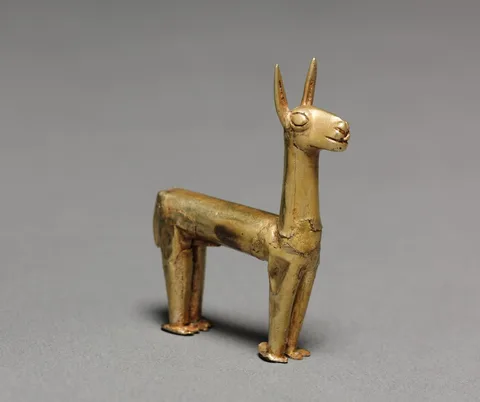
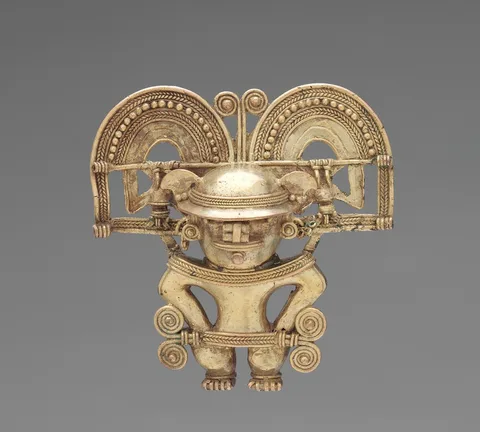
A small gold llama stands in profile with four slender legs and a very long upright neck. Two pointed ears rise above a narrow head with rounded eyes and a slightly open mouth. The body is compact and the tail short. Seams and uneven joins are visible along the neck, chest and legs.A gold pendant shows a squat frontal human-like figure beneath an enormous symmetrical arched headdress. Fine braided borders, rows of beads and spiral terminals fill the design. Small upside-down bat forms hang within the upper framework. A round-ended lip ornament projects below the mouth, and bent arms and legs leave open spaces around the torso.
A closer comparison

Gold, seams and openwork ↗

An Inka llama and a Tairona pendant reveal different demands on precious metal.
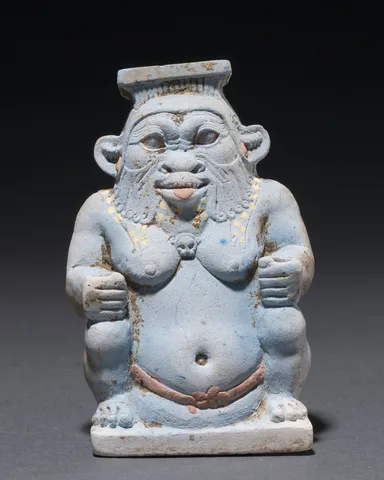
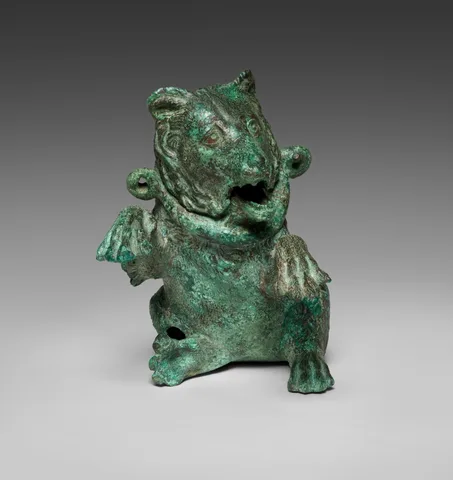
A pale blue vessel takes the form of a squat frontal figure with large ears, heavy brows and a broad open mouth. Curving beard or mane patterns frame the face. Bent legs flank a rounded belly, and clenched hands rest at the sides. A short rectangular-edged opening rises above the head; small yellow and reddish details survive.A green-patinated bronze bear sits upright with its front paws raised. Its head turns slightly, and the mouth gapes open. Small circular loops project on either side of a collar around the neck. The body is hollow-looking in damaged areas, with short hind feet spread below and incised texture across the surface.
A closer comparison

Faces that pour ↗

Bes and a Roman bear turn anatomy into container structure.
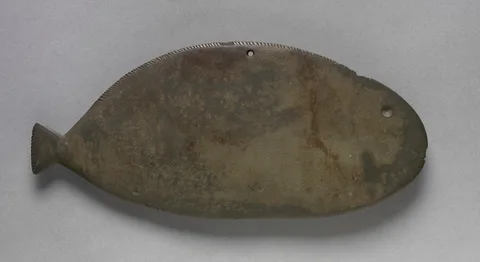
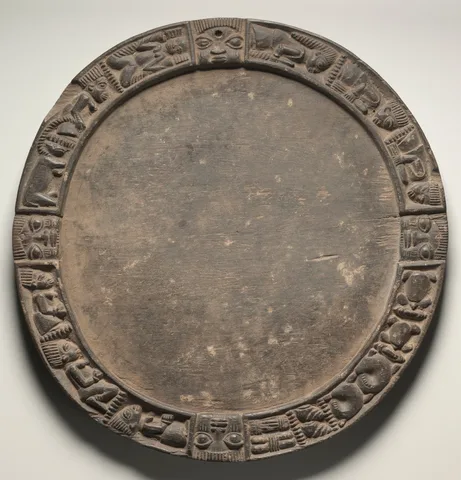
A flat dark grey stone is shaped like a broad fish, with a small forked tail at the left and a rounded head at the right. A pale circular eye marks the head. Fine short cuts edge the upper back, and a small drilled hole sits near the top. The broad central surface is smooth and unpatterned.A circular wooden tray has a broad plain centre surrounded by a raised carved border. Four large faces occur at roughly equal intervals around the rim. Smaller human and animal forms fill the spaces between them. The central surface is worn and scratched, contrasting with the densely incised outer band.
A closer comparison

Plain centres, speaking edges ↗

A fish palette and an Ifá tray reserve open space for work.
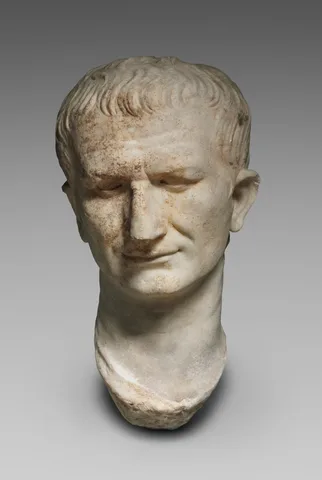
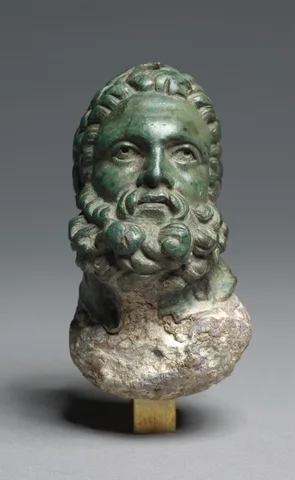
A marble male head is shown frontally with a slight turn. Short locks lie across the forehead above strongly modeled brows, a long nose and a tightly closed mouth. The neck extends into a rough rounded lower section. The pale stone is mottled and worn, with small losses around the face and hair.A small green bronze male head has short curled hair, a thick curled beard and an upward-tilted face. The eyes and mouth are dark and deeply defined. Beneath the neck is a rough pale mass where the form broadens irregularly. A small modern support holds the object upright against a grey background.
A closer comparison

Portraits after revision ↗

A recut emperor and a reused hero preserve more than one material life.
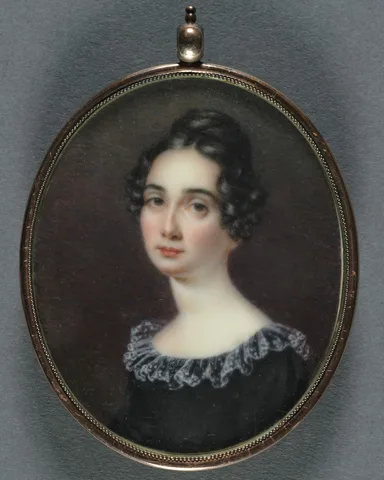
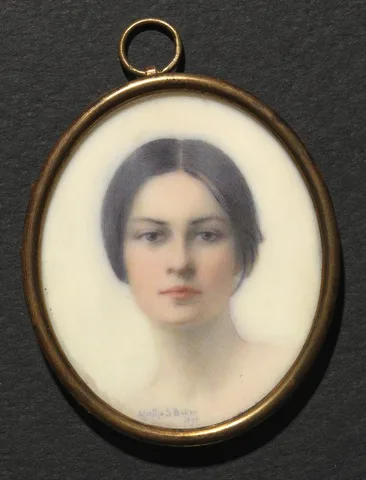
An oval portrait miniature in a narrow metal locket frame shows a dark-haired woman against a deep brown background. Her black dress has a pale lace-trimmed neckline. Soft curls surround her face, and pink cheeks and red lips stand out against pale skin. A small suspension fitting sits above the oval.An oval portrait in a plain gold-coloured frame shows a young woman facing forward. Dark hair is parted in the centre and drawn close around her head. Her face is softly shaded, while the neck and shoulders fade into a cream background. A circular suspension ring rises above the frame, and a small signature appears near the lower edge.
A closer comparison

Miniatures and fading edges ↗

Anna Claypoole Peale and Martha Baker make small portraits distinct through boundaries.
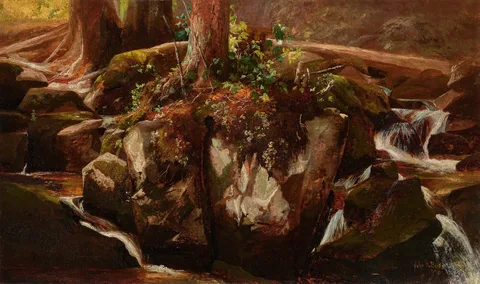
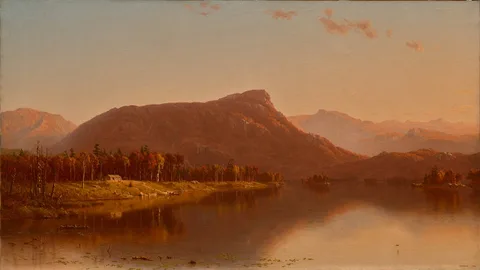
A close woodland view centres on a large angular boulder covered with moss and small plants. Tree trunks rise immediately behind it, with roots spreading over surrounding rocks. Water descends in narrow white cascades along both sides. Warm brown, green and reddish vegetation fills the shaded scene, with little open sky visible.A warm golden landscape shows a broad still body of water before wooded mountains. The central peak rises dark against a hazy peach sky. At the left shore, a small cabin stands in a cleared patch among trees and stumps. Tiny figures and a canoe occupy the landing, while the mountain and sky reflect softly in the foreground water.
A closer comparison

Close stream, distant home ↗

Beers and Gifford offer different scales of looking at New Hampshire landscapes.
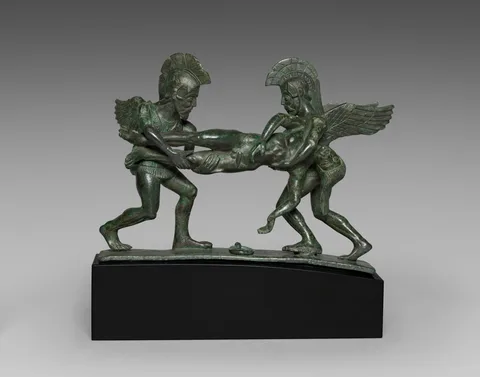
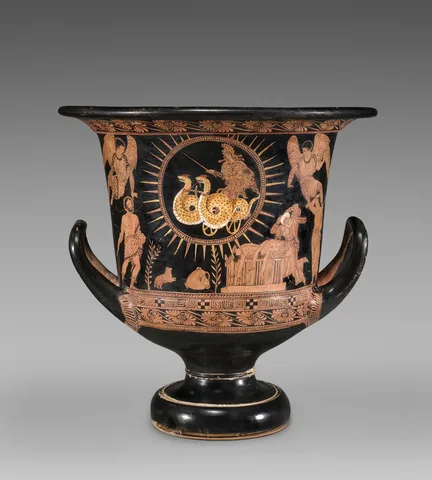
Three small bronze figures stand on a narrow curved strip. Two helmeted winged figures face inward, their bent legs set apart as they support a horizontal nude body. The central figure’s head tips backward at the right, with long locks hanging below it. A small helmet lies on the strip below, and a modern dark block supports the group.A black and reddish ceramic mixing vessel has a flared rim, two curved handles and a round foot. On its front, a woman rides a dragon-drawn chariot inside a circle of radiating lines. Winged figures flank her. Smaller people and prone bodies occupy the lower scene, framed by dense floral and geometric borders.
A closer comparison

Carrying and escaping ↗

A bronze handle and a painted krater organize the aftermath of death.
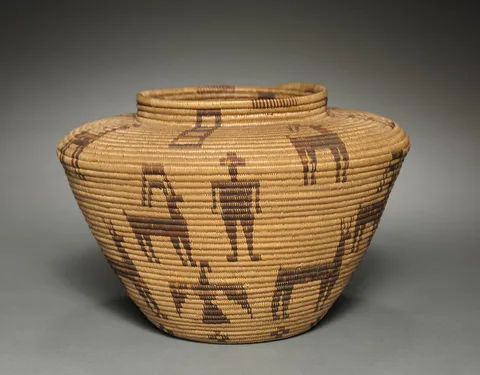
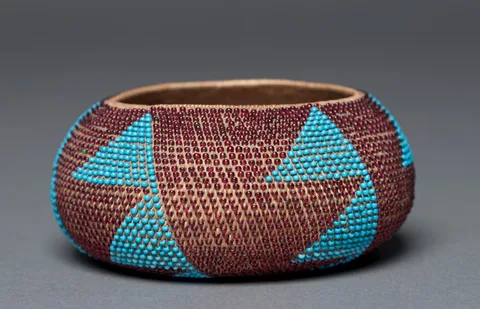
A honey-coloured jar-shaped basket has a narrow raised mouth, broad shoulders and tapering sides. Dark brown woven figures depict angular humans, four-legged animals and birds across its surface. Fine horizontal coils remain visible beneath the motifs. Small geometric marks cluster near the neck, and the lower edge rounds into a compact base.A rounded basket bowl has a small open mouth and a densely beaded outer surface. Turquoise triangular forms alternate with broad fields of dark red beads. The beads follow close parallel rows around the swelling sides. The undecorated brown rim and interior remain visible above the bright exterior.
A closer comparison

Woven and beaded rhythms ↗

Sarah Hunter’s basket and a Wappo bowl distinguish structure from surface.
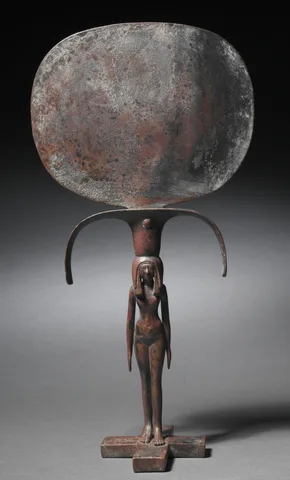
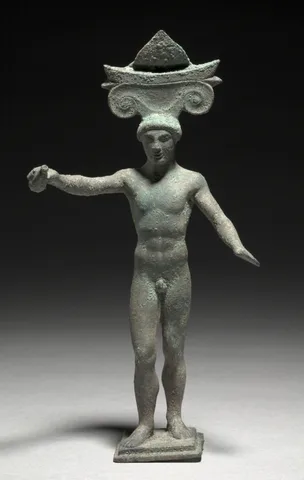
A bronze mirror has a broad rounded rectangular-oval disk above a slender female figure. The disk is mottled green, brown and reddish rather than brightly reflective. Curved papyrus-like forms spread between the woman's head and the disk. The nude figure wears a wig and collar, stands with arms lowered, and rests on a cross-shaped base.A bronze nude youth stands on a small rectangular plate with arms extended. One hand holds a small hanging object, while the other opens outward. Above the head is a broad ornament with curled ends and a triangular projection. The legs form a slight forward stride; no mirror disk survives above the attachment.
A closer comparison

Bodies below mirrors ↗

An Egyptian caryatid and a Greek athlete turn figures into supports.
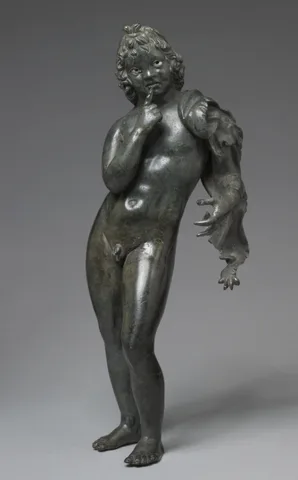
A small bronze boy stands with weight shifted to one leg and a finger raised to his mouth. Curly hair frames a rounded face with pale inlaid eyes. An animal skin hangs over one shoulder and arm, while the other arm bends upward. The dark metal catches bright highlights across the torso and limbs.A small tan sculpture of the Buddha stands on a two-tiered lotus pedestal against a dark background. One hand reaches downward with its palm outward; the other is raised near the shoulder. Repeated dark flowers cover the long robe. The head has small curls and a rounded top, and the eyes look downward.
A closer comparison

Gestures need context ↗

A finger at the mouth and a downward palm require different readings.
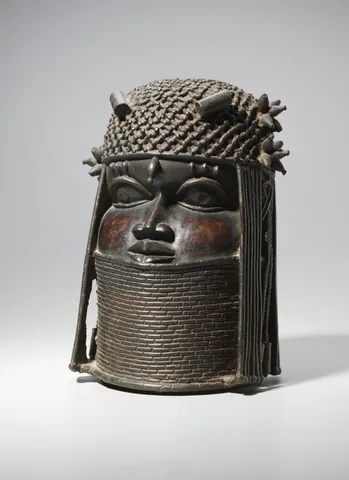
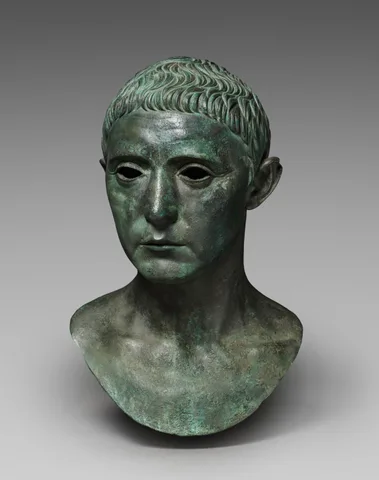
A copper-alloy head faces forward with large almond-shaped eyes and a small mouth. Many closely stacked bead rows form a high collar beneath the face. A textured net-like cap covers the head, with projecting tubular beads and narrow strands descending at the temples. The polished dark surface has reddish and golden highlights.A bronze portrait bust shows a man with a short neatly arranged hairstyle, narrow lips and prominent ears. The eye sockets are empty and dark. Fine lines mark the forehead and areas beside the eyes. The neck widens into a short shoulder section with an irregular lower edge, and green-brown patina covers the metal.
A closer comparison

Faces, office and person ↗

A Benin ancestral head and an unnamed Roman portrait make different claims.
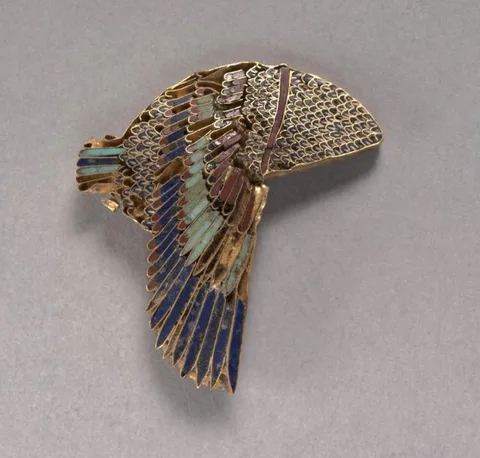
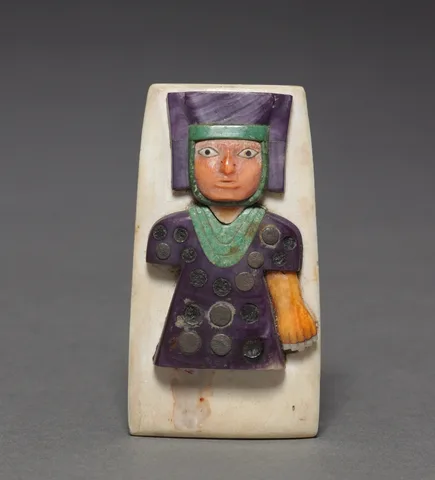
A small curved inlay shaped like a vulture headdress is shown at an angle. Long dark blue feathers descend from a densely patterned upper section. Pale blue, red and white elements alternate among them. Thin gold lines separate the individual pieces. A short striped tail-like projection extends from one side of the rounded body.A small human figure is assembled on a pale rectangular shell backing. A pink-orange face with bright outlined eyes sits beneath a broad purple headdress and green band. A green collar covers a purple tunic dotted with dark circular inserts. One orange arm descends at the side; the other is absent or incomplete in this view.
A closer comparison

Images from fitted pieces ↗

An Egyptian vulture element and a Wari figure make assembly visible.
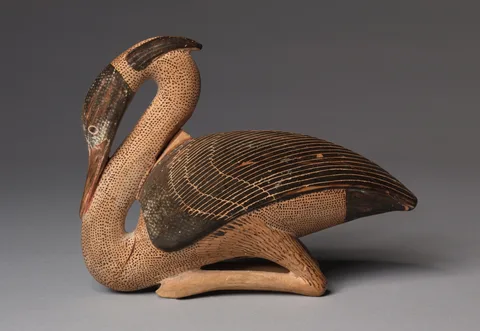
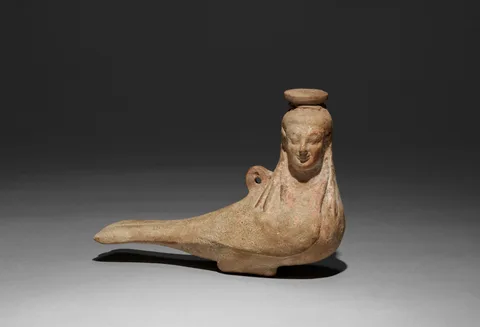
A ceramic heron crouches with its long neck curving down and back upward toward the head. The pointed beak nearly touches the lower body. Dark painted wings curve over a speckled pale body, with fine incised lines separating feathers. Folded legs support the bird, and the whole form is rounded and compact despite the elongated neck.A pale terracotta vessel combines a woman's head and long hair with a low bird body and extended tail. A small circular mouth rises above the head. A pierced loop is visible near the shoulder or back. The wings lie close to the rounded body, and faint surface marks remain on the weathered clay.
A closer comparison

Birds as containers ↗

A heron and a siren solve different problems of shape.
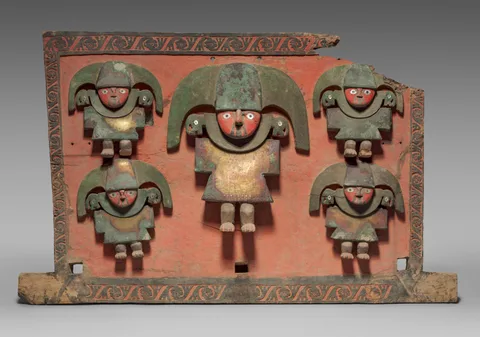
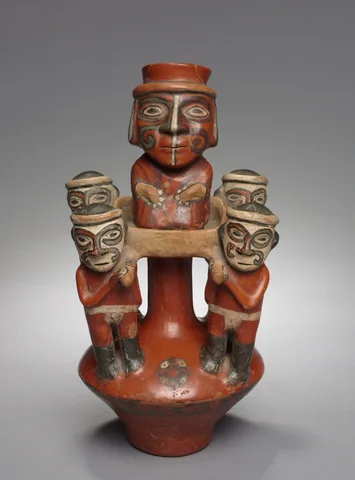
A rectangular wooden panel has a red background and five projecting human figures. One large figure stands at the center with four smaller figures around it. All wear wide collars, tunics and crescent-shaped headdresses. Gold-toned and green-corroded metal surfaces contrast with red faces. Patterned borders frame the panel, and several holes appear along the lower edge.A red-brown ceramic vessel supports a sculptural group. Four smaller porters carry a horizontal litter with a large seated dignitary above them. The figures have strongly outlined eyes, patterned faces and light-colored hats or headbands. The central dignitary’s head is much larger than those below. A hollow red support rises from the rounded vessel body.
A closer comparison

Carrying and representing rank ↗

A Chimú litter part and a Wari vessel show two relationships with transport.
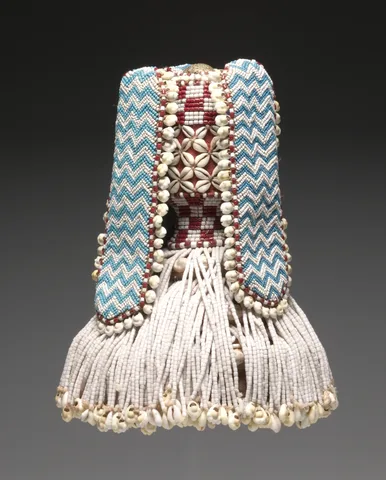
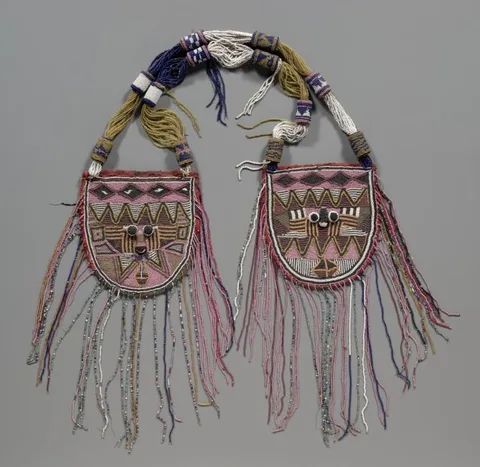
A tall hat has two long blue-and-white zigzag panels framing a red-and-white central section. Pale cowrie shells border the panels and form flower-like arrangements near the top. Dense white beaded strands flare outward below, with shells at their ends. The underlying dark structure is mostly hidden by the layered decoration.A necklace forms an inverted U of bundled bead strands and cylindrical bands. Two large rounded pouches hang below, covered with multicolored geometric patterns and small face-like features. Long fine beaded fringes descend from their sides and lower edges. Pink, blue, white, green and yellow tones alternate across the cloth-supported forms.
A closer comparison

Beads frame a wearer ↗

A Kuba official’s hat and a Yoruba diviner’s necklace organize flexible materials.
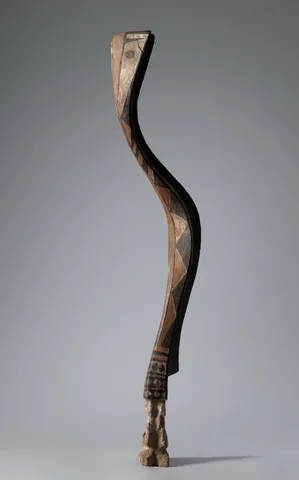
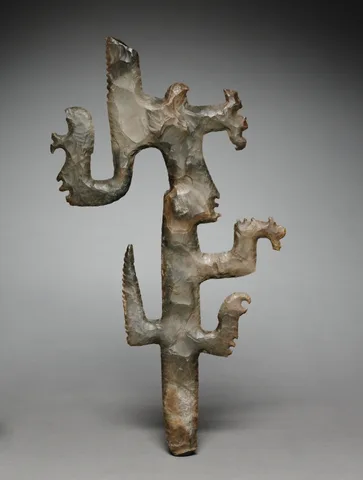
A tall narrow wooden serpent undulates in an S-like curve. Its flat upper head has a small dark eye and angular painted divisions. Dark and pale geometric bands follow the length of the body. A thicker lower section has repeated carved patterns, ending in a rough narrow support at the bottom.A tall flint object has an irregular branching outline with a main profile face near the middle. Several projecting arms of stone end in smaller faces or curved forms. A narrow stem extends below. Pale and darker patches cross the flaked surface, and sharp notches and chipped edges separate the figures from surrounding open space.
A closer comparison

Silhouettes within silhouettes ↗

A serpent headdress and a Maya eccentric flint demand attention to the edge.
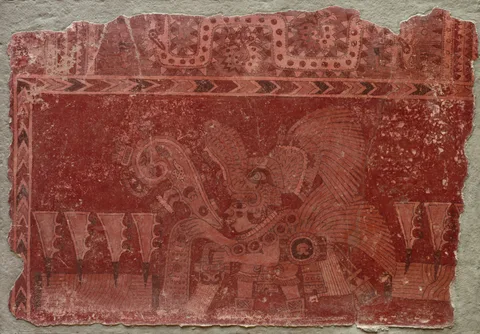
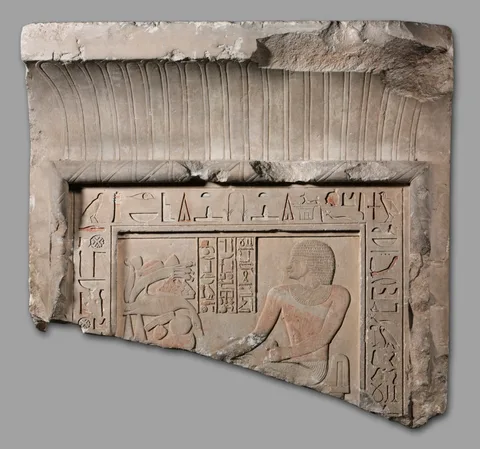
A red-toned wall-painting fragment shows an elaborately dressed profile figure with a large feathered headdress. A curling form extends from the mouth, and decorated streams fall from an outstretched hand. Tall pointed plant-like forms stand on either side. Patterned bands frame the scene, and irregular broken edges interrupt the upper painted register.A broken limestone stele resembles a framed doorway beneath a broad grooved cornice. Inside, a seated man faces a table piled with offerings. Columns of hieroglyphs stand between figure and table, while additional signs run around the frame. The lower edge is broken diagonally, and faint reddish paint survives on the figure and signs.
A closer comparison

Giving in two images ↗

A Teotihuacan mural and an Egyptian stele represent provision differently.
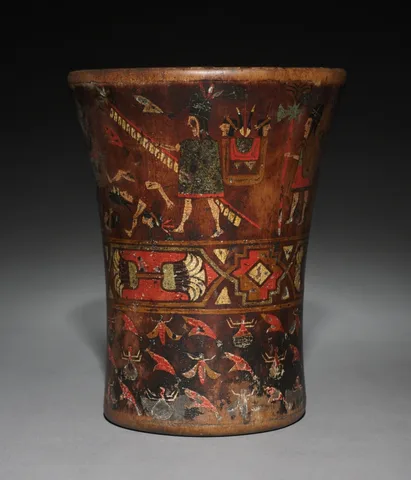
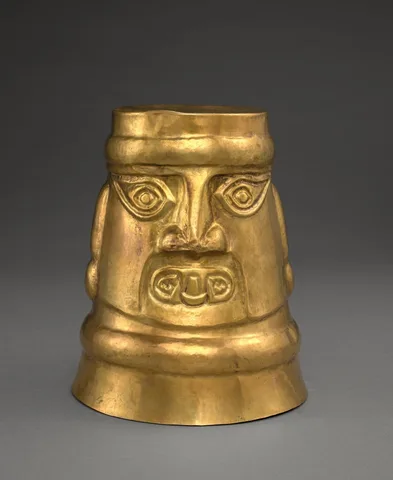
A dark wooden cup has a wide mouth, narrowed middle and slightly flaring lower body. Colored inlaid designs form three horizontal zones. Armed human figures with tall headdresses occupy the upper band, a strong geometric motif crosses the middle, and smaller lively forms fill the lower band. Wear interrupts some of the red, pale and greenish details.A gold beaker is displayed with a large face upright on its flaring body. Spiral-like eyes, a long projecting nose and a toothy mouth stand in relief between rounded horizontal bands. Its broad lower edge rests on the surface in this view. Uneven highlights and small surface variations show the worked metal rather than a perfectly smooth cylinder.
A closer comparison

Cups and changing orientation ↗

A colonial Inka kero and a Lambayeque beaker connect images with use.