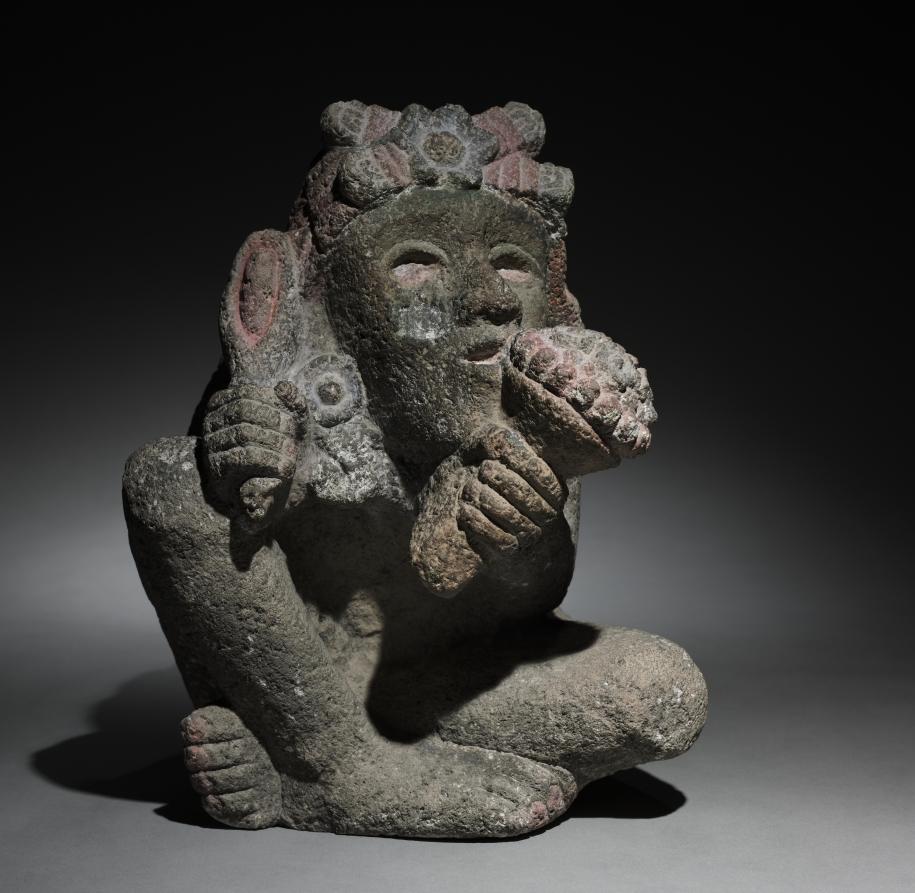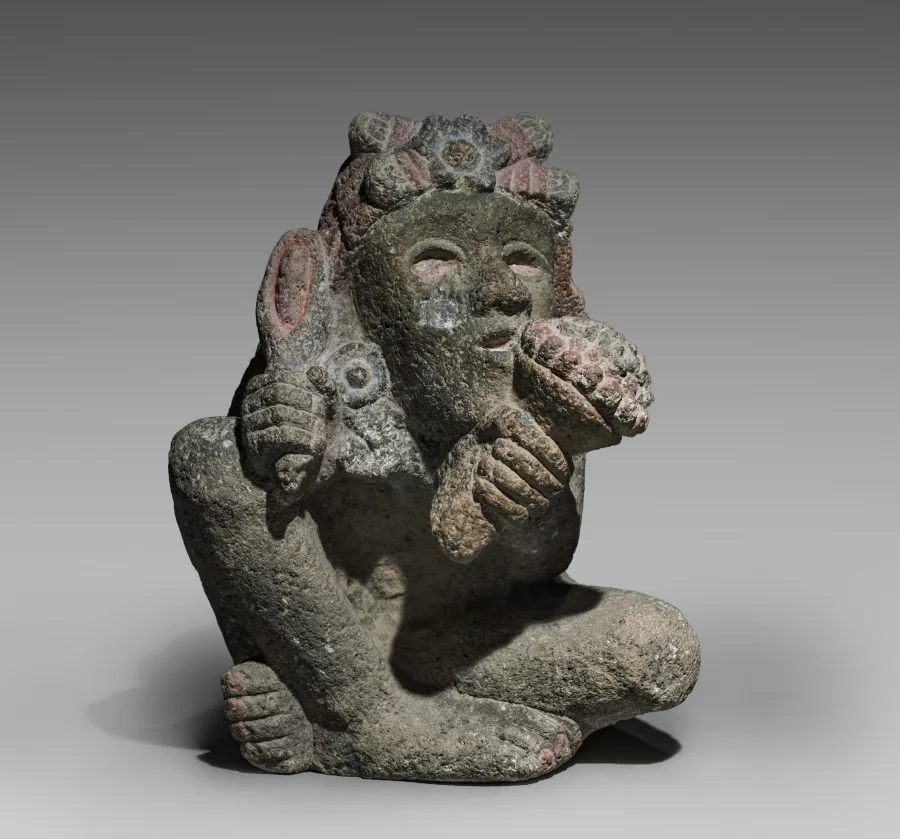
Flowers crowd a headdress and a handheld cone, but the figure's exact divine name remains open to more than one reading.
The flowers are easier to identify than the figure's exact name. They appear above the head and in the cone held close to the face, making repetition a major part of the design. Bent legs keep the body compact, while the raised hands bring attributes into the space around the head. Pigment survives unevenly across the stone.
The museum proposes either Macuilxochitl or Xochipilli, Aztec deities associated with arts, beauty and pleasure. Its discussion connects flowers with fertility and refinement in this context, not with a universal meaning applicable to every floral image. The catalogue also identifies a burden of maize on the back, which this front view does not fully reveal. That distinction matters: a title can direct attention to information beyond one photograph. The visible floral forms support interpretation, while the precise deity and the significance of the load remain qualified rather than settled by appearance alone.
The deity is tentatively identified as Macuilxochitl or Xochipilli. The maize burden is not fully visible from the selected angle, and the museum's interpretation of its creative significance remains a possibility.