Read the
Picture
An open collection
Native North America, Southwest, Arizona, Pueblo, Hopi · Ceramic

Canteen with a Katsina-like Face

Maker unrecorded · 1890

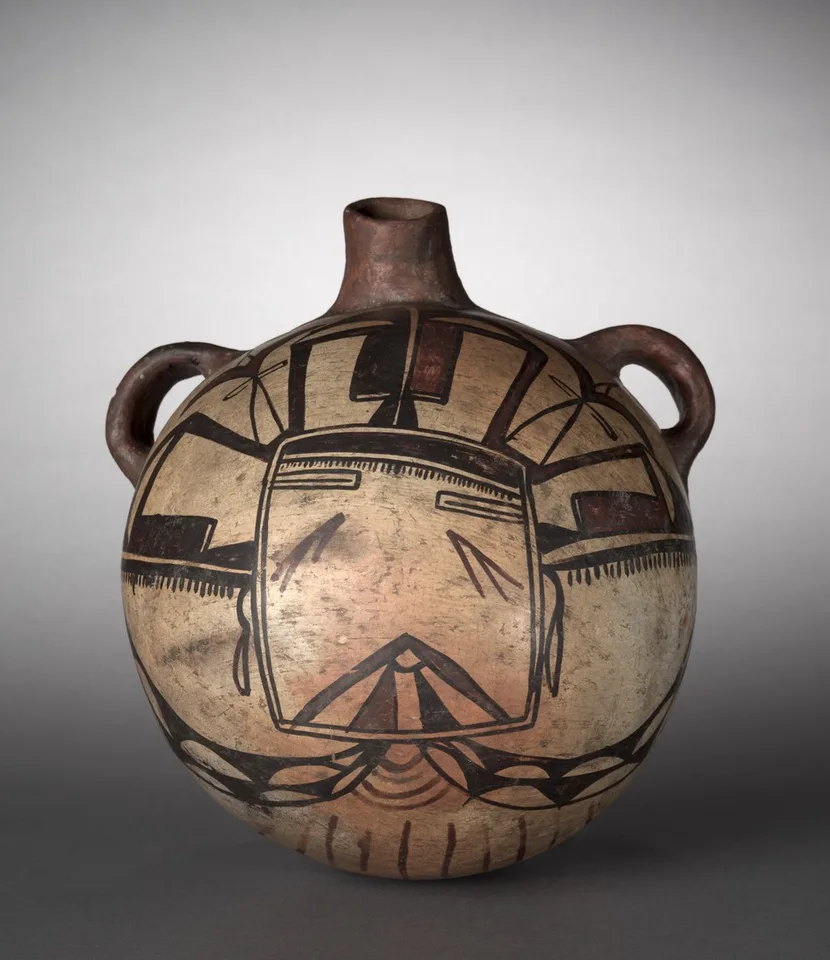
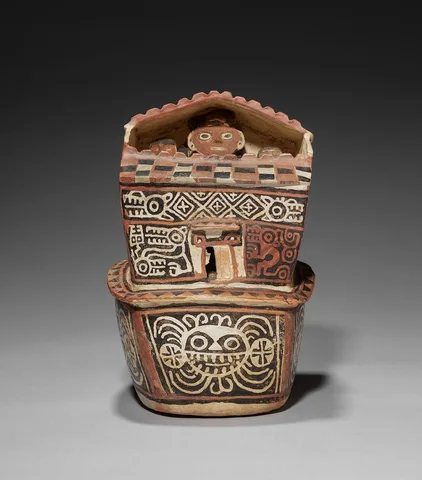
A rounded ceramic canteen has a short narrow neck and two loop handles at the shoulders. Dark brown and reddish painted lines cover the pale surface. A large rectangular face-like form occupies the front, with angular eyes, cheek marks and a triangular lower feature. Curved bands and geometric motifs wrap around the belly.
100%

Drag to move · Pinch or +/− to zoom · Arrow keys to pan · 0 to reset

The Cleveland Museum of Art · 1937.708 · Image: CC0Museum image ↗
A little context

A face-like design dominates a water canteen, but its resemblance to a Katsina does not make it an image of an actual spirit being.

Hopi women adapted large-bellied water canteens from Spanish prototypes beginning in the sixteenth century. By the late nineteenth century, such vessels also attracted Euro-American tourists, and makers developed decoration for that market. The museum describes this example’s face as Katsina-like but explicitly distinguishes it from an actual Katsina, a spirit being central to Pueblo religion. That distinction prevents a visual resemblance from becoming a false religious identification.

The painted face fills the broad front, while the neck and paired handles keep the canteen’s carrying function visible. Angular eyes, cheek marks and a triangular lower form give the design strong symmetry, interrupted by smaller differences in line and colour. The museum raises the possibility that the maker shaped how outsiders consumed images of Hopi culture. This is a question about artistic agency, not proof of a private intention. The canteen can be read securely as a skilled adaptation of vessel shape and face-like design within a changing market.

A careful reading

The face is a fanciful Katsina-like design, not an identified Katsina. The maker’s intention toward tourist buyers is a question raised by the museum rather than a documented statement.
Try your eye

Which statement best fits the museum’s identification of the painted face?

Where this reading begins

  • Canteen with a Katsina-like Face: collection record — The Cleveland Museum of Art. Identification, qualified cultural and maker attribution, materials, object-specific historical context, provenance and stated uncertainties; photograph independently inspected for visual observations. Museum record updated 2026-05-29; accessed 2026-11-14.

Our observations describe the supplied museum photograph. Historical identifications and context follow the cited collection record; interpretive limits are stated above. This is an independent guide, not a museum endorsement.

Image rights & attribution

Canteen with a Katsina-like Face, 1890. Native North America, Southwest, Arizona, Pueblo, Hopi. Ceramic, slip; overall: 21.5 x 24.5 cm (8 7/16 x 9 5/8 in.). The Cleveland Museum of Art, Gift of Amelia Elizabeth White, 1937.708

Individual API record marked CC0; checked 2026-11-14. CC0 1.0 dedication. Record date: 2026-05-29 06:05:10.826000. Museum print JPEG preserved unchanged in local originals; overview JPEG resized and recompressed from that same full frame; responsive WebP and zoom derivatives resized and recompressed; numbered annotation overlay separate from image.