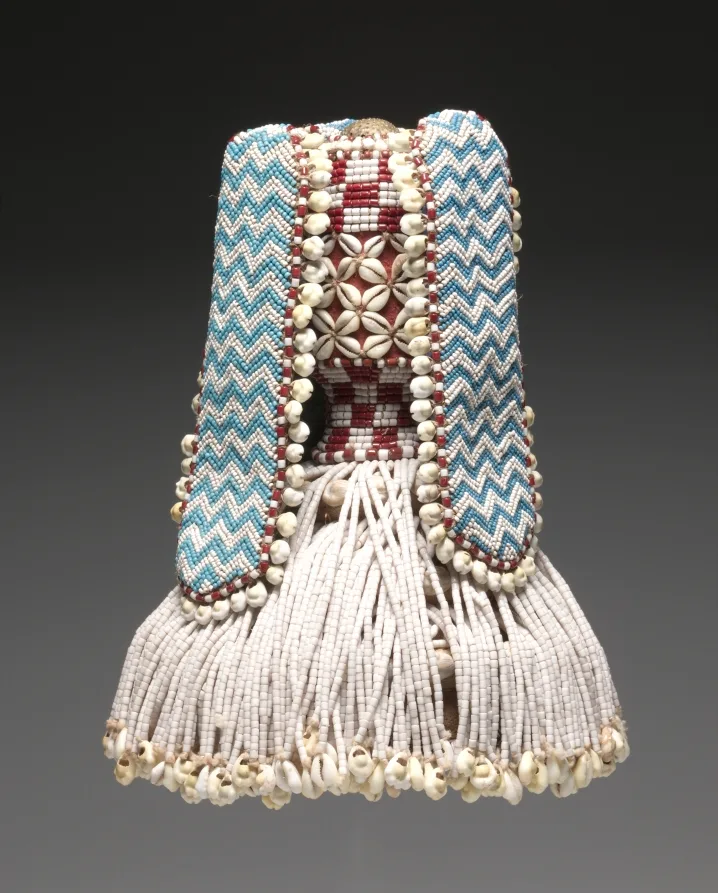
 Africa, Central Africa, Democratic Republic of the Congo, Kuba-style maker · possibly early 1900s
Hat (Kalyeem)
Maker unrecorded
Raffia, glass beads, cowrie shells, cloth (including wool), thread, and copper alloy
Beads can form a broad patterned surface, collect into bundles or hang in a fringe. Compare two wearable objects with different documented roles. Their many small components produce larger shapes around an absent body, while the museum’s contextual information connects those shapes with particular forms of standing.
Africa, Central Africa, Democratic Republic of the Congo, Kuba-style maker · possibly early 1900sMaker unrecorded
Raffia, glass beads, cowrie shells, cloth (including wool), thread, and copper alloy
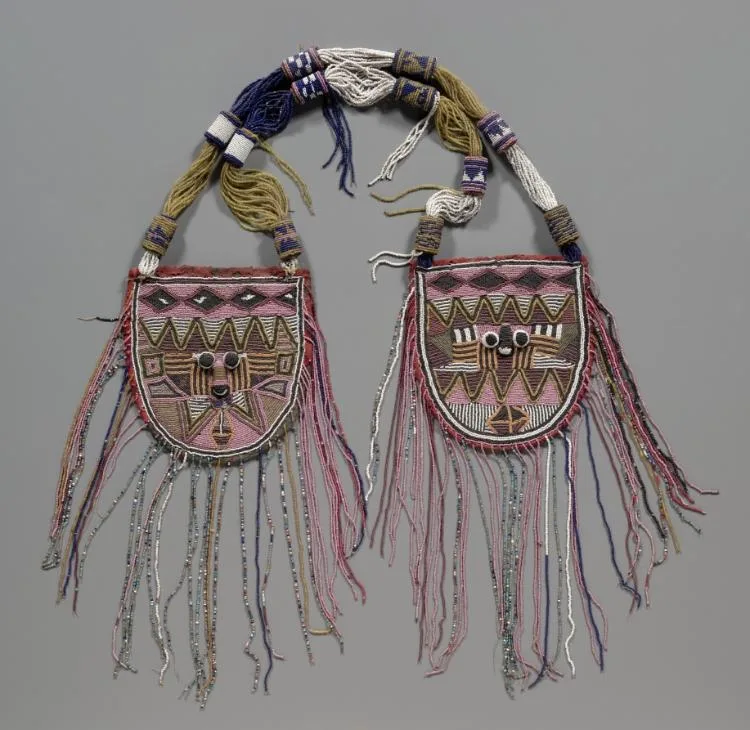 Africa, West Africa, Nigeria, Yorùbá-style maker · 1900s
Maker unrecorded
Cloth, glass beads, cardboard, cotton, probably wool, and wood
The hat’s blue and white zigzags spread across long panels. The necklace gathers fine strands into bundles held by short cylindrical bands. Compare a broad surface pattern with a construction that keeps many strings functioning as one larger wearable form.
Cowries border the hat’s panels and gather prominently near the top. The necklace’s decorated pouches held substances intended to protect the diviner. Costly visible materials and concealed contents contribute differently to each object; one cannot infer the pouches’ ingredients from their surface patterns.
The hat’s white fringe fans outward below its panels, while the necklace’s finer strands hang below and beside its pouches. Both would move with a wearer. Their still arrangements preserve length and density while withholding the changing appearance of movement and performance.
Kuba official rank and Yoruba Ifa divination are distinct institutional contexts. Similar beadwork techniques are not evidence that these wearables carried one shared meaning.
The comparison of visible choices is our own reading. Follow either artwork page for its full context, uncertainty note and image-rights record.
Five distinct ways to make authority visible.
Four sculptures and ornaments connect visible forms with partly hidden work.