 France · 1892
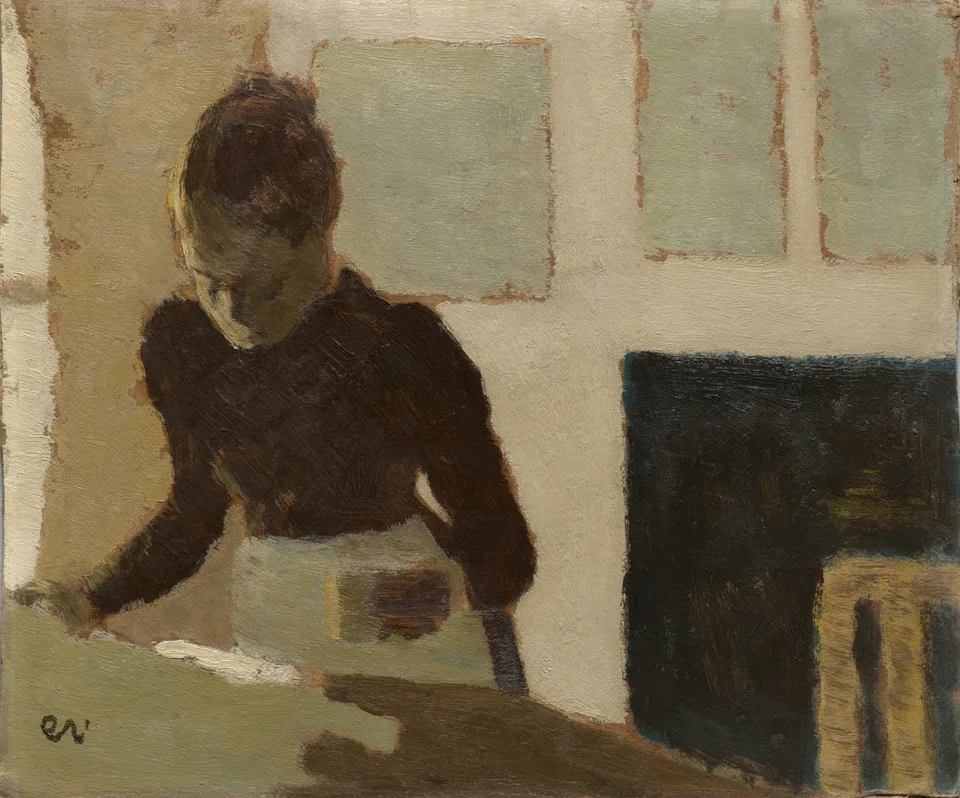
Woman Ironing
Édouard Vuillard (French, 1868–1940)
oil on board
Two paintings make textile work central while reducing the surrounding space to broad shapes. Compare how a small light accent and a luminous sheet reveal labor within otherwise restrained or flattened compositions.
France · 1892Édouard Vuillard (French, 1868–1940)
oil on board
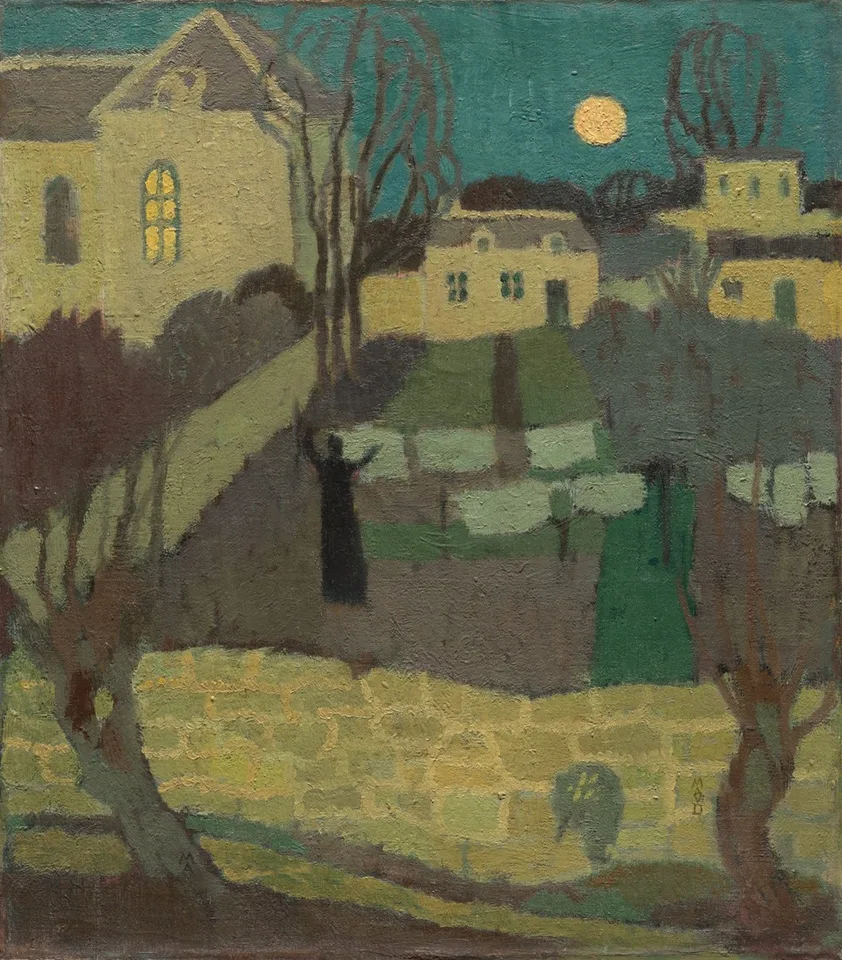 France · 1894
Maurice Denis (French, 1870–1943)
oil on canvas glued to cardboard
Vuillard’s face emerges through a narrow sliver of light from a dark silhouette. Denis’s woman appears as a small dark figure raising an arm. Both preserve the action with limited description rather than turning the worker into a fully modeled portrait.
Vuillard’s diagonal board anchors the garment and reaching hand. Denis’s hanging sheets repeat rectangular forms across a garden. Textile work gives each composition its geometry, but one concentrates on a near surface while the other distributes cloth through an enclosure.
The cup near Vuillard’s apron catches a warm accent. Denis’s moon forms a bright circle above the garden. Each small illuminated form helps orient the scene, though the cup belongs to the worker’s immediate space and the moon establishes a larger atmosphere.
Vuillard’s series draws on family work but does not securely name this sitter. Denis’s painting predates his purchase of its garden setting, so it does not establish a scene from his later household. The shared subject of work cannot supply either woman’s identity.
The comparison of visible choices is our own reading. Follow either artwork page for its full context, uncertainty note and image-rights record.
Household labor, kinship, accusation, and a stranger’s aid.