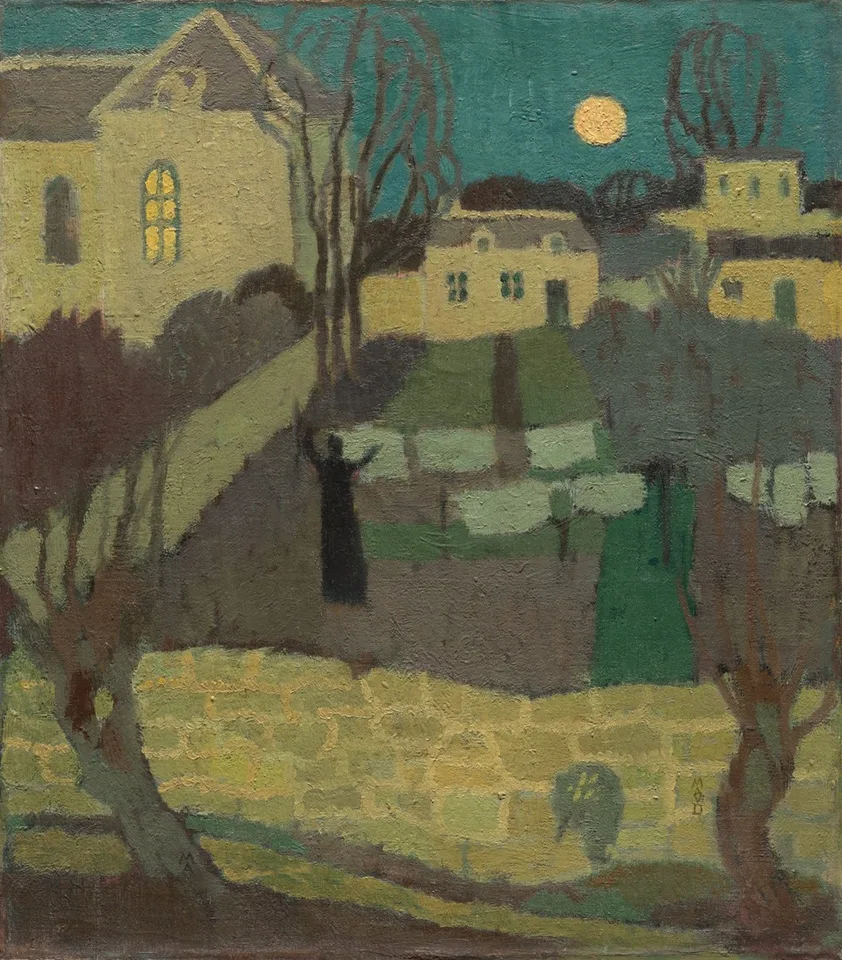
White laundry becomes a sequence of glowing rectangles in a garden where moonlight turns work into a patterned nocturne.
The sheets stretch across the middle as pale rectangles. They echo the windows and wall surfaces behind them, while the bare branches make a more irregular frame. A small dark woman reaches toward the laundry, her body nearly absorbed into the surrounding shapes. The moon is a bright circle above this network of flat, interlocking areas.
The museum identifies the activity as hanging linen to be bleached by moonlight, following a customary practice. It identifies the garden as that of a former priory which Denis later made his family home. The painting is dated 1894, while the museum records his purchase of the property in 1914. A view can precede an artist’s ownership of its setting; those dates do not establish that the scene already shows his own household. Look at how ordinary work supplies the pale rectangles that organize the enclosed garden.
The painting’s recorded date precedes Denis’s purchase of the property. The museum does not identify the woman, so the scene should not be treated as a documented portrait of his later household.
Which repeated shape connects laundry and architecture?
Practise looking at Drying the Linen, or Moonrise at the Priory →