Hands that work and support
Hands may join people through making, care, music, or conflict. Follow six scenes whose practical gestures establish relationships before their titles explain them. A family drawing with an uncertain plot, a portrait of musical harmony, intimate kinship, domestic labor, and a biblical act of aid offer different kinds of evidence; similarity of gesture should sharpen those distinctions.
Begin the journey ↓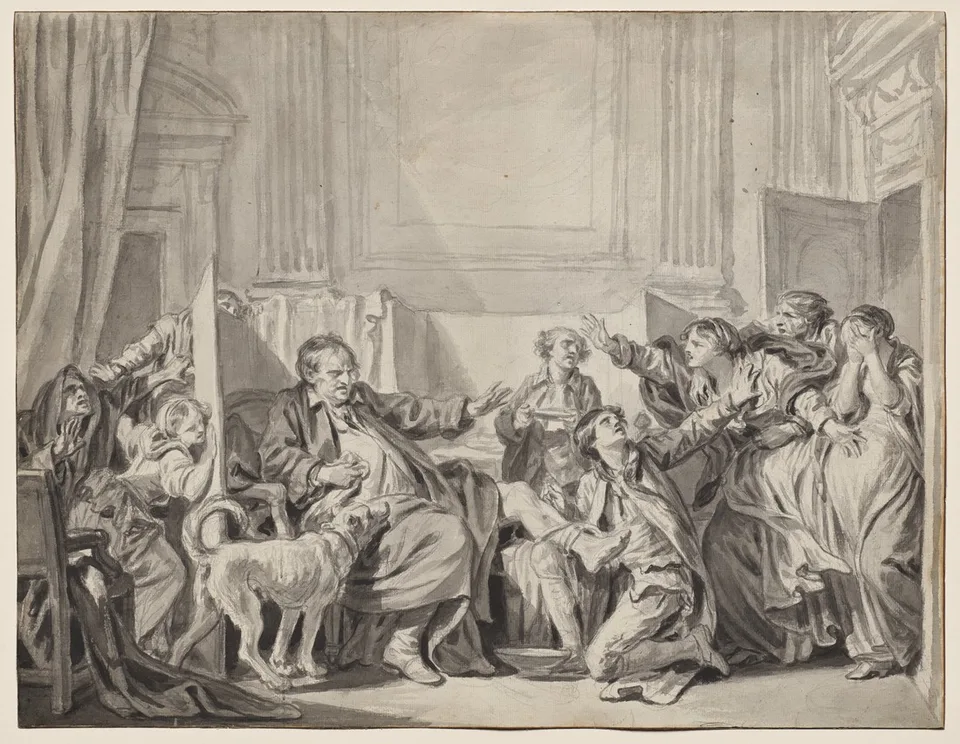
The kneeling figure
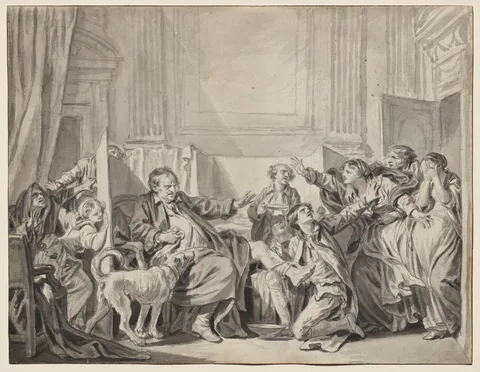
The kneeling man’s gesture joins a tense family encounter, but the exact accusation remains uncertain. Begin by describing appeal and confrontation without deciding the entire plot.
Carry this question: Which gesture is clearest even without the title?
Open the artwork ↗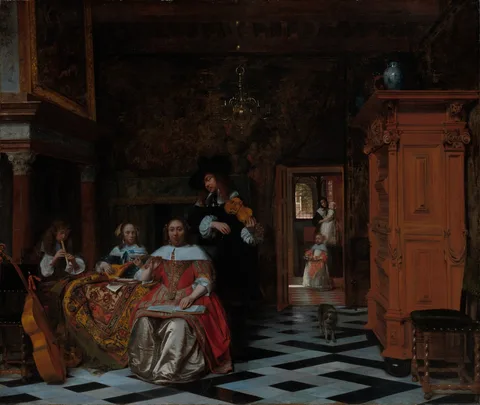
Music around the table
The family’s hands coordinate musical activity around a costly table covering. The museum reads harmony symbolically, while reminding us that the sitters’ identities remain unknown.
Carry this question: What links the musicians beyond their shared room?
Open the artwork ↗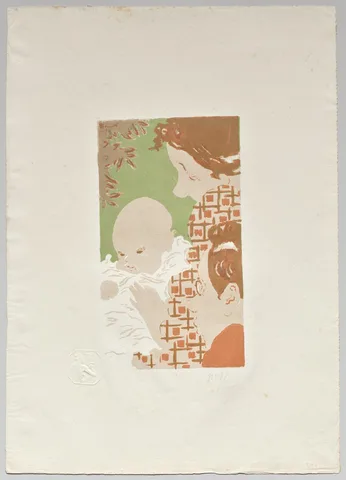
The artist at the edge
Bonnard inserts his own cropped head beside his nephew. Proximity creates intimacy here through compression and framing rather than through an elaborate room or a fully staged group portrait.
Carry this question: How does the cropped edge affect your sense of closeness?
Open the artwork ↗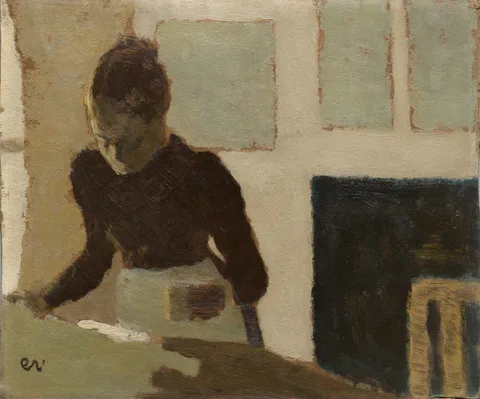
The diagonal working surface
A diagonal work surface gives the woman’s posture a practical focus. Her dimly lit face and cup emerge gradually, making a small domestic task worth sustained looking.
Carry this question: Which details become visible only after the dark silhouette?
Open the artwork ↗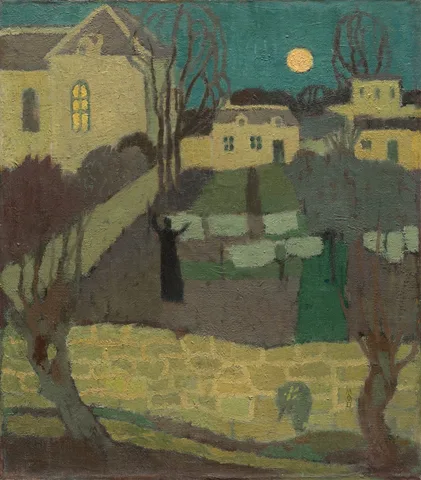
A figure reaching to the linen
A raised arm makes hanging laundry readable within flat garden shapes. The painting predates Denis’s purchase of the property, so the activity should not automatically be identified as work within his later household.
Carry this question: How does the figure animate the rectangles of cloth?
Open the artwork ↗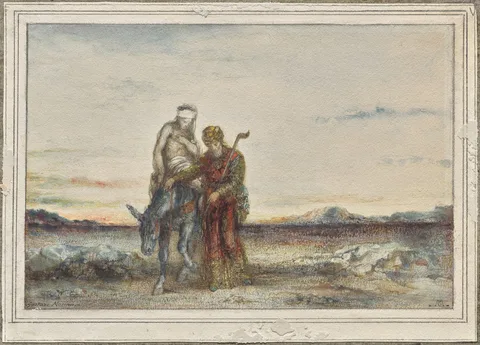
The standing helper
The final helper gives up his own mount to an injured stranger. Support is an actual transfer of mobility, making the parable’s ethical relationship visible in a compact group.
Carry this question: What practical resource passes from helper to traveler?
Open the artwork ↗Look at a pair more closely
- Support and accusation
Moreau’s roadside aid and Greuze’s family crisis
- Domestic work in light
Vuillard’s ironing and Denis’s moonlit laundry
Read with the sources
Historical context follows the individual museum records linked on each artwork page. These routes make original comparisons of visible form; resemblance alone is not evidence of shared meaning or direct influence.
- The Guilty and Repentant Daughter — museum collection record
- Portrait of a Family Playing Music — museum collection record
- Family Scene — museum collection record
- Woman Ironing — museum collection record
- Drying the Linen, or Moonrise at the Priory — museum collection record
- The Good Samaritan — museum collection record