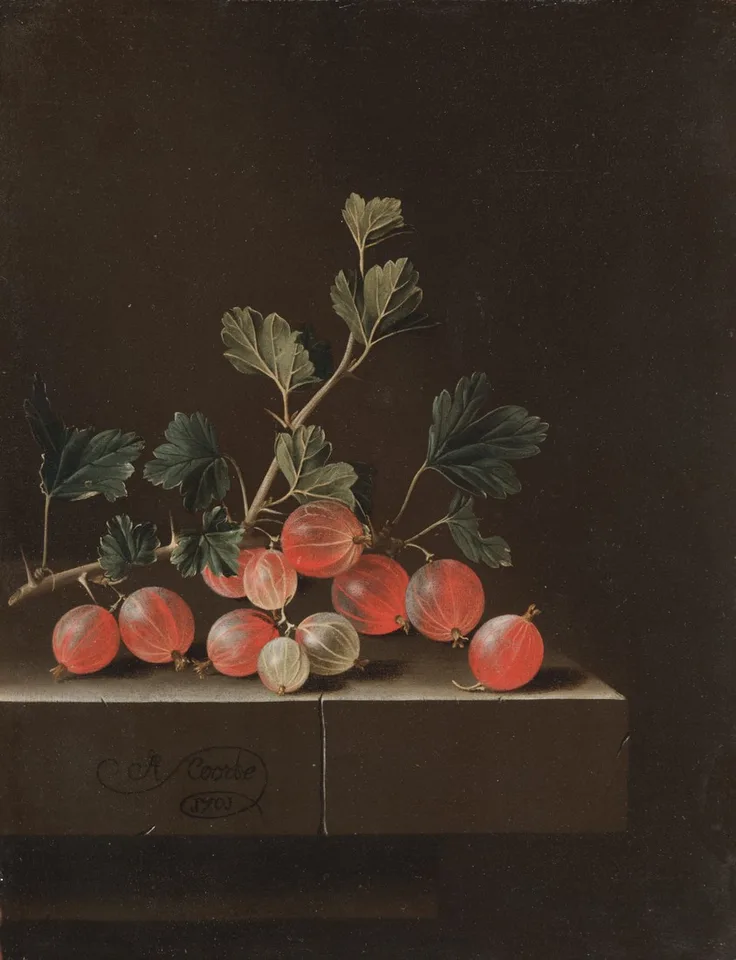
 Netherlands, early 18th Century · 1701
Gooseberries on a Table
Adriaen Coorte (Dutch, 1660–1707)
oil on paper mounted on wood
Both still lifes give fruit a dark setting, but their supporting objects create different encounters. Compare luminous skins, the structures beneath them, and small details that cross or interrupt the table edge.
Netherlands, early 18th Century · 1701Adriaen Coorte (Dutch, 1660–1707)
oil on paper mounted on wood
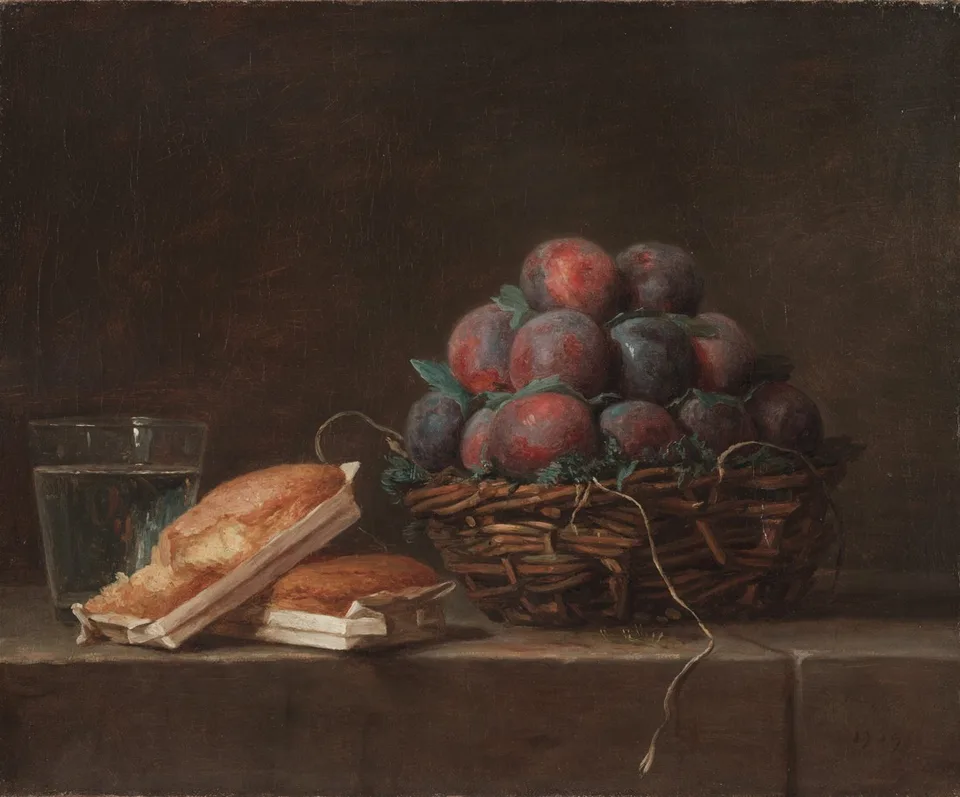 France · 1769
Anne Vallayer-Coster (French, 1744–1818)
oil on canvas
Coorte’s pale-veined berries glow against an almost empty field. Vallayer-Coster gathers larger red and purple plums into an overlapping mound. Darkness makes both groups prominent, while spacing distinguishes an isolated plant cluster from a fuller serving arrangement.
Coorte’s cracked stone ledge feels rigid and weighty. Vallayer-Coster’s basket sends a flexible strand over the table edge. Both details make the support tangible, but one emphasizes fracture in a hard surface and the other the behavior of woven material.
Coorte sets dark waxy leaves above translucent fruit. Vallayer-Coster places crisp cake papers beside transparent water and glass. Each painting builds interest through differences of surface rather than requiring a grand narrative or an exotic central ingredient.
The fruits and historical settings differ, and neither record assigns a complete symbolic code to the arrangement. Shared darkness does not establish identical meanings.
The comparison of visible choices is our own reading. Follow either artwork page for its full context, uncertainty note and image-rights record.
Fruit, flowers, utensils, and the people who look past them.