Things on tables and near faces
A still life can stand alone, enter a portrait, or become part of a scientific study. These works ask us to compare how ordinary objects receive light and attention. Move from kitchen equipment and fruit to flowers beside named sitters, then to Merian’s insects and their food plant, keeping ornamental arrangement distinct from botanical evidence and personal symbolism.
Begin the journey ↓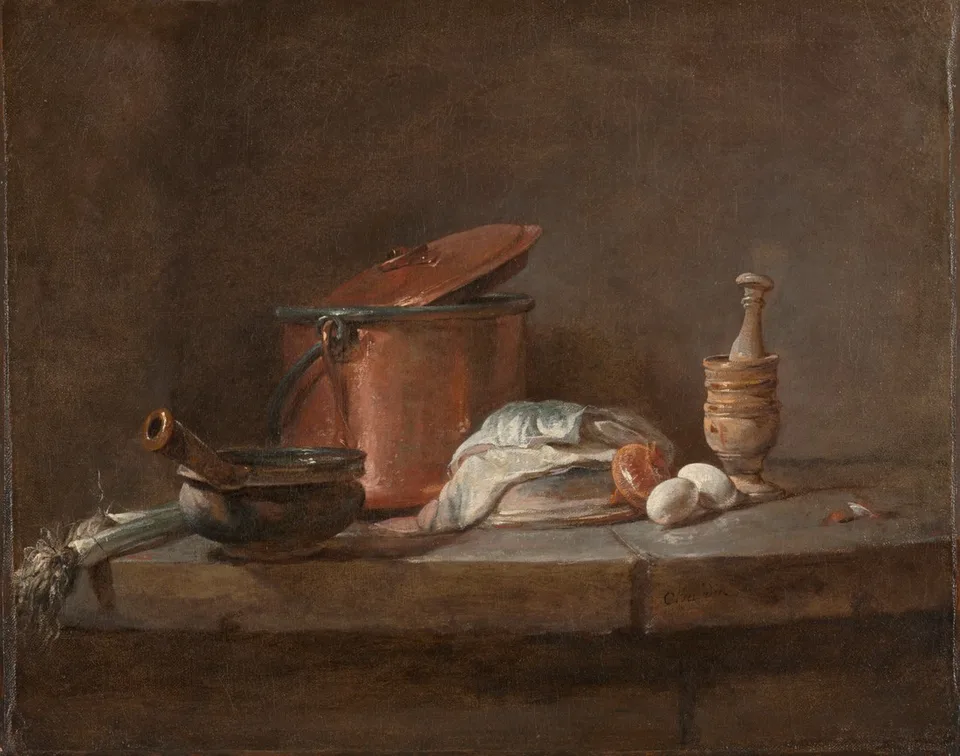
The tilted lid
Start with the tilted lid and its relationship to the pot. Chardin makes familiar utensils active through placement, showing that modest equipment can sustain a carefully balanced composition.
Carry this question: Which nearby object answers the lid’s diagonal?
Open the artwork ↗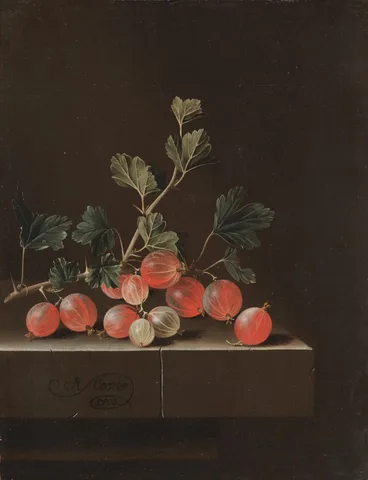
Translucent red fruit
Coorte gives small local fruit a dark stage. The luminous skins differ from Chardin’s solid metal, shifting the exercise from weight and arrangement toward delicate translucency.
Carry this question: What does the dark background let the berry reveal?
Open the artwork ↗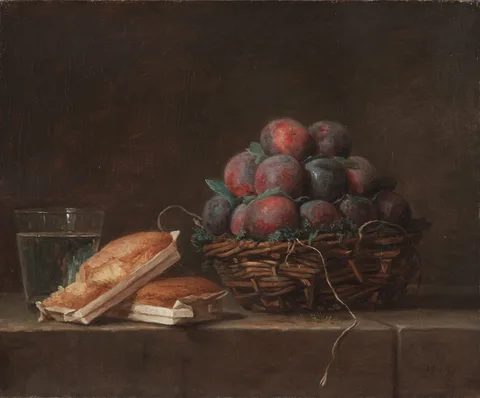
Paper beside glass
Vallayer-Coster adds paper and water to fruit. Compare the cake’s opaque folded wrapper with the glass, then notice how the loose basket strand crosses the table edge.
Carry this question: Which surface needs the fewest marks to become recognizable?
Open the artwork ↗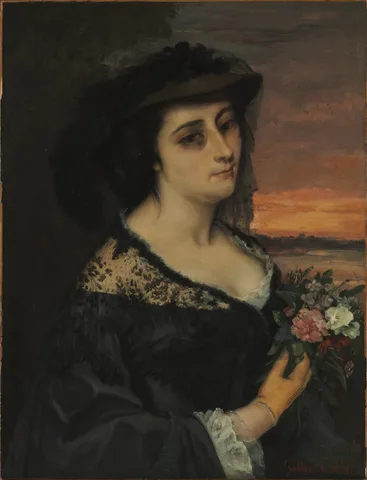
Lace at the neckline
Objects now enter a portrait as lace and a bouquet. Their elegance coexists with unidealized features, complicating the assumption that decorative accessories necessarily produce a flattering likeness.
Carry this question: How does the lace connect skin with the dark dress?
Open the artwork ↗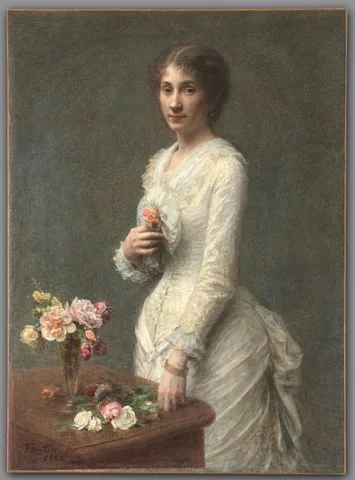
The rose at the bodice
A hand-held rose links Madeleine Lerolle with a separate floral still life on the table. The portrait’s gesture becomes the bridge between a person and a specialty of the painter.
Carry this question: Trace the route from her upper hand to the tabletop flowers.
Open the artwork ↗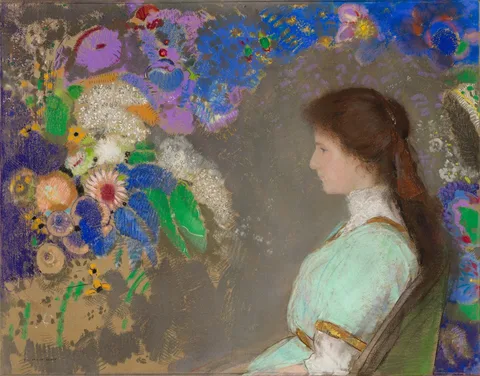
A field of blue flowers
Redon’s flowers expand beyond a modest vase into a dreamlike surrounding field. Violette’s clear profile remains separate, so the floral abundance need not be read as a literal room.
Carry this question: Where does the floral field leave space for the face?
Open the artwork ↗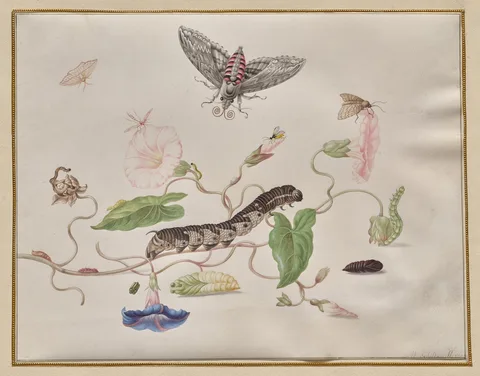
A caterpillar on the stem
Merian joins plants with insect study, yet deliberately includes more than one caterpillar species. End by separating the page’s scientific observations from its choices of arrangement.
Carry this question: Why can proximity alone not prove a shared life cycle?
Open the artwork ↗Look at a pair more closely
- Fruit, light, and table edges
Coorte’s gooseberries and Vallayer-Coster’s plums
- Plants cut and studied
Runge’s lilac silhouette and Merian’s moth sheet
Read with the sources
Historical context follows the individual museum records linked on each artwork page. These routes make original comparisons of visible form; resemblance alone is not evidence of shared meaning or direct influence.
- Kitchen Utensils with Leeks, Fish, and Eggs — museum collection record
- Gooseberries on a Table — museum collection record
- Basket of Plums — museum collection record
- Mme L . . . (Laure Borreau) — museum collection record
- Madame Lerolle — museum collection record
- Violette Heymann — museum collection record
- Convolvulus and Metamorphosis of the Convolvulus Hawk Moth — museum collection record