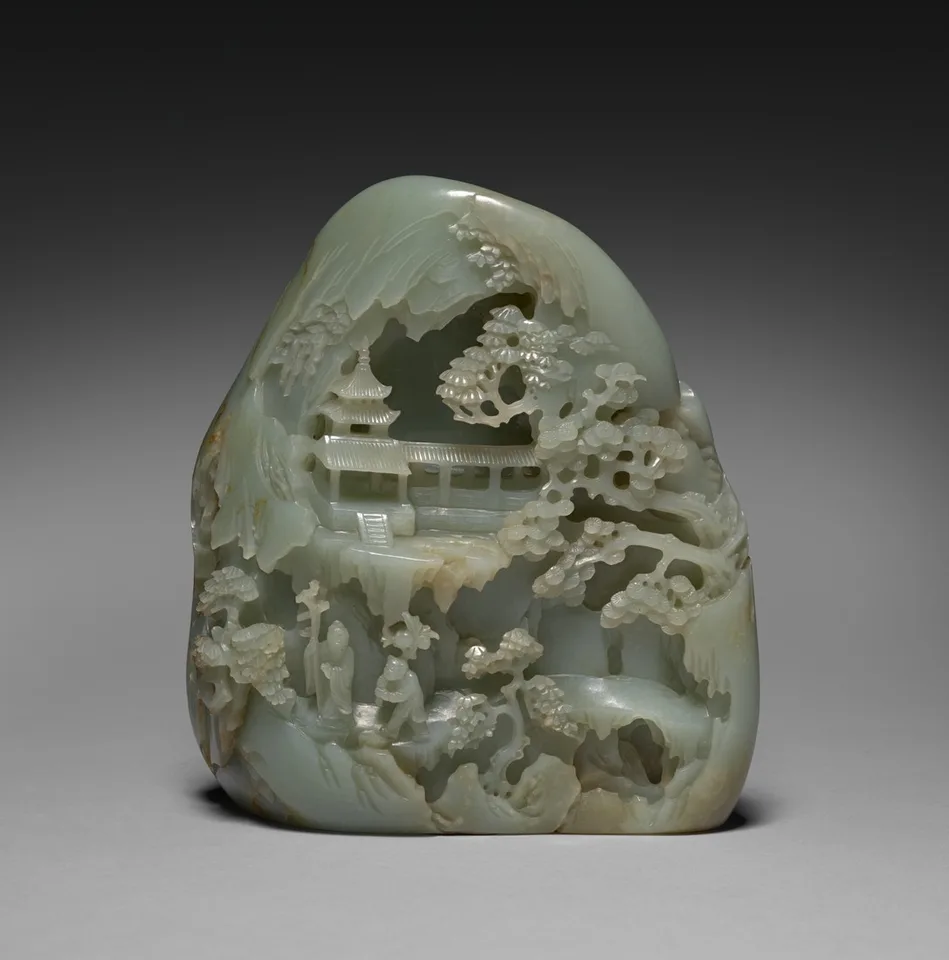
 China, Qing dynasty (1644–1911), Qianlong reign (1736–95) · 1736–95
Miniature Mountain with Daoist Paradise
Maker unrecorded
green jade with brown markings
Both works invite the eye into a landscape that remains larger than its tiny inhabitants. Their purposes differ: the jade offers an imagined Daoist dwelling, while the painted gorge makes river travel precarious. Compare scale and openings before assigning a shared meaning to mountains.
China, Qing dynasty (1644–1911), Qianlong reign (1736–95) · 1736–95Maker unrecorded
green jade with brown markings
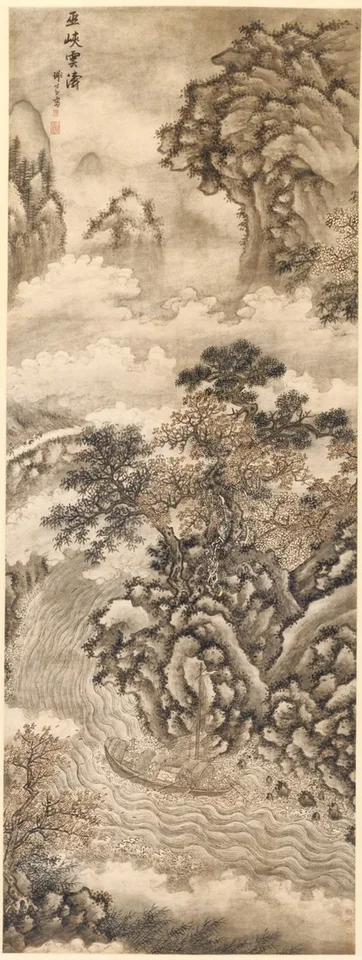 China, Ming dynasty (1368–1644) · c. 1547–67
Xie Shichen (Chinese, 1487–after 1567)
hanging scroll; ink and light color on paper
The jade pavilion suggests a place to enter among the carved ledges. The painting’s wave-filled river suggests a passage to negotiate. Each makes a landscape accessible through a small feature, but only one route is explicitly described as perilous.
Tiny companions in the jade make the boulder seem inhabitable. In the gorge painting, dense rocks and trees dwarf the river activity. The disparity in scale encourages different imaginative responses without turning either composition into a measured map.
The jade retains a smooth outer boulder around its pierced scene. Pale mist gaps organise distance within the ink painting. Stone mass and unpainted space provide different ways to separate visible forms and invite the viewer beyond them.
Mountains do not automatically have one symbolic meaning across these works. The comparison concerns scale and access while retaining the specific Daoist and travel-related contexts supplied by the records.
The comparison of visible choices is our own reading. Follow either artwork page for its full context, uncertainty note and image-rights record.
Refuge, poetry, travel, paradise and a porcelain river.