Landscape on changing supports
A landscape can be a gift, a literary setting, a route through danger, a carved paradise or a scene on a useful vessel. Begin with how the eye moves, then ask what the source adds about place and purpose. None of these works needs to operate as a surveyed map.
Begin the journey ↓

Make room for refuge
Pale intervals let mountains emerge through mist. The documented gift thanking a host for shelter gives the calm image a history of displacement that cannot be recovered from atmospheric brushwork alone.
Carry this question: What changes when you learn why the painting was given?
Open the artwork ↗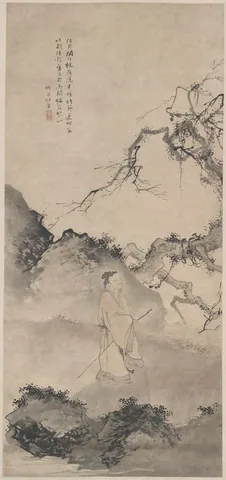
Enter a poet’s remembered world
The sweeping plum branch leads toward a small walker. Lin Bu lived centuries before the painter, so the encounter makes a literary identity visible rather than preserving a witnessed walk.
Carry this question: How much of the poet’s identity depends on the tree?
Open the artwork ↗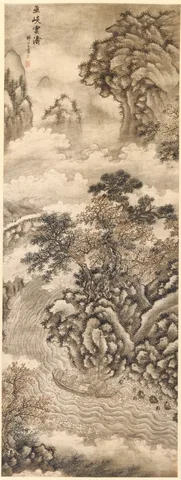
Feel the difficulty of a route
Repeated wave lines beneath steep rocks make a tiny vessel seem vulnerable. The possible connection with Xie Shichen’s journey enriches the scene without converting its dramatic composition into a navigation chart.
Carry this question: Which marks turn water from scenery into an obstacle?
Open the artwork ↗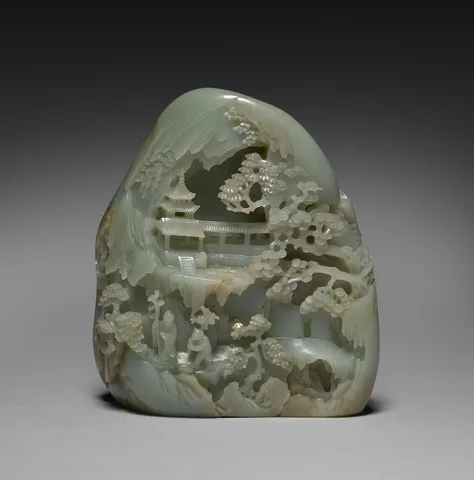
Imagine entering a stone
A small pavilion offers an inhabitable scale within the jade boulder. The material’s spiritual associations and the Daoist paradise subject reinforce one another, while the outer stone remains clearly present.
Carry this question: Can you see the boulder and an imagined destination at once?
Open the artwork ↗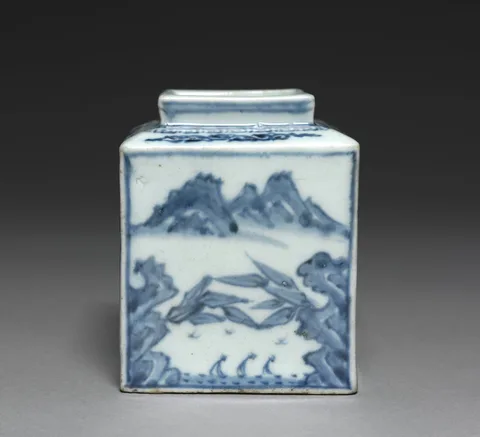
Give a river a flat wall
The square porcelain face frames a compressed river view. The bottle’s proposed use for ink water links landscape with cultivated activity, but the practical identification remains less certain than its visible shape.
Carry this question: How do the corners affect the way you read the landscape?
Open the artwork ↗Look at a pair more closely
- Mountains to enter or negotiate
A carved paradise and a perilous river view
Read with the sources
Historical context follows the individual museum records linked on each artwork page. These routes make original comparisons of visible form; resemblance alone is not evidence of shared meaning or direct influence.
- Cloudy Mountains — museum collection record
- The Poet Lin Bu Wandering in the Moonlight — museum collection record
- Clouds and Waves at the Wu Gorge — museum collection record
- Miniature Mountain with Daoist Paradise — museum collection record
- Square-shaped Bottle with the Scenery of the Han River — museum collection record