A jade boulder becomes a place to enter imaginatively, with paths, trees and a pavilion hidden inside its surface.
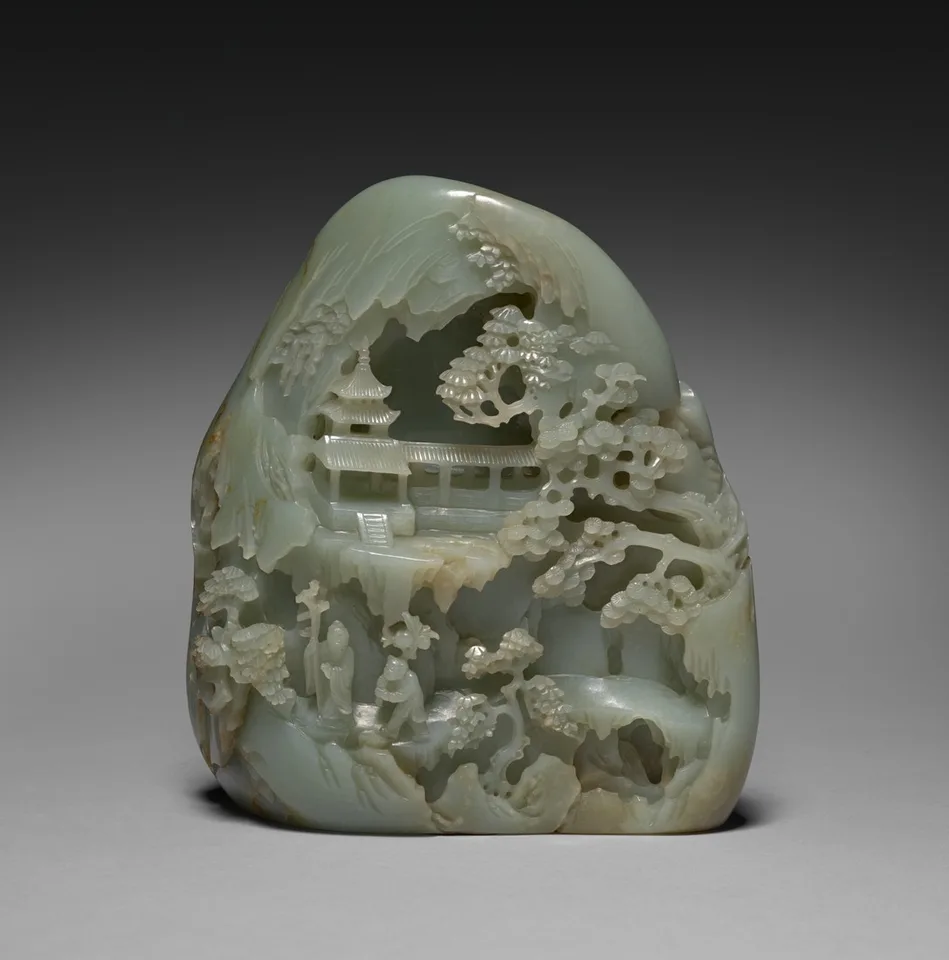
The rounded boulder remains recognisable even after it becomes a landscape. Within its perimeter, the carver opens dark recesses, projects rocky ledges and places a small pavilion among trees. Tiny figures near the lower edge offer an imagined scale: the stone can be held as an object, yet its scenery invites a much larger mental journey. The contrast between smooth outer mass and pierced interior makes that transformation particularly clear.
The museum identifies a Daoist paradise, associated with the search for immortals’ mountain dwellings. A bearded immortal is accompanied by a servant carrying peaches, another immortality motif. Jade itself carried spiritual associations, giving material and subject a shared significance. This does not mean the scene maps a real destination or proves a particular belief held by its owner. It shows how a treasured substance could become an intricate setting for imagining transcendence.
The landscape represents an imagined Daoist realm rather than a mapped place. The record does not identify the original owner or prove how that person understood the object.
What makes the jade look like an inhabitable landscape rather than only an abstract rock?
Practise looking at Miniature Mountain with Daoist Paradise →