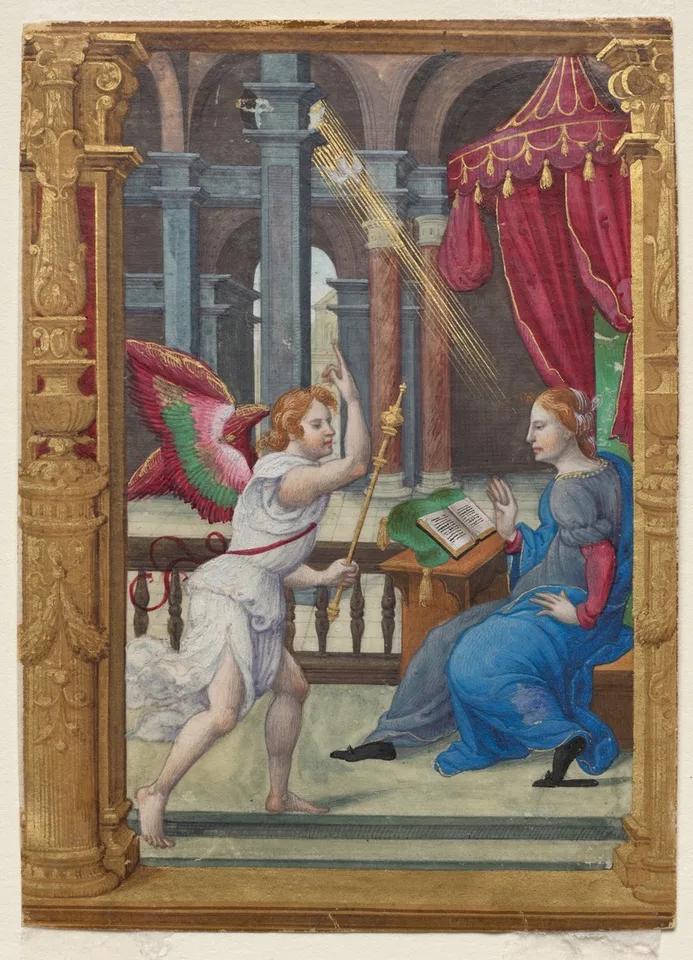
 France, Paris · c. 1530–35
The Annunciation (Matins, Office of the Virgin): Leaf from a Book of Hours (1 of 3 Excised Leaves)
Noël Bellemare (French, d. 1546); and The 1520s Hours Workshop (French)
ink, tempera, and liquid gold on vellum
These detached manuscript leaves once belonged to different kinds of books. Compare the relation between image, text, and frame while remembering that the current isolated pages omit original sequences of reading and handling.
France, Paris · c. 1530–35Noël Bellemare (French, d. 1546); and The 1520s Hours Workshop (French)
ink, tempera, and liquid gold on vellum
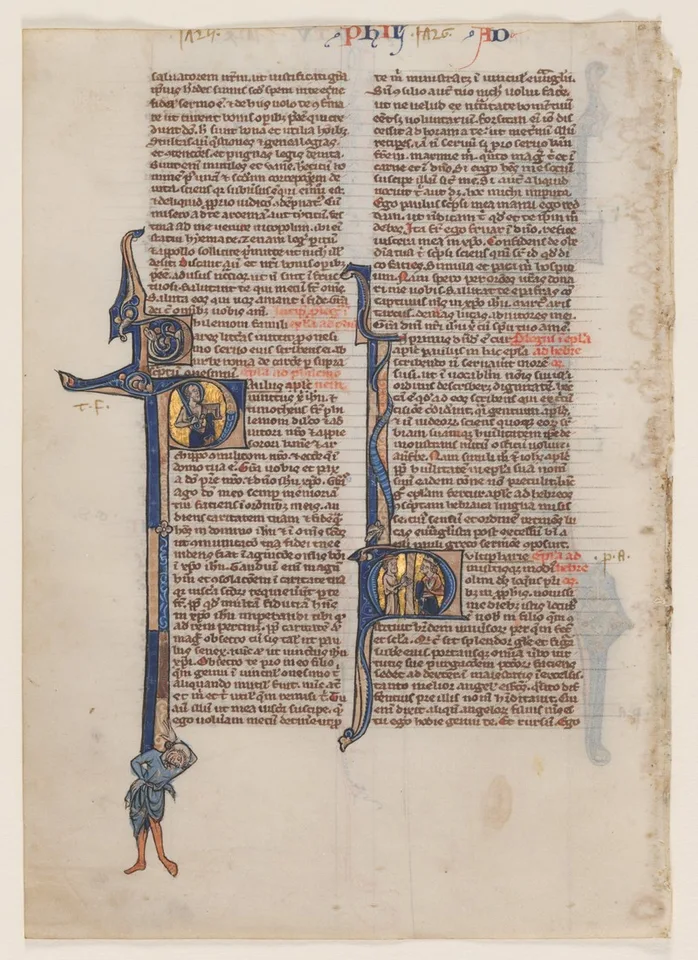 England, Oxford, 13th century · c. 1230–40
circle or workshop of William de Brailes (English, active c. 1230)
ink, tempera, and gold on vellum
The Paris leaf places an open book within the Annunciation scene, echoing its own devotional function. The Oxford initial contains Paul at the opening of his epistle. Both connect a sacred figure with reading, but at different levels of page design.
Gabriel raises his hand within a spacious architectural miniature. The Bible’s small drollery appears to support a descending initial. One gesture participates in the sacred narrative, while the other playfully animates the structure of a letter.
The Annunciation’s pink canopy and gold architecture occupy most of the leaf’s pictorial space. Dense paired columns dominate the Bible page. Both require skilled making, but their distribution of image and writing serves different rhythms of devotional reading and study.
A luxury book of hours and a portable Bible are not interchangeable reading tools. The Paris leaf is credited to Bellemare and the 1520s Hours Workshop; the Oxford leaf remains attributed to the circle or workshop of de Brailes. Neither detached leaf reconstructs its complete original volume.
The comparison of visible choices is our own reading. Follow either artwork page for its full context, uncertainty note and image-rights record.
High walls, intimate plaques, relic shrines, and portable books.