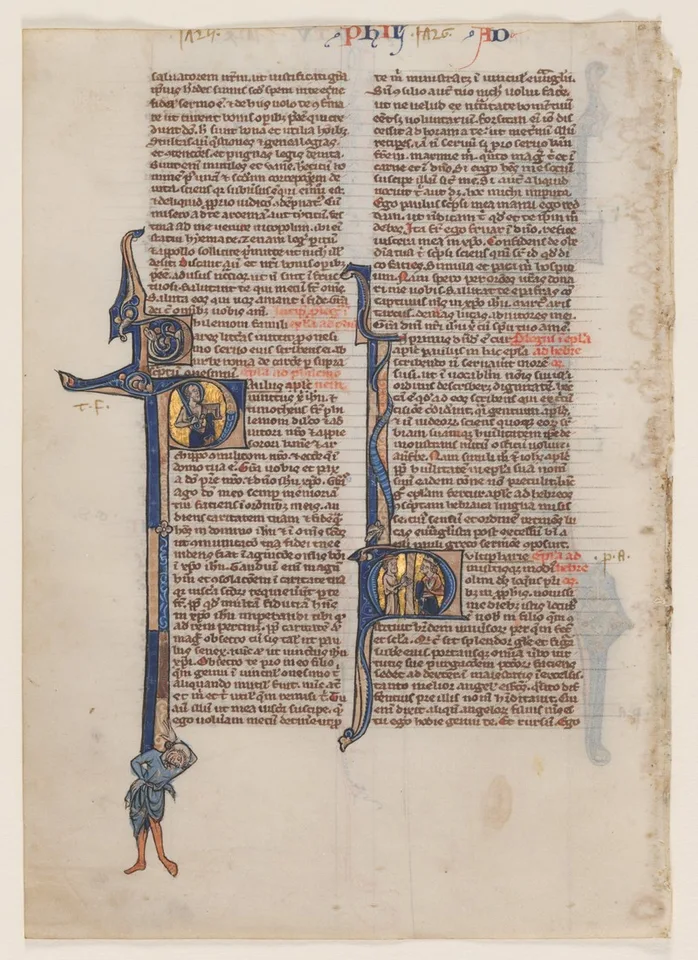
A tiny figure seems to shoulder a giant letter, making the edge of a serious study Bible unexpectedly playful.
The writing is dense and carefully divided into two columns. Against that regularity, the large initial P stretches far down the left side, its decorated stem becoming almost an independent architectural support. A small figure below bends under its end. Within the letter, another figure has a more solemn role, so the same initial accommodates both sacred subject and playful visual invention.
The museum identifies Saint Paul with a sword and book inside the P introducing the Epistle to Philemon. It attributes the leaf to the circle or workshop of William de Brailes, an illuminator documented in Oxford, while explaining that several artists worked in his style. The little supporting figure is a drollery wearing a scholar’s cap. Such details belong to a portable, single-volume Bible intended for study, likely produced in a lay workshop in an academic town. The museum also reads the marginal abbreviations T.F. and P.A. as evidence of likely Carthusian monastic use. Production in a lay workshop and reading in a monastery are different parts of the book’s history. The page joins disciplined reading with a margin that invites another kind of attention.
The attribution is to a circle or workshop, whose organization remains uncertain. The detached leaf cannot establish the full original Bible’s appearance or the reactions of its readers.
What makes the lower figure a playful part of the letter?
Practise looking at Leaf from a Latin Bible: Initial P: St. Paul with a Sword and a Book →