Devotion and original viewing
Religious images were encountered at different distances and through different actions. These works suggest looking upward, approaching a small relief, venerating relics, following a prayer book, and studying a compact Bible. Their current photographs preserve important evidence while omitting much of the original architecture, sequence, handling, or ritual setting. Begin with the visible clue and keep the proposed use appropriately qualified.
Begin the journey ↓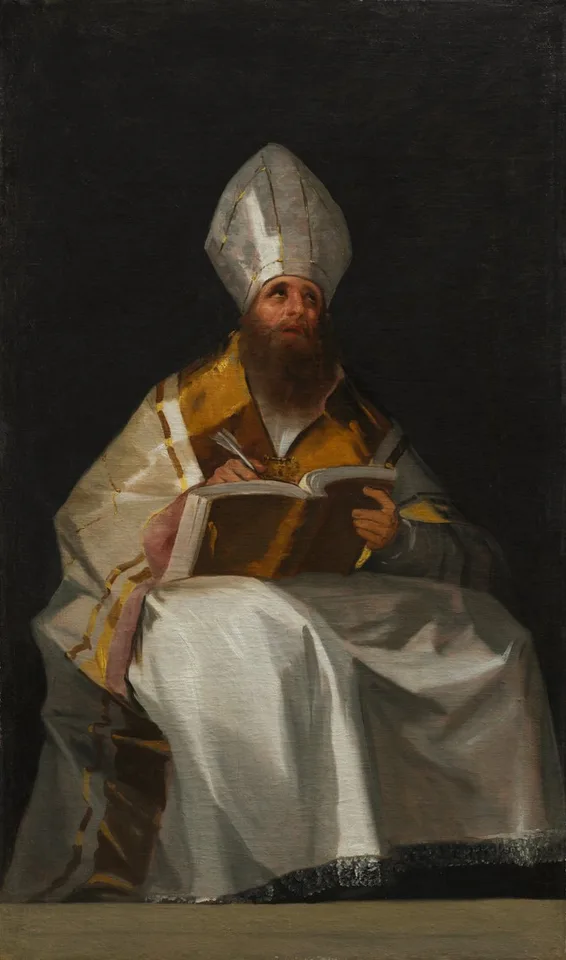
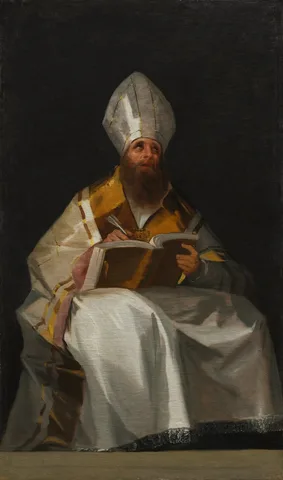
Broad folds below
Broad vestment folds and a low viewpoint suggest a high wall position. The museum does not identify the original institution, so the visual clue remains a hypothesis.
Carry this question: Which forms would stay legible from far below?
Open the artwork ↗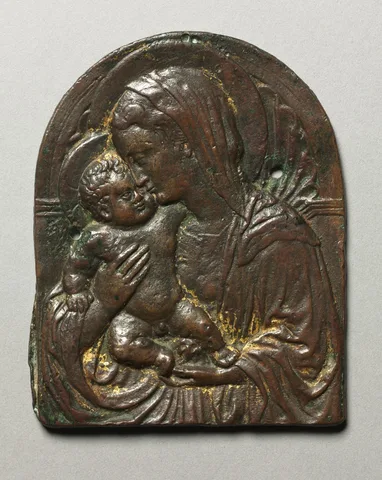
A small mounting hole
Small holes suggest a wall-mounted private devotional plaque. The intimate faces and angled bodies may have addressed a viewer below, but the installation is not documented.
Carry this question: What can the holes establish, and what remains unknown?
Open the artwork ↗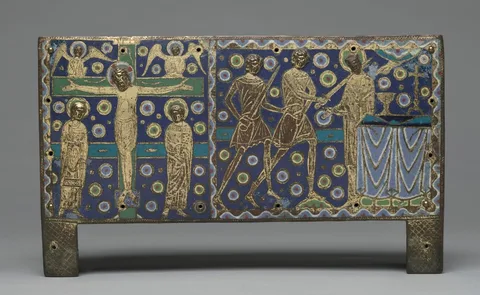
Christ on the cross
The surviving shrine face pairs Becket’s death with Christ’s Crucifixion. Its devotional relationship is clear even though the complete container and specific relics are absent.
Carry this question: How does adjacency make the two narratives speak together?
Open the artwork ↗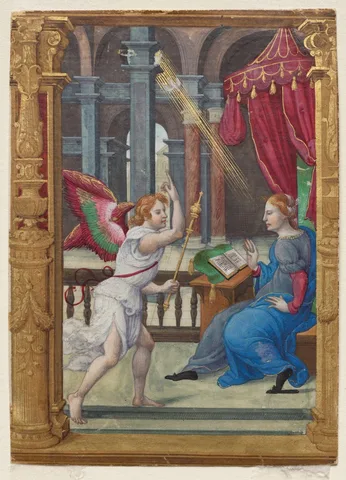
The open book
A book appears inside a page once used for prayer. The excised miniature survives, while the original rhythm of neighboring texts and page turns has been lost.
Carry this question: How does the represented book echo the object’s own use?
Open the artwork ↗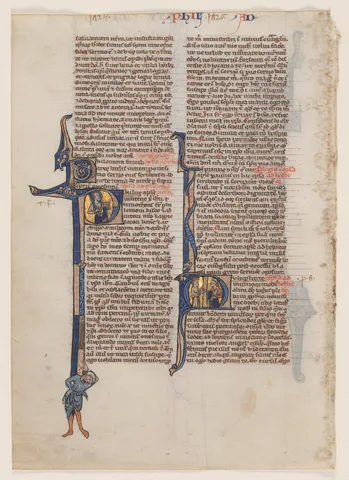
The supporting drollery
A playful figure supports a large initial in a portable study Bible. Sacred reading and marginal invention coexist without requiring us to assign a single reaction to every reader.
Carry this question: How does the letter become something like a physical structure?
Open the artwork ↗Look at a pair more closely
- Pages for prayer and study
A Paris Annunciation and an Oxford Bible leaf
Read with the sources
Historical context follows the individual museum records linked on each artwork page. These routes make original comparisons of visible form; resemblance alone is not evidence of shared meaning or direct influence.
- Saint Ambrose — museum collection record
- Virgin and Child — museum collection record
- Plaque from a Chasse for Relics of Saint Thomas Becket — museum collection record
- The Annunciation (Matins, Office of the Virgin): Leaf from a Book of Hours (1 of 3 Excised Leaves) — museum collection record
- Leaf from a Latin Bible: Initial P: St. Paul with a Sword and a Book — museum collection record