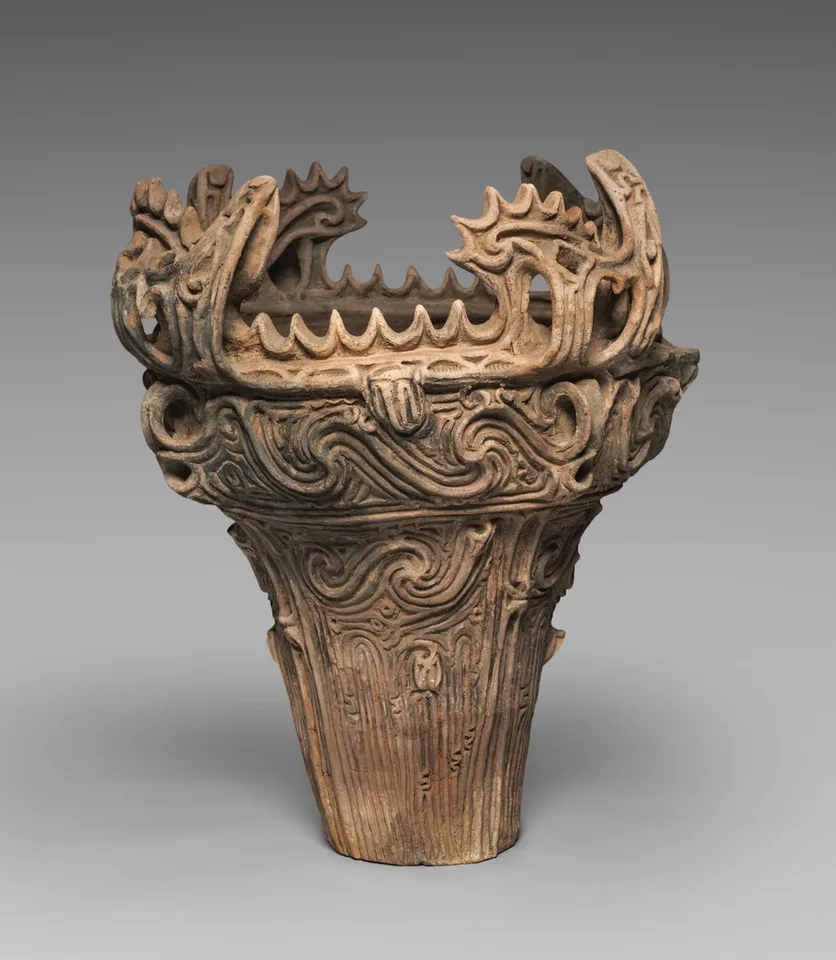
 Japan, Jōmon period (c. 10,500–300 BCE) · c. 2500 BCE
Fire-flame Cooking Vessel (Ka'en Doki)
Maker unrecorded
Earthenware with carved and applied decoration
Both ceramics carry later intervention, but the changes do different things. A borrowed lower section altered the Jōmon vessel’s apparent scale, whereas gold lacquer at the celadon bottle’s mouth makes a local repair conspicuous. Begin by separating original design from subsequent care.
Japan, Jōmon period (c. 10,500–300 BCE) · c. 2500 BCEMaker unrecorded
Earthenware with carved and applied decoration
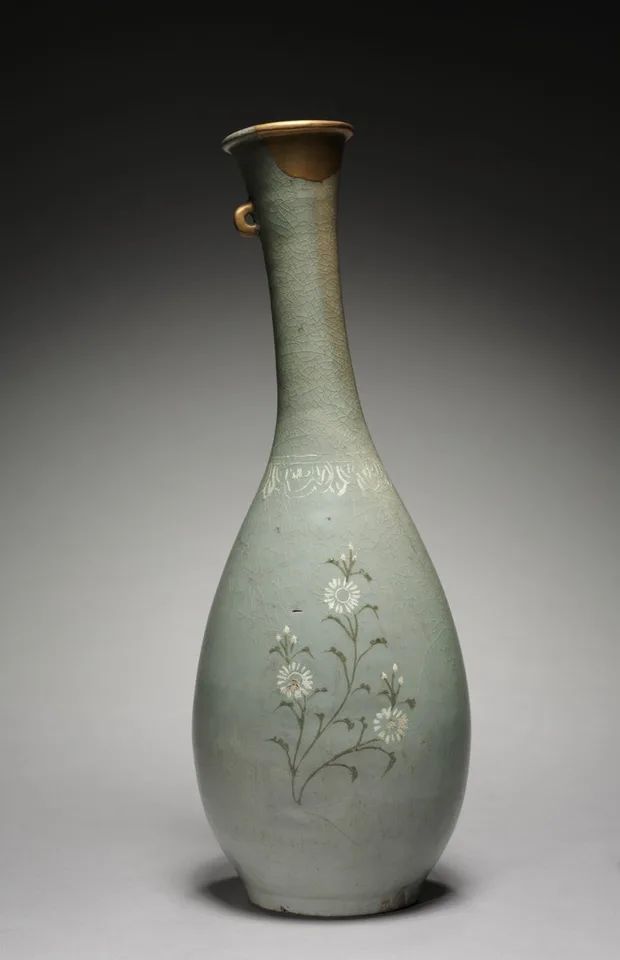 Korea, Goryeo dynasty (918–1392) · 1200s-1300s
Maker unrecorded
Celadon ware with inlaid white and black slip decoration
The Jōmon vessel’s elaborate rim and the celadon bottle’s inlaid flowers give each object a distinctive original surface. Their visual importance survives the later interventions, so condition history need not replace attention to the makers’ work.
The reconstructed lower section makes the fire-flame vessel taller than its original form. The bottle’s gold patch fills damage at the lip. One changes the overall proportions; the other draws attention to a particular damaged area.
The ancient meaning of the Jōmon spirals remains unknown, while the date and maker of the bottle’s repair are unrecorded. Looking at texture and neck shape cannot by itself answer either kind of historical question.
The comparison does not treat all restoration as equivalent or judge past repair decisions by appearance alone. The museum supplies different evidence and uncertainties for each object.
The comparison of visible choices is our own reading. Follow either artwork page for its full context, uncertainty note and image-rights record.
Repair, reconstruction, deliberate irregularity and represented possessions.