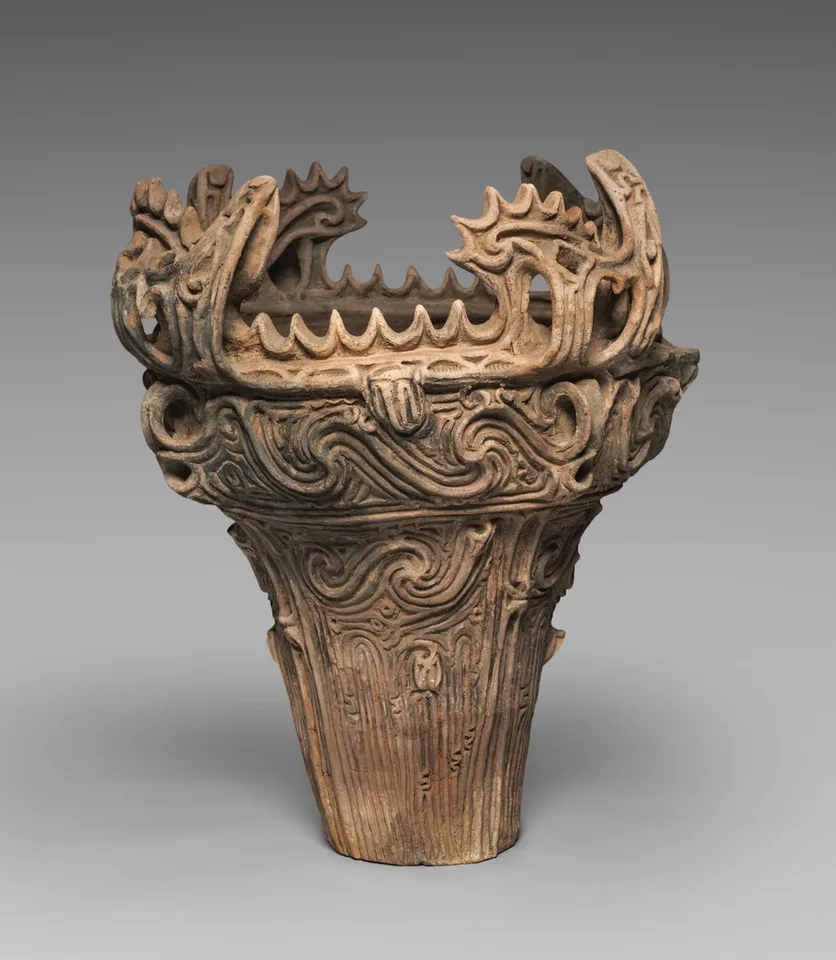
The spectacular rim suggests flames, but the vessel’s reconstructed lower section changes how tall we imagine it originally stood.
The rim pulls attention away from the vessel’s ordinary task of containing something. Tall projections, smaller points and looping ridges turn the opening into an elaborate silhouette. Below that crowded top, the wall narrows through bands of curving and vertical texture. The modern name “fire flame” describes a visual resemblance; it does not tell us what the Jōmon makers intended the design to represent.
A crucial qualification concerns the base. The museum reports that a lower section from a different vessel was used in a twentieth-century reconstruction, making the object about four inches taller than it originally would have been. Vessels of this type were partly set into the ground during use, and their bases often deteriorated. The reconstruction therefore changes not only completeness but proportion. Looking responsibly means noticing the powerful rim while keeping the present composite height distinct from the ancient form.
The lower section comes from another vessel and changes the original scale. “Fire flame” is an archaeological name, and the ancient meaning of the design is unknown.
Which fact changes how we should judge the vessel’s proportions?
Practise looking at Fire-flame Cooking Vessel (Ka'en Doki) →