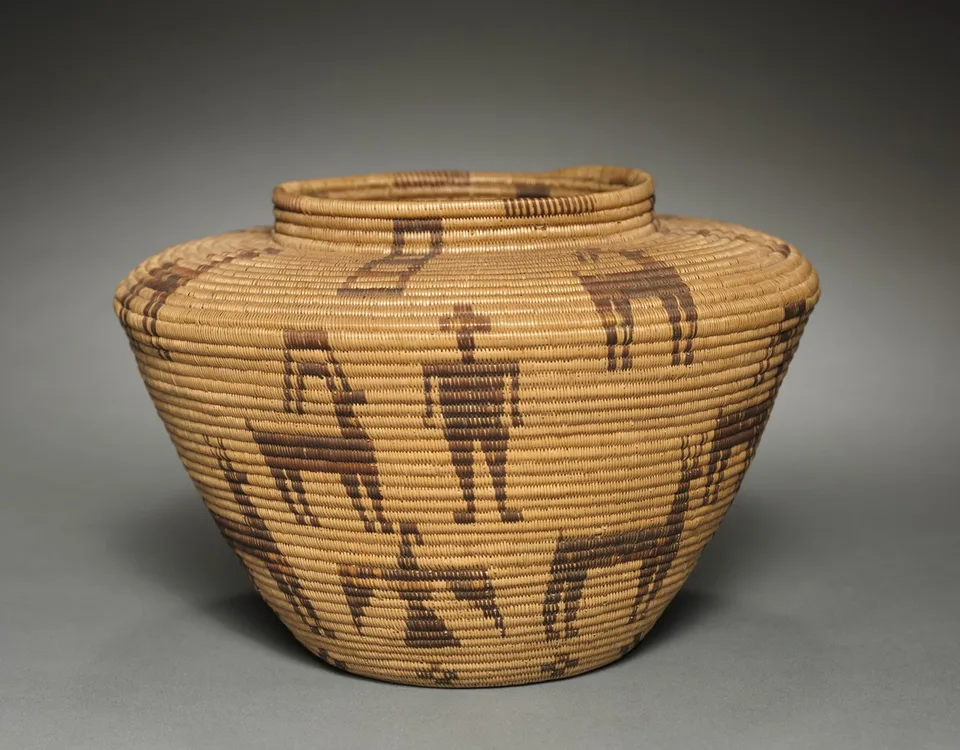
 Native North America, Great Basin, California, Death Valley · 1910
Jar-shaped Basket
Sarah Hunter (Timbisha Shoshone (Panamint), 1883–1967)
Willow, bulrush; coiled (3 rods)
Both baskets use repeated small units to build a rounded form and a larger pattern. Sarah Hunter’s dark figures are woven into the pale ground; the Wappo bowl adds a dense bead covering. Comparing their units helps separate technique from the more uncertain meanings attached to particular motifs.
Native North America, Great Basin, California, Death Valley · 1910Sarah Hunter (Timbisha Shoshone (Panamint), 1883–1967)
Willow, bulrush; coiled (3 rods)
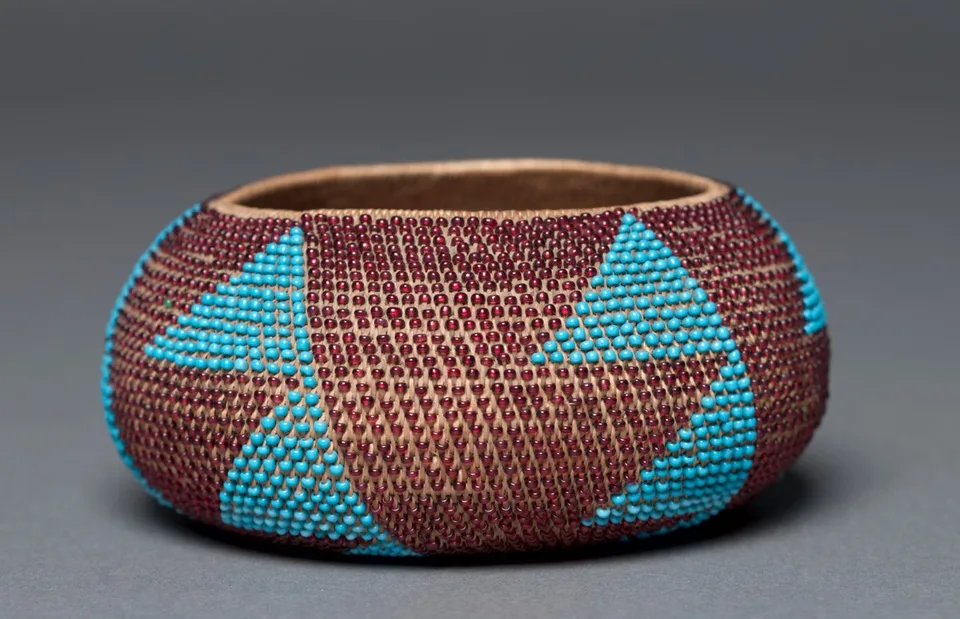 California, Wappo, late 19th- early 20th century · c. 1895
Maker unrecorded
willow, sedge, with beads; coiled (1 rod)
Hunter’s angular human figure steps through horizontal woven rows. The Wappo bowl’s turquoise triangles step through rows of beads. The large shapes emerge from repeated small units, although those units belong to different material processes.
A four-legged animal crosses Hunter’s pale lower coils. Dense red bead rows form the Wappo bowl’s field around turquoise motifs. In one, dark material draws recognizable creatures; in the other, colour blocks organize the outer covering.
Hunter’s close coils continue around the raised neck and beneath the imagery. The Wappo bowl’s plain rim exposes the basket under its beadwork. These details reveal woven structure directly, even when pattern initially attracts more attention.
Hunter’s animal imagery and the Wappo bowl’s possible spirit-door bead belong to distinct contexts. A shared stepped pattern does not establish a common symbolic language.
The comparison of visible choices is our own reading. Follow either artwork page for its full context, uncertainty note and image-rights record.
Five vessels carry basketry figures, faces, architecture and an animal body.