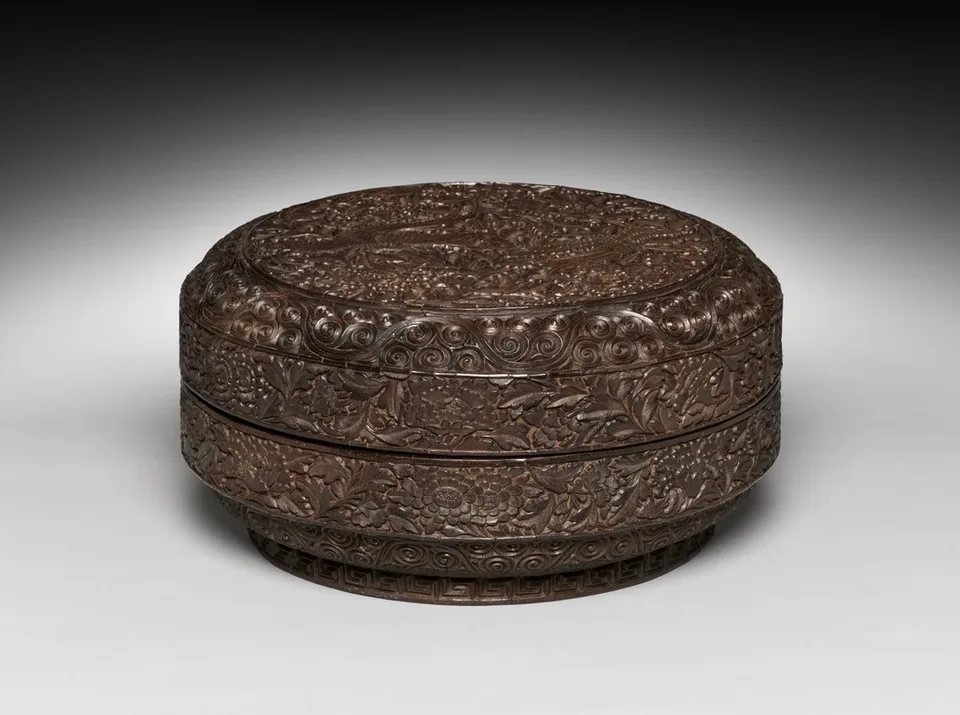
Carving turns a dark round box into layers of flowers and birds, with decoration continuing across the lid’s seam.
The narrow seam around the middle is the first useful landmark: it separates a container from its cover. Above and below it, carved leaves, blossoms and birds create a busy surface that seems to continue beyond the join. The rounded lid and low foot keep the densely worked object legible as a simple circular volume. Light catches the raised carving while the recesses remain dark.
The museum compares the box with a silver container bearing related birds and flowers, suggesting that successful designs moved between materials, workshops and regions. It also notes that Chinese lacquer was prized in exchanges with Japan, where this example was long preserved. These connections make the box more than an isolated decorative achievement, although they do not identify the individual carver or a particular original gift. Looking across the seam is a way to study design before reconstructing circulation.
The museum’s comparison suggests shared designs but does not identify a single workshop or route of transmission. The original contents and first owner are unrecorded.
Which visible feature best establishes how the object opens?
Practise looking at Round Box with Bird and Peonies Design →