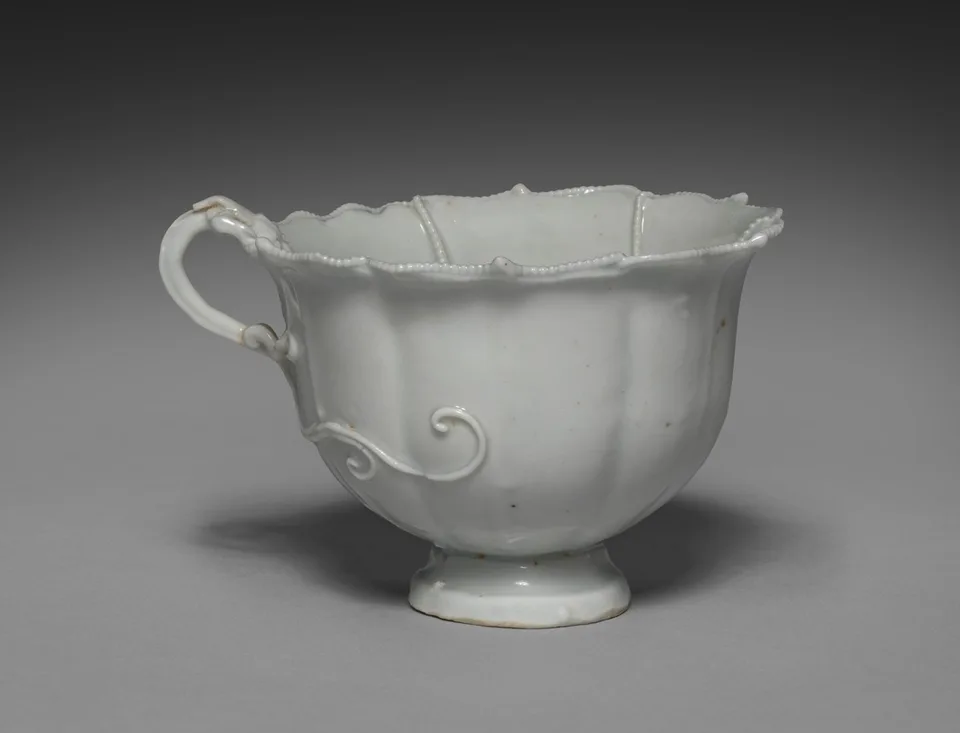
A delicate flower-shaped cup gains an unexpected companion: an archaic dragon that curls around its side as a handle.
At first the cup looks like a flower: its rim rises and falls in soft scallops, and beaded lines divide the interior into petal-like panels. Then the handle introduces a different kind of form. A dragon curves away from the wall before sending a thin raised curl across it. The creature is simultaneously something to grasp and an interruption of the otherwise botanical shape.
The museum connects the thin porcelain body with earlier silver cups made in floral forms. The dragon, meanwhile, recalls decoration on much older bronzes. This Yuan vessel brings those references together in one pale glaze, so the applied pieces blend with the body instead of announcing separate materials. Its historical interest lies partly in that mixture of new making and remembered forms. The photograph cannot demonstrate translucency directly, but it makes the shallow relief and delicate rim clear.
The links with earlier metal vessels are comparisons of form, not evidence that this cup copies one identified object. Its thinness is difficult to judge from a photograph.