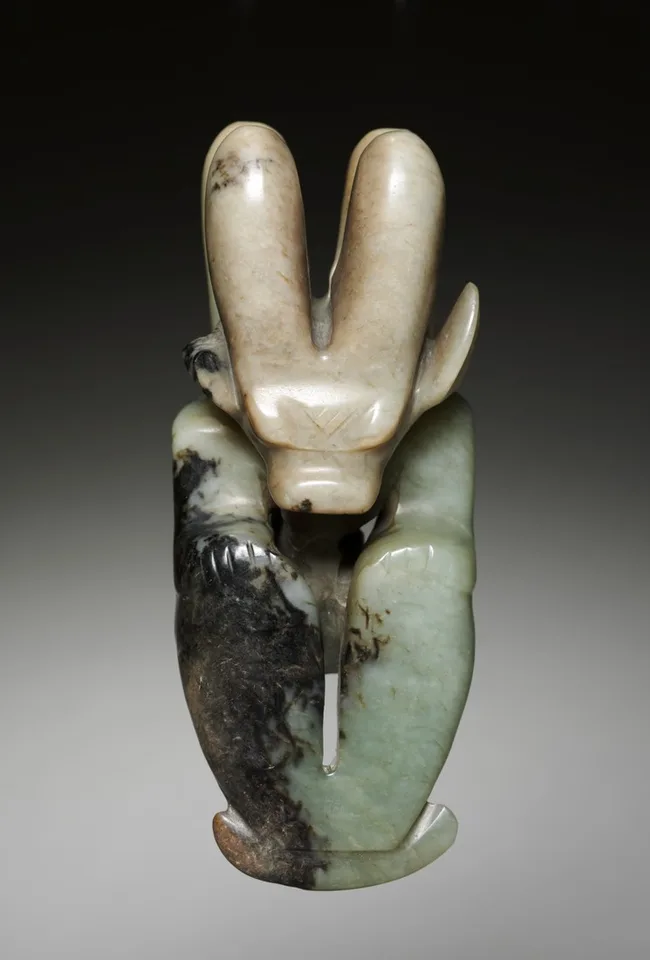
Four projections and a folded body make a tiny jade figure look powerful, even while its original meaning remains uncertain.
Begin with the opening between the folded limbs and the long paired projections above the head. The figure compresses an animal-like face and a seated body into a small, compact piece of jade. Changes from cream to green and almost black make the stone’s surface as noticeable as the carving. They are material features, not evidence for painted clothing or a particular character.
The museum places the object probably within the Hongshan culture of northeast China. That identification developed through comparison with archaeologically excavated jades after the museum acquired it. Connected holes above the shoulders suggest suspension as a pendant. A shamanic use is proposed in the museum interpretation, but neither the identity of a wearer nor a particular ceremony is preserved by this image. The strongest starting point is the object’s carved form and the practical evidence for hanging it.
The Hongshan attribution is probable, and the proposed shamanic use is an interpretation. The available record does not identify an excavated context or an original wearer.
Which claim has the clearest physical support in the museum record?
Practise looking at Amulet in the Form of a Seated Figure with Bovine Head →