Read the
Picture
An open collection
Japan, Kamakura period (1185–1333) · Sculpture

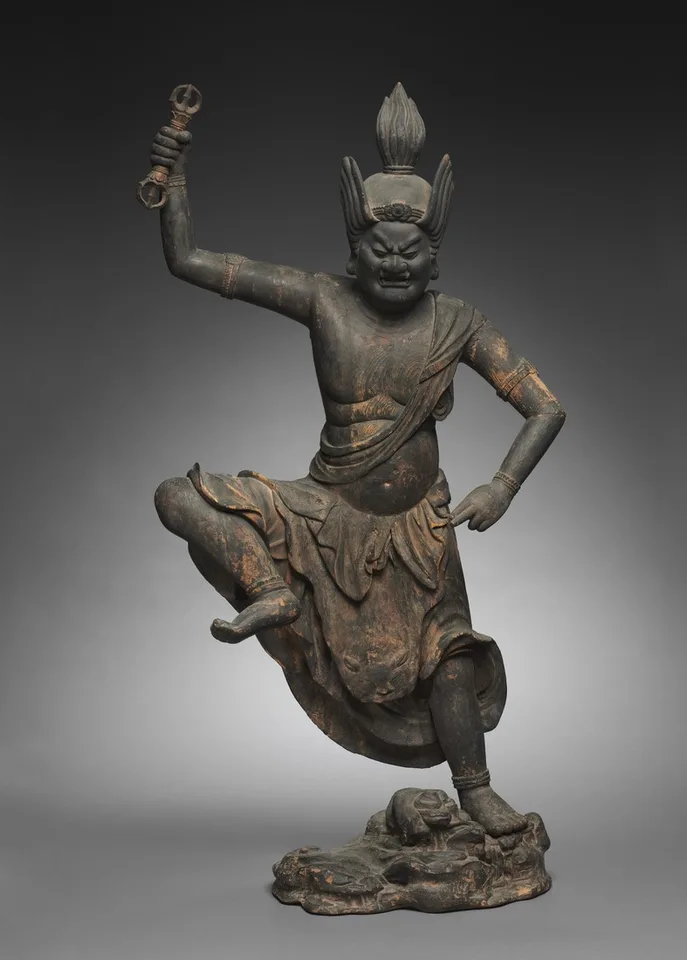
Zaō Gongen

Maker unrecorded · 1200s

A dark standing deity balances on one leg with the other knee raised sharply to the side. One arm holds an implement overhead, while the opposite hand rests near the hip. The face is fierce, the hair rises in a pointed tuft, and drapery and an animal pelt hang around the lower body.
100%

Drag to move · Pinch or +/− to zoom · Arrow keys to pan · 0 to reset

The Cleveland Museum of Art · 1973.105 · Image: CC0Museum image ↗
A little context

One raised leg and one lifted arm make this mountain guardian seem to gather force while balancing on a single foot.

The pose refuses the symmetry expected of a calmly standing figure. One knee lifts high, one arm reaches upward, and the remaining foot anchors the body to a rough base. The fierce face and upright hair intensify that gathering energy. Drapery moves around the bent leg, where the face of a large feline becomes part of the costume.

The museum identifies Zaō Gongen, the guardian of Mount Kinpu in Yoshino, south of Nara. In the tradition described by the record, he appears in response to En no Gyōja’s prayer for a powerful mountain protector. His identity combines manifestations associated with the past, present and future: Shakyamuni, Thousand-Armed Kannon and Miroku. The threatening appearance is therefore attached to a protective religious role, not evidence that the sculpture represents an ordinary angry person or a generic demon.

A careful reading

Zaō Gongen’s identity belongs to a particular mountain and religious tradition. A fierce face or raised weapon alone cannot distinguish him from every other protective deity.
Try your eye

What creates the strongest impression of active balance?

Where this reading begins

  • Zaō Gongen — collection record — The Cleveland Museum of Art. Supports dating, materials, attribution, provenance and the contextual reading; observations describe the individually inspected museum photograph. Museum record updated 2026-06-17; accessed 2026-11-14.

Our observations describe the supplied museum photograph. Historical identifications and context follow the cited collection record; interpretive limits are stated above. This is an independent guide, not a museum endorsement.

Image rights & attribution

Zaō Gongen (蔵王権現像), 1200s. Japan, Kamakura period (1185–1333). Wood; average: 106.7 cm (42 in.). The Cleveland Museum of Art, Purchase from the J. H. Wade Fund, 1973.105

Individual API record marked CC0; checked 2026-11-14. CC0 1.0 dedication. Record date: 2026-06-17 11:19:44.561000. Museum print JPEG downloaded unchanged and retained; complete overview resized and recompressed as JPEG; responsive WebP and zoom derivatives resized and recompressed; numbered annotation overlay separate from image.