Protection through a face
Powerful faces do not all mean the same thing. A prehistoric pendant, a tomb guardian, door hardware, a mountain deity and an architectural mask belong to different settings. Follow horns, limbs and attachments while distinguishing documented function from proposed ritual meaning.
Begin the journey ↓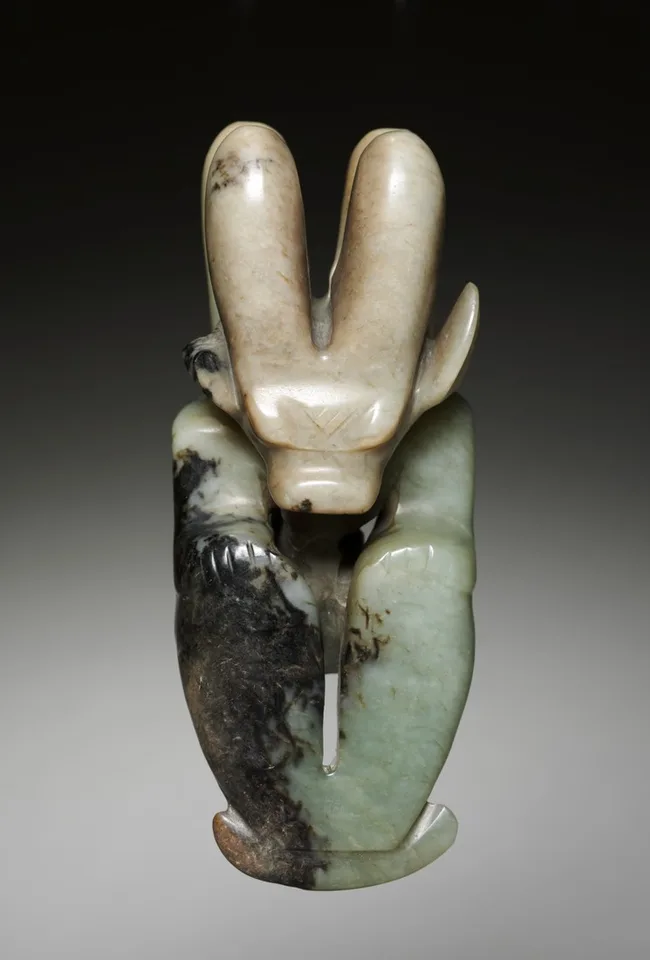
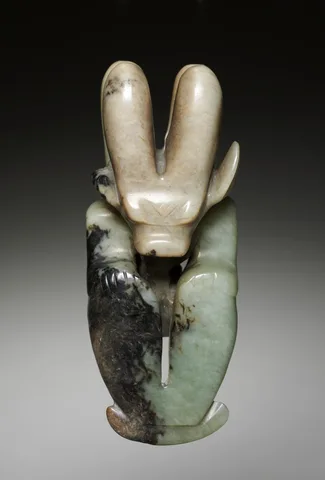
Keep ritual use provisional
The bovine-like head is visible, while suspension holes support use as a pendant. A particular shamanic wearer remains a proposal, showing why physical function and reconstructed religious meaning deserve different levels of certainty.
Carry this question: Which claim can you connect to a physical feature?
Open the artwork ↗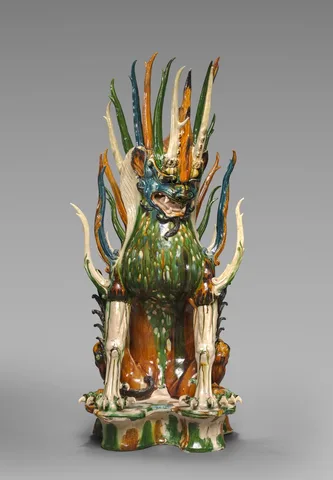
Extend the threatening outline
Spikes turn a seated ceramic body into a bristling silhouette. The museum places the figure within funerary protection and procession, where the object could address living spectators before entering a tomb.
Carry this question: How far beyond the body does its protective outline reach?
Open the artwork ↗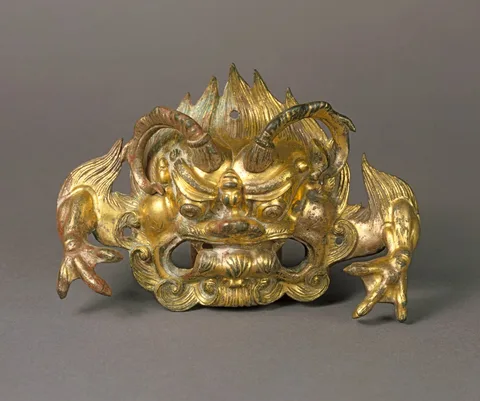
Meet a monster at the door
The missing ring once made this fierce mouth part of a usable knocker. Rivet holes anchor the image to a threshold, giving practical hardware and protective imagery a shared location.
Carry this question: How would touching the ring change the encounter with this face?
Open the artwork ↗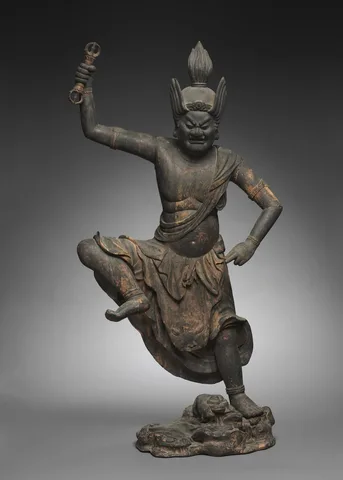
Identify a specific guardian
The raised knee and supporting foot gather force into an active balance. The museum identifies a protector of Mount Kinpu; fierceness alone would not supply that particular name or religious history.
Carry this question: Which parts of the reading require more than the visible pose?
Open the artwork ↗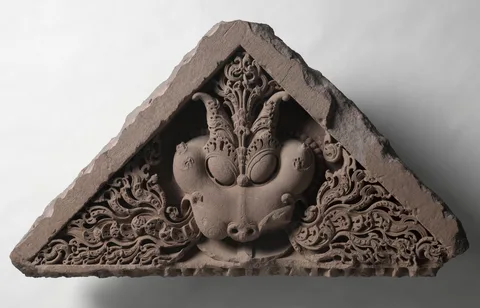
Let a mask address an entrance
The frontal face looks outward from an architectural frame. Its flowing vegetation belongs to a specific account of temple protection and abundance, rather than a universal dictionary of scary faces.
Carry this question: How does the triangular frame change where you imagine the face?
Open the artwork ↗Read with the sources
Historical context follows the individual museum records linked on each artwork page. These routes make original comparisons of visible form; resemblance alone is not evidence of shared meaning or direct influence.
- Amulet in the Form of a Seated Figure with Bovine Head — museum collection record
- Tomb Guardian with Animal Head — museum collection record
- Monster Face: Door Ring Holder (Pushou) — museum collection record
- Zaō Gongen — museum collection record
- Pediment with the Face of Glory (Kirti-mukha) — museum collection record