Read the
Picture
An open collection
Northern India · Sculpture

Pediment with the Face of Glory (Kirti-mukha)

Unknown sculptor · c. 1000s

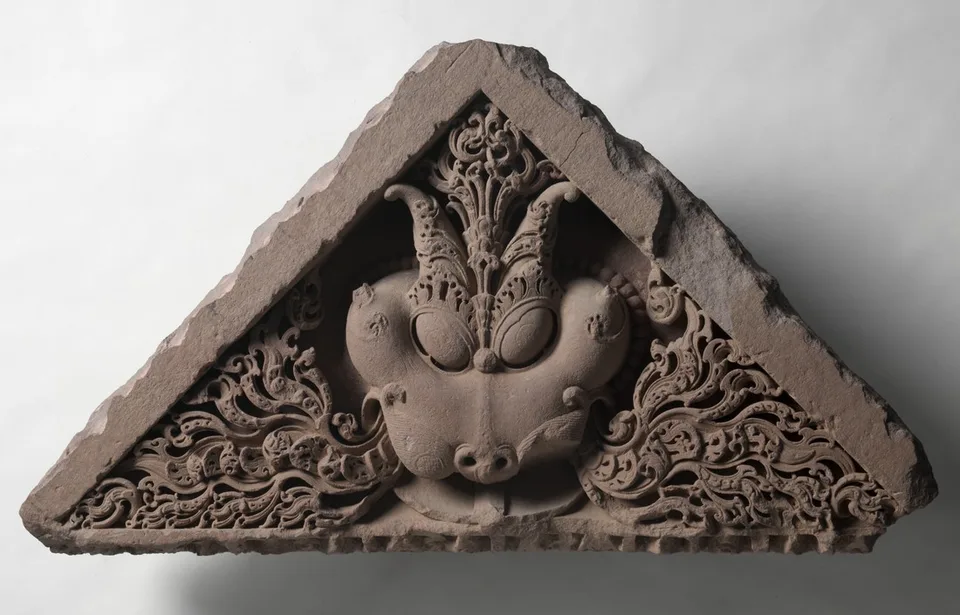
A triangular sandstone architectural piece encloses a large frontal face with rounded eyes, curling horns and a broad muzzle. Intricate leafy scrolls spread outward from the sides of the mouth to fill the lower corners. A narrow spray rises between the horns toward the apex. Deep recesses create shadows behind the carving, while the thick sloping edges are comparatively plain.
100%

Drag to move · Pinch or +/− to zoom · Arrow keys to pan · 0 to reset

The Cleveland Museum of Art · 1988.102 · Image: CC0Museum image ↗
A little context

Follow the curling foliage outward from the large face inside a triangular stone frame.

The face is simple enough to register immediately, but the surrounding vegetation asks for a much slower look. Leaves split into smaller curls and fill the triangular corners without becoming a flat, uniform pattern. Deeply cut spaces make shadows as important as the remaining stone. The thick sloping edges hold this activity within an architectural outline. The object therefore combines a strongly frontal encounter with details that lead the eye sideways and upward through the carving.

The museum identifies the face as kirti-mukha, the “face of glory,” and places the sandstone pediment in northern India around the eleventh century. Its explanation connects such protective images with temple entrances aligned with the sanctum. The vegetation issuing from the mouth expresses abundance associated with worship and devotion. This is the source’s account of a specific temple-image tradition, not a universal explanation for every horned face or floral scroll. Removed from a building, the pediment can still make its architectural purpose visible, but the photograph cannot restore its original height, surrounding sculptures or the approach of a worshipper.

A careful reading

The original temple and surrounding architectural programme are not supplied here. The museum’s explanation concerns this image tradition and should not be applied to every visually similar face.

Try your eye

What best reveals that this carving belonged to architecture?

Where this reading begins

  • Pediment with the Face of Glory (Kirti-mukha) — The Cleveland Museum of Art. Individual museum record supplies the qualified identification, material, date and historical context; observations refer to the inspected museum print photograph. Museum record updated 2026-05-29 07:57:24.526000; accessed 2026-11-14.

Our observations describe the supplied museum photograph. Historical identifications and context follow the cited collection record; interpretive limits are stated above. This is an independent guide, not a museum endorsement.

Image rights & attribution

Pediment with the Face of Glory (Kirti-mukha), c. 1000s. Northern India. Sandstone; overall: 50.8 x 94 cm (20 x 37 in.). The Cleveland Museum of Art, The Severance and Greta Millikin Purchase Fund, 1988.102

Individual API record marked CC0; checked 2026-11-14. CC0 1.0 dedication. Record date: 2026-05-29 07:57:24.526000. Complete museum print photograph resized and recompressed for local overview and WebP derivatives; numbered details are a separate overlay. No cropping or generated replacement.