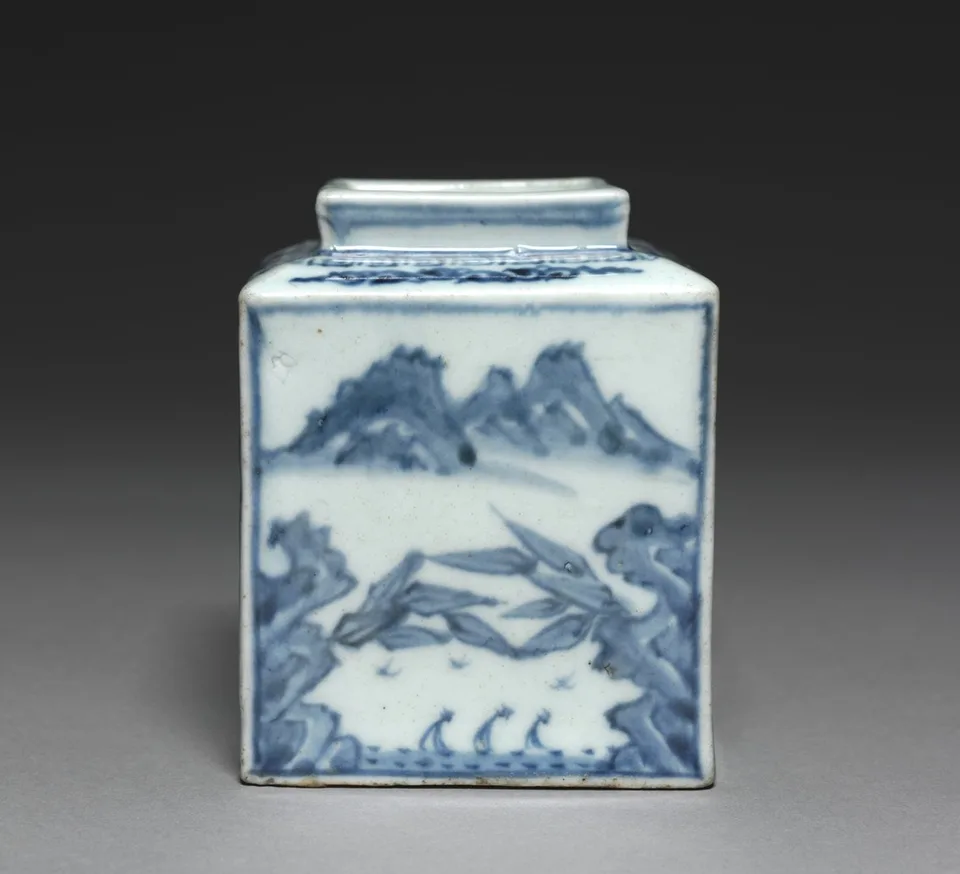
A square porcelain wall becomes a river view, making the bottle’s corners behave like the edges of a small painting.
The flat front gives the blue landscape something like the boundary of a painting. Mountains sit above a broad pale interval, while darker forms and curling waves gather lower down. The bottle’s corners make the edges unusually definite compared with decoration on a round jar. Its short neck and sloping shoulders then return the eye from landscape to container.
The museum identifies the scenery with the Han River through Seoul and places the bottle within a later Joseon interest in Korean places. It suggests that the vessel was a water dropper used when preparing ink, but keeps that function provisional. Each flat side was made separately and joined before firing. The object therefore brings together construction, landscape imagery and the equipment of cultivated activity. Its painted view should not be treated as a navigational chart, nor should the proposed use become a certainty merely because it suits the scene.
The water-dropper function is proposed rather than established. The blue landscape evokes the Han River, but its compressed scenery is not a reliable topographical map.
How does the bottle’s shape affect the landscape decoration?
Practise looking at Square-shaped Bottle with the Scenery of the Han River →