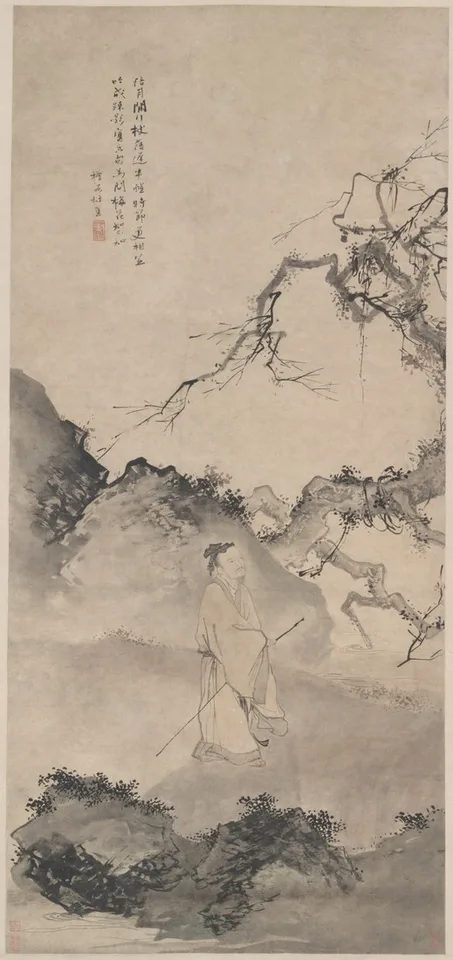
A poet’s small figure pauses under a sweeping plum branch, turning a famous literary attachment into a route for the eye.
Follow the long branch from the right edge into the open field, then look down for the small robed figure. The tree’s uneven strokes and dark knots give it an animated presence beside the quiet walker. Open space between branch and figure allows a pause within the otherwise narrow composition. The result is less a crowded garden than a carefully selected encounter with one tree.
Du Jin depicts Lin Bu, a Northern Song poet who lived by West Lake in Hangzhou centuries earlier. The museum connects the scene with Lin’s celebrated poem about plum blossoms and his reputation for treating plum trees and cranes as companions. This is an imaginative literary portrait, not an eyewitness likeness. The artist’s varied dots, strokes and washes make the surrounding landscape active, giving a remembered poet a setting that can be explored through looking as well as through biography.
Du Jin lived centuries after Lin Bu. The painting presents a literary image of the poet, and the photograph cannot verify a specific location or historical moment.
What makes this a literary portrait rather than an eyewitness record?
Practise looking at The Poet Lin Bu Wandering in the Moonlight →