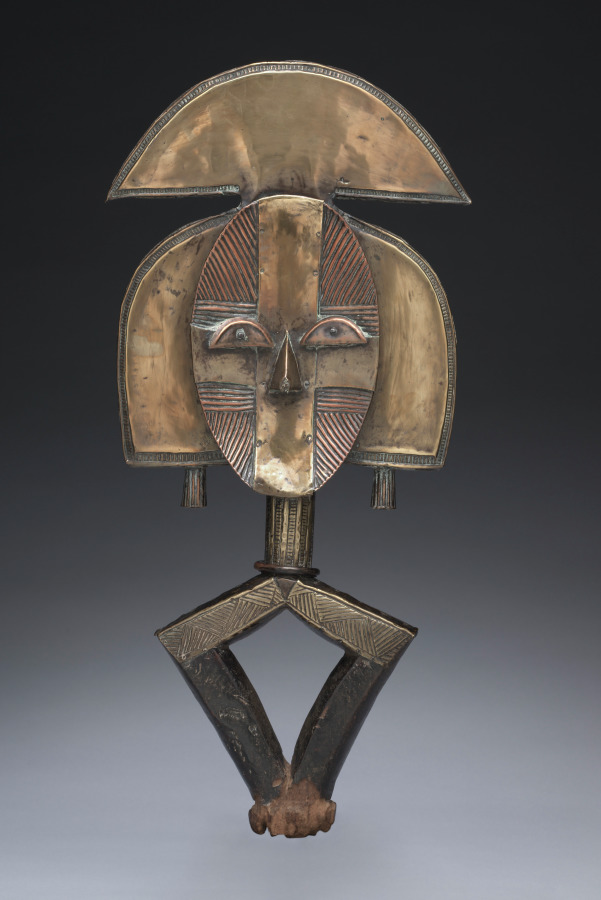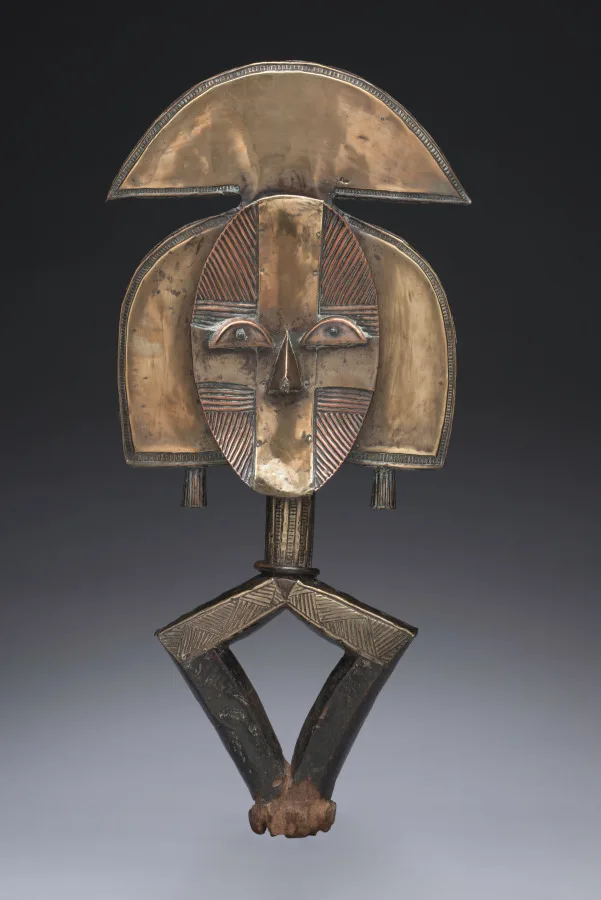
Reflective metal makes a flattened face luminous, while an open lower shape reveals how it once joined a container.
The face is broad and shallow rather than fully rounded. Metal sheets create a luminous surface, while narrow strips and incised areas divide it into sharply ordered zones. Below the neck, an open diamond shape replaces the fuller body we might expect from a human figure. That contrast is a clue to how the object functioned.
The museum identifies this as an element of a Kota-style reliquary ensemble. It stood above a container holding ancestral remains, with the lower section inserted into the container. Metal covered the parts meant to remain visible. Its brightness was understood to help protect and honor the ancestors and living family. The collected element is therefore not the complete original object. Reading it responsibly means recognizing both its striking design and the absent container, contents and setting. The broad Kota attribution refers to connected communities and traditions, not a simple map with fixed cultural borders.
The original container and ancestral remains are absent from this view. The museum's cultural account recognizes complex connected communities; it should not be simplified into a claim of one uniform tradition across Gabon.
What does the open lower section help explain?
Practise looking at Sculptural Element from a Reliquary Ensemble (mbulu ngulu) →