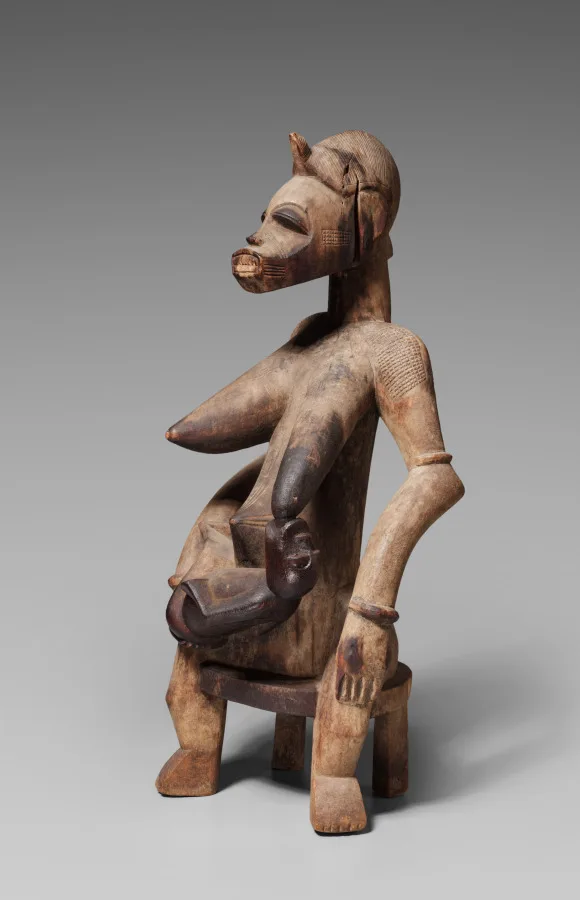
A small child and a mature woman's carefully marked face turn nursing into a larger image of transmission and care.
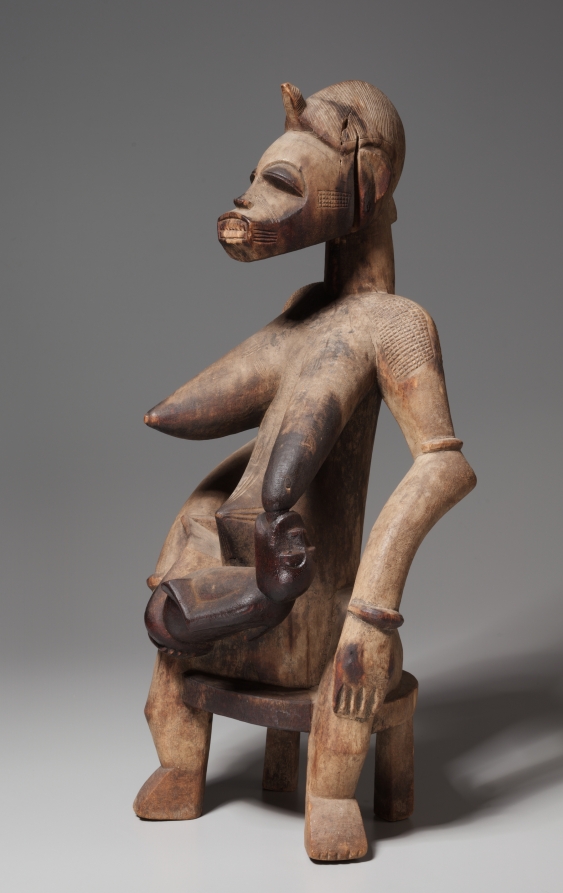
Follow the connection from the woman's breast to the small figure across her lap. The child is simplified, while the adult's face, body and adornment receive more elaborate carving. This difference in treatment creates a relationship rather than two equivalent portraits. The stool and downward arm make the seated body feel structurally stable.
The museum relates the work to Senufo ideas of ancestral motherhood and, in some communities, a Great Mother who nourishes initiates with knowledge. Within that interpretation, the child's less developed form can refer to an initiate's unfinished state. This account should not be generalized to every nursing image or every Senufo community. The darkened surface also has a history: oils applied as offerings and protectants changed the wood's appearance. The sculpture joins bodily care, inherited knowledge and accumulated handling, none of which can be reduced to the identification of a mother and baby alone.
The Great Mother interpretation belongs to particular Senufo beliefs described by the museum. The reported Korhogo origin is qualified, and the simplified child should not be treated as a securely identified historical person.