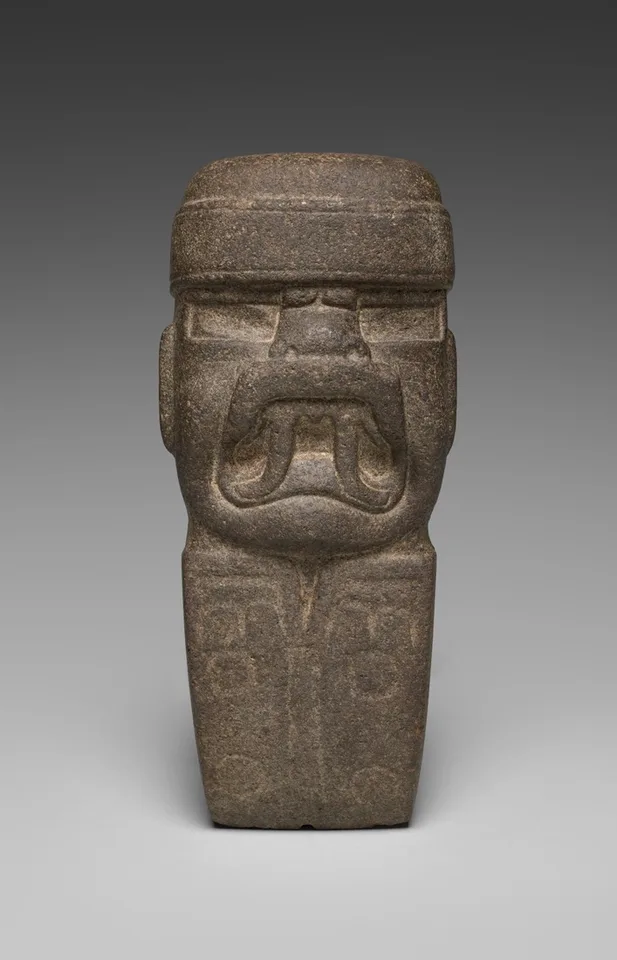
A supernatural face occupies the top of an axe-shaped stone, while a quieter body motif hints at connections that remain incompletely understood.
The museum describes this ceremonial object as a deity’s head joined to a body shaped like a celt, the axe blade used for agricultural clearing. Its mouth combines toothless gums with fangs, features associated with Olmec supernatural beings. The object’s form therefore connects an extraordinary face with the shape of an important tool, without requiring it to have functioned as an ordinary axe.
The mouth is the strongest feature: its flaring outline and descending fangs occupy much of the lower face. Beneath the head, the broad blade-shaped body becomes quieter, carrying a motif described as four dots and a bar. The museum notes that related motifs sometimes occur in plant imagery and proposes a fertility connection, but acknowledges that the sign's meaning is unclear. The dark, granular stone makes these shallow lower details less immediately conspicuous than the face. Moving attention downward is a useful way to keep the proposed agricultural association from becoming a certainty.
The four-dots-and-a-bar motif is not securely understood, and the fertility association is proposed. A ceremonial axe-like shape does not prove that this object was used to clear land.