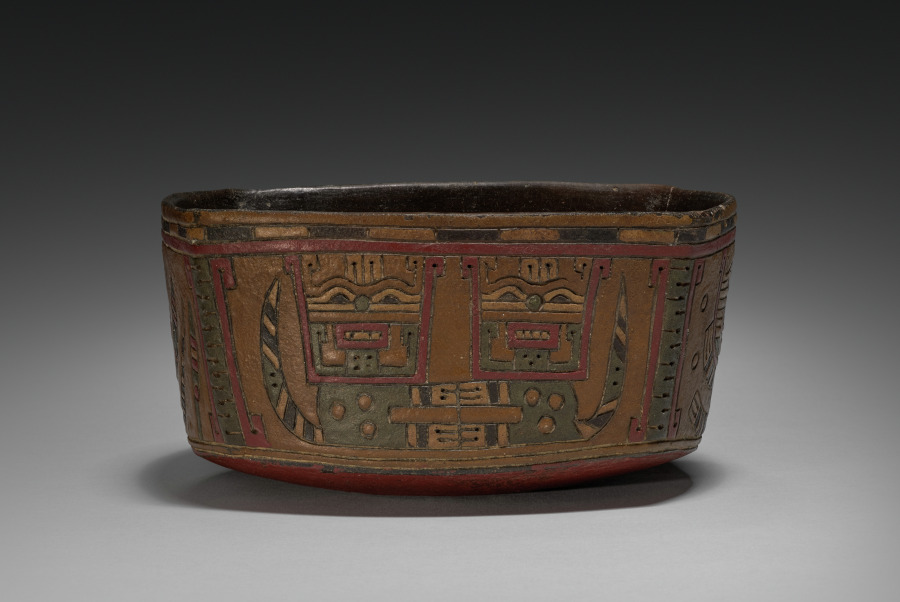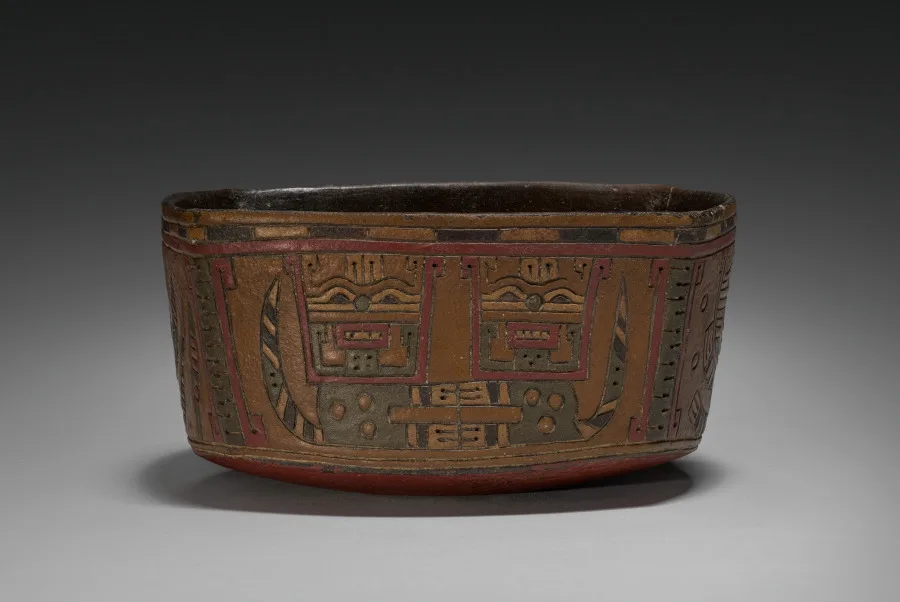
Square faces and curling bodies transform small wild cats into a repeating design fitted to a bowl with rounded corners.
The paired faces are easy to miss if we expect cats to be drawn with naturalistic profiles. Rectangular heads, patterned eyes and compact mouths sit within a design of curved striped forms and small repeated marks. The bowl's broad side gives the figures a shared field, while rounded corners carry the design toward surfaces hidden from this angle.
The museum identifies Pampas cats, small wild felines living around the margins of agricultural land. It proposes that their role in controlling pests contributed to associations with fertility and continuity. That interpretation should remain a proposal rather than an automatic translation of every cat motif. The object also introduces a particular making sequence: its paint was applied after firing. Surface wear therefore belongs to the history of a painted ceramic object, not simply to its original pattern. The work shows how geometric simplification can remain observant of animal identity while adapting it to an organized vessel surface.
The fertility interpretation is inferred from the cat's ecological role and cultural context. The post-firing paint is worn, and this view does not show all sides of the bowl or the complete repeated design.