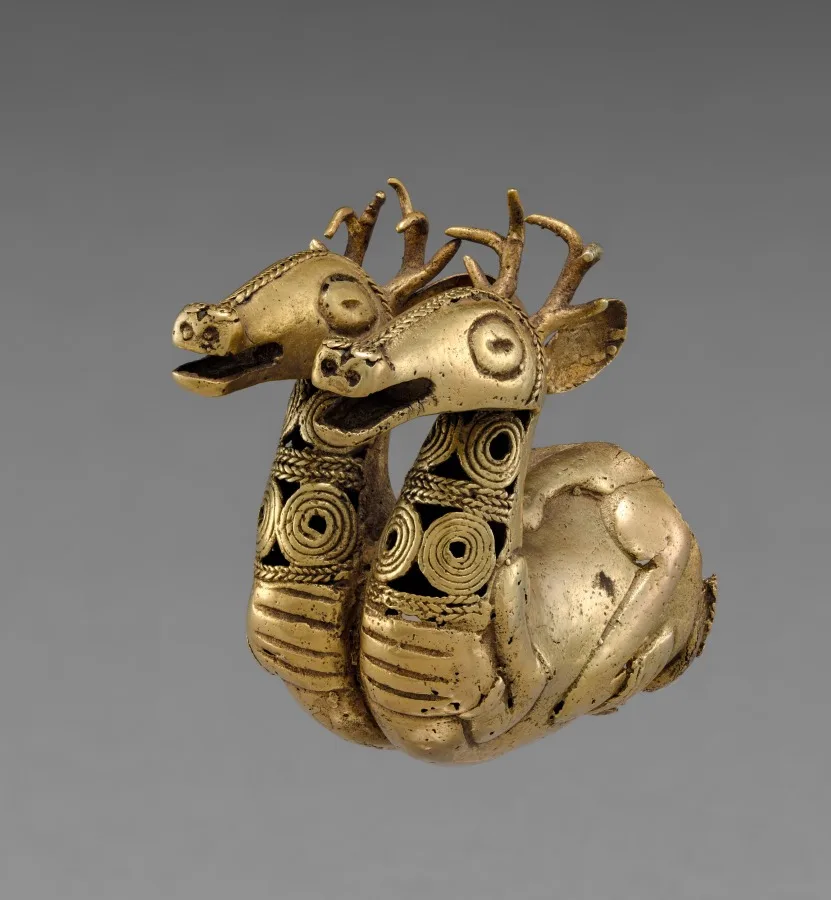
Two antlered heads rise above spiral-patterned chests, combining deer traits and human-like hands on a small cast finial.
The paired heads are immediately striking, but the hands change the reading. Deer-like antlers and mouths combine with gestures that look human, while spirals cover the upright chests. The figure is not a simple record of two animals in nature. Its compact arrangement gathers several kinds of form into a small object meant to join something larger.
The museum identifies a Sinú or Zenú staff finial made by lost-wax casting. Such finials fit over staff ends and may have been held horizontally, making the sculptural orientation significant. It remains unclear whether this image represents two deer or one two-headed being. The museum also notes that Sinú animal imagery is insufficiently studied for confident detailed interpretation. That uncertainty should shape our account. We can closely describe antlers, openwork spirals and hands without assigning a fully reconstructed cosmology to them or treating later beliefs as an automatic explanation of this earlier object.
Two deer and a single two-headed being remain alternatives. Staff orientation is proposed, and the museum describes this animal imagery as understudied; a precise cosmic meaning should not be invented.