Animal forms in four settings
A face can follow a curved stone band; deer can combine with human-like hands; a vessel can turn a supernatural head upside down in use. These examples do not express one universal animal symbolism. They offer four distinct ways to observe how a material and an object’s shape guide the representation of a living or composite being.
Begin the journey ↓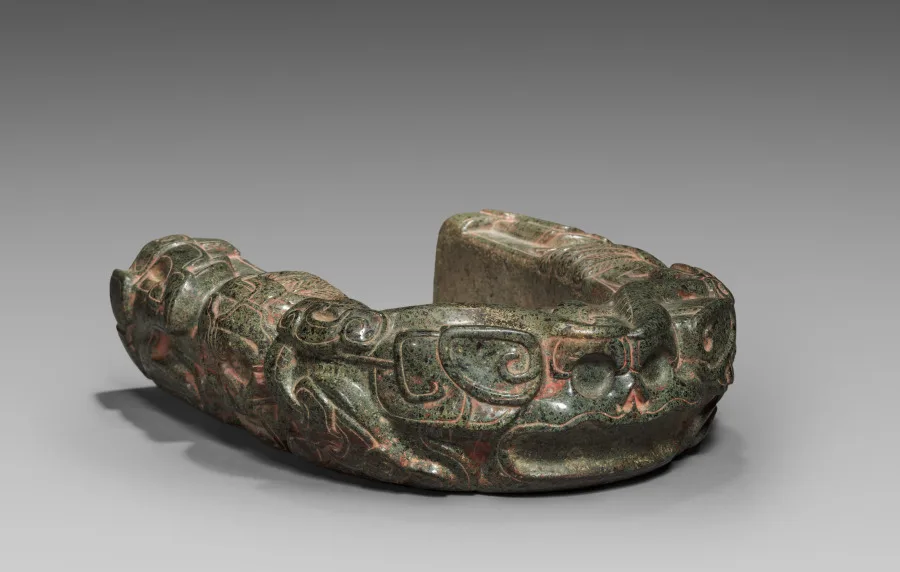
A face follows a protective shape
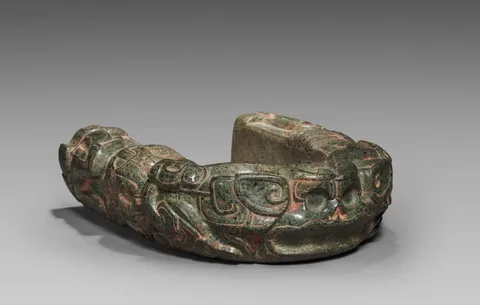
The broad face occupies the outer curve of the U-shaped stone yoke. The museum links its imagery with death and the ballgame’s larger themes. The stone version imitates protective equipment, but should not be assumed to have been ordinary gear worn during strenuous play.
Carry this question: How does the curve become part of the represented face?
Open the artwork ↗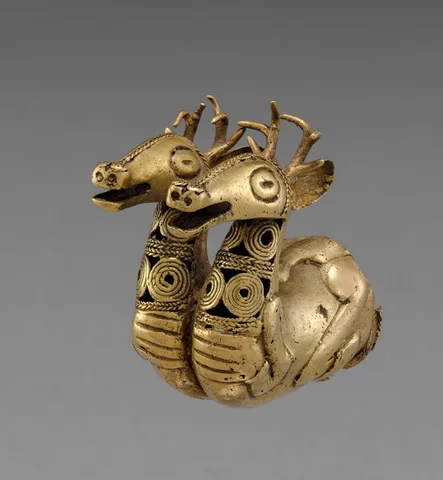
Animal heads above human-like hands
Two deer heads rise from an elaborate cast structure. Below, hand-like forms and spirals complicate a naturalistic reading. The museum leaves open whether this represents two deer or one two-headed being, and acknowledges the limits of present knowledge about its cosmological meaning.
Carry this question: Which details make this more than a straightforward pair of natural animals?
Open the artwork ↗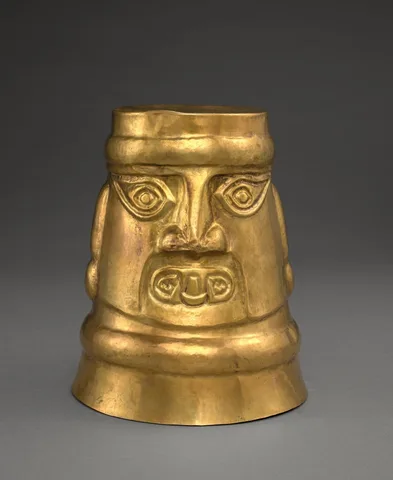
A head changed by turning the vessel
The face appears upright in the museum photograph because the beaker rests on its rim. Turning it for use would invert the head. The museum considers a deity or deified dynastic founder, but neither the specific identity nor the reason for inversion is settled.
Carry this question: Imagine rotating the object: what happens to the relationship between mouth, eyes and vessel opening?
Open the artwork ↗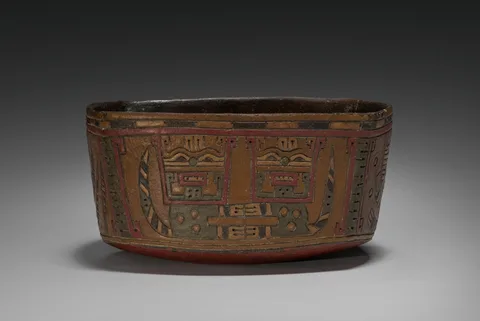
Feline faces organised into a band
Repeated geometric faces cross the vessel, with angular eyes, mouths and surrounding curves. The museum identifies pampas cats and discusses their possible relationship with fertility. The painted forms are visible evidence; their broader ecological and religious associations require the contextual interpretation.
Carry this question: How does repetition turn separate animal faces into a continuous surface pattern?
Open the artwork ↗Look at a pair more closely
- Cups and changing orientation
A colonial Inka kero and a Lambayeque beaker connect images with use.
Read with the sources
Historical context follows the individual museum records linked on each artwork page. These routes make original comparisons of visible form; resemblance alone is not evidence of shared meaning or direct influence.