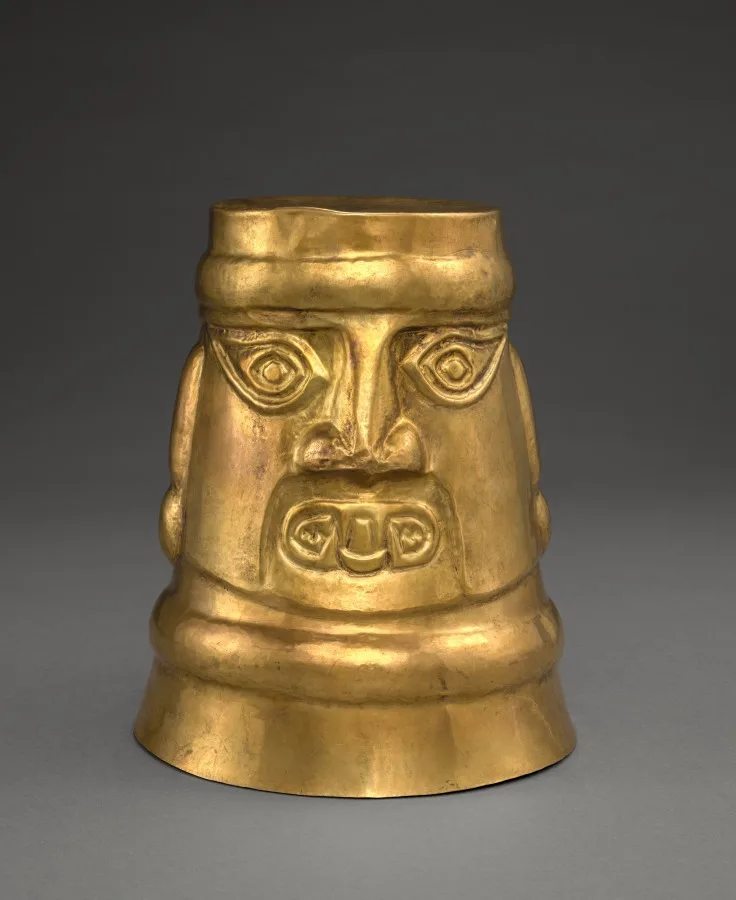
The face looks upright only when the beaker rests on its rim, turning the simple act of orienting a cup into a question.
The eyes and mouth encourage us to accept this as the correct orientation. Yet the museum explains that the face is upright only when the beaker rests on its rim. An object made to contain liquid can therefore present its image differently during use and when inverted. Display position is part of the problem, not a neutral detail outside it.
The vessel comes from the Lambayeque or Sicán tradition of Peru's north coast, where metalworking produced substantial containers as well as ornaments. Its gold was hammered into shape, and the face has been interpreted as either a principal deity or a deified dynastic founder. Feline-like fangs support a supernatural reading, but do not settle the choice. The reason for the inverted face remains unknown. We can describe relief features, vessel shape and material confidently while leaving that design decision as an open historical question rather than inventing a ritual explanation.
The figure's identity and the reason for its inverted orientation remain uncertain. The current display makes the face upright but should not be assumed to show the vessel's orientation while holding liquid.