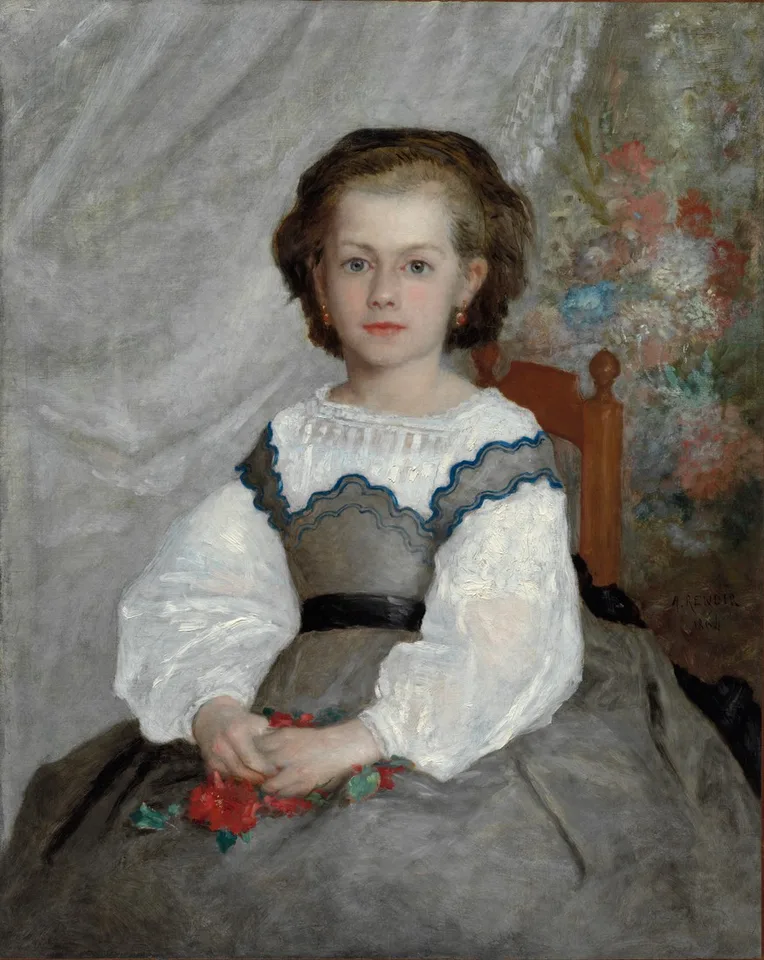
White sleeves hold many colors in a portrait that turns a child’s formal clothing into a study of reflected light.
Romaine sits very still, her hands gathered low over a small cluster of red flowers. The dark sash establishes a clear waist, while the blouse spreads outward in rounded white sleeves. Yet those sleeves are not simply white: cool gray and warmer touches describe folds and the light passing across them. Their movement of color offsets the steadiness of the pose.
Renoir painted this commissioned portrait for the vacationing Lacaux family while staying at Barbizon in 1864. The museum suggests it may be his earliest signed canvas and relates the delicate coloring of the face to his previous work decorating porcelain. That connection concerns a practiced sensitivity to small tonal changes, not a claim that the sitter resembles a decorative object. Comparing the face, blouse, and curtains reveals how he adjusts the same patient attention to skin, translucent fabric, and the softer setting behind the child.
The portrait presents a commissioned, posed likeness. Its calm expression cannot establish Romaine’s temperament, and the claim that this is Renoir’s earliest signed canvas remains qualified.