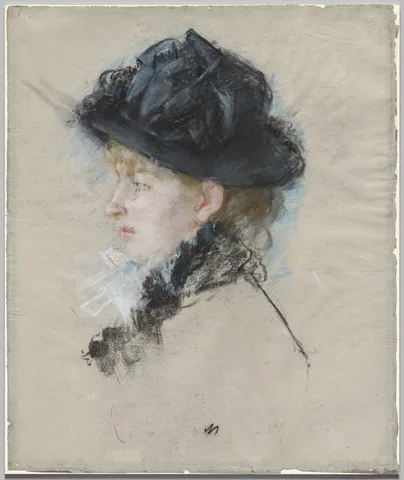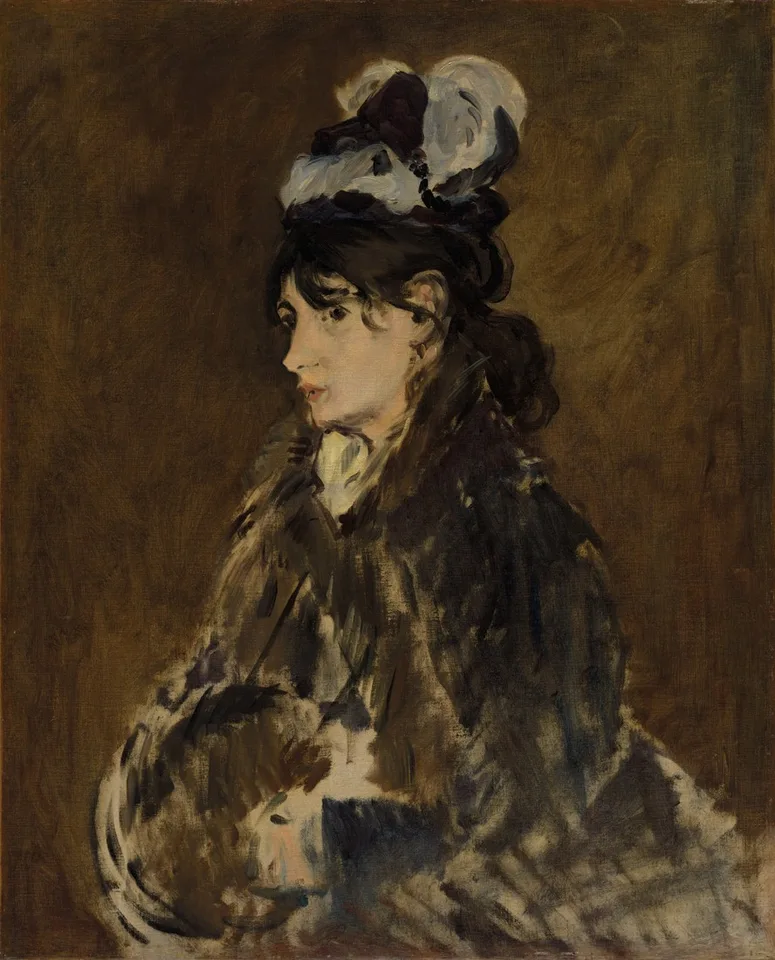
Winter clothing nearly surrounds Morisot’s face, but the lively strokes may also point toward her identity as a painter.
The face occupies a small pale opening within a mass of dark clothing. A white feather curls above it, and the muff makes a rounded shape below. Broad marks run across the coat without becoming a meticulous inventory of seams and fur. These differences in handling concentrate attention while allowing the lower body to remain partly unresolved.
The sitter is Berthe Morisot, an important painter in her own right and a close colleague of Manet. This is one of two portraits he made of her in winter dress. The museum proposes that the broad strokes and crosshatching evoke her own painting, offering a possible acknowledgment of her profession without showing brushes or a palette. That is a persuasive comparison rather than a documented statement of Manet’s intention. Follow the transition from the relatively distinct profile to the freer clothing and consider how technique can contribute to a portrait’s account of its sitter.
The suggestion that Manet’s brushwork acknowledges Morisot’s art is an interpretation in the museum record. The picture does not independently disclose their private feelings or conversation.