Read the
Picture
An open collection
Netherlands · Painting

Portrait of a Woman

Gerard ter Borch (Dutch, 1617–1681) · c. 1665

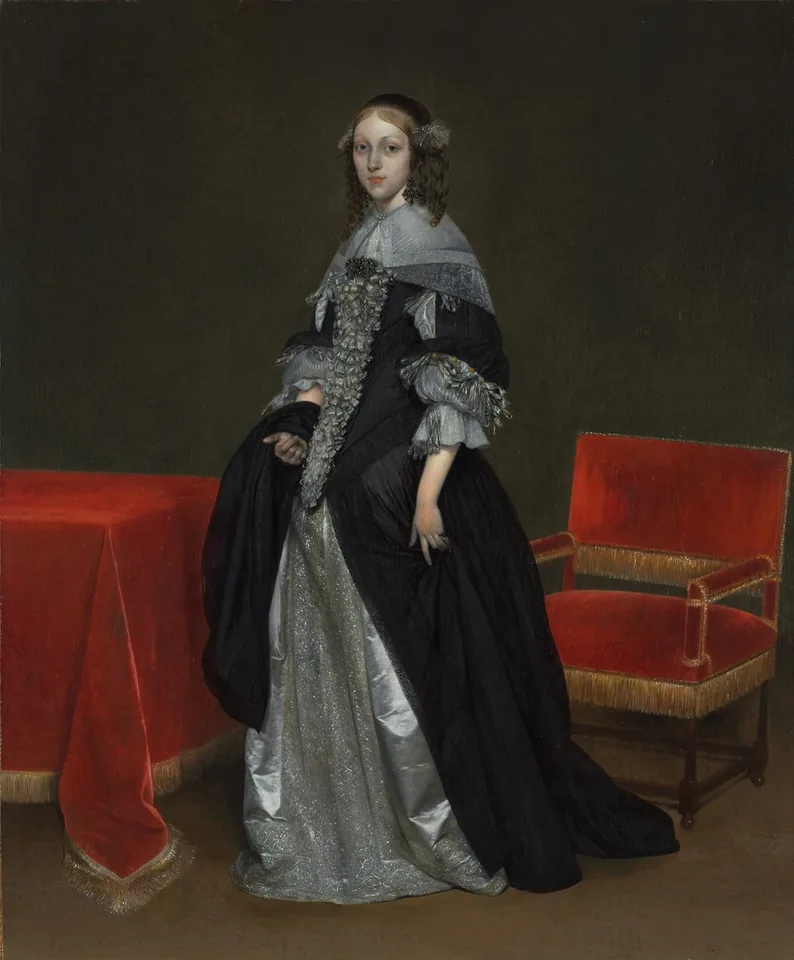
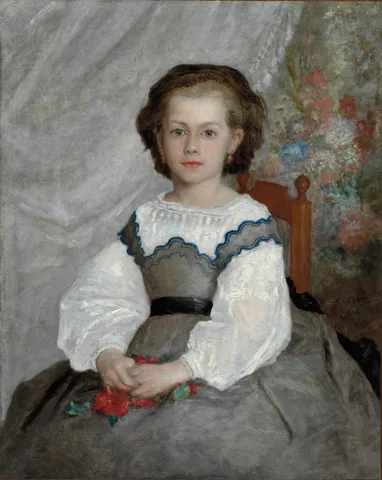
A woman stands in an empty brown room between a red-covered table and a red upholstered chair. Her black outer dress opens to reveal a long silver-white satin skirt. Lace, ribbons, and jewelry decorate her bodice and sleeves. One hand gathers the dark fabric, while the other hangs at her side.
100%

Drag to move · Pinch or +/− to zoom · Arrow keys to pan · 0 to reset

The Cleveland Museum of Art · 1944.93 · Image: CC0Museum image ↗
A little context

The room withdraws so that black silk, white satin, and small knots of ribbon can become the portrait’s principal setting.

The sitter stands between two red furnishings, but neither competes with the bright satin emerging from her black dress. Pale folds widen toward the floor, their highlights changing sharply beside darker creases. Smaller ribbons and lace gather around the bodice and sleeves. The sparse brown background makes these differences of material unusually easy to compare.

Ter Borch was renowned for rendering satin’s luster. The museum describes fine strokes and selective wiping of paint used to create the fabric’s shine. Those physical actions of painting produce the illusion of a different physical surface: woven cloth catching light. The woman’s identity is unknown, though her elaborate costume presents her as part of the wealthy Dutch elite. Her reserved pose and bare setting should not make the portrait seem socially neutral. Much of its account of status has been transferred from architecture and attendants into dress itself.

The museum tentatively connects the painting’s later ownership with Jan Jacob Faesch, whose wealth came chiefly from the sugar and coffee trade and who owned estates in Surinam. This qualified provenance links the object to a later colonial commercial history; it does not identify the seventeenth-century sitter.

A careful reading

The sitter is unidentified. Her costly costume supports a reading of elite status, but neither her reserved pose nor the spare room establishes her personality or everyday surroundings.
Try your eye

Why is the plain background useful to the portrait?

Where this reading begins

  • Portrait of a Woman — collection record — The Cleveland Museum of Art. Documents unidentified elite sitter, satin made through fine application and wiping, spare setting; tentatively identifies later owner Faesch and his sugar/coffee trade and Surinam estates. 2026-05-29; accessed 2026-11-16.

Our observations describe the supplied museum photograph. Historical identifications and context follow the cited collection record; interpretive limits are stated above. This is an independent guide, not a museum endorsement.

Image rights & attribution

Portrait of a Woman, c. 1665. Gerard ter Borch (Dutch, 1617–1681). Oil on canvas; framed: 87.5 x 77 x 7 cm (34 7/16 x 30 5/16 x 2 3/4 in.); unframed: 63.3 x 52.7 cm (24 15/16 x 20 3/4 in.). The Cleveland Museum of Art, The Elisabeth Severance Prentiss Collection, 1944.93

Individual API record marked CC0; checked 2026-11-14. CC0 1.0 dedication. Record date: 2026-05-29 06:23:56.446000. Museum print JPEG retained unchanged as original. Overview JPEG and responsive WebP and zoom derivatives resized and recompressed from that same complete print photograph; numbered annotation overlay separate from image.