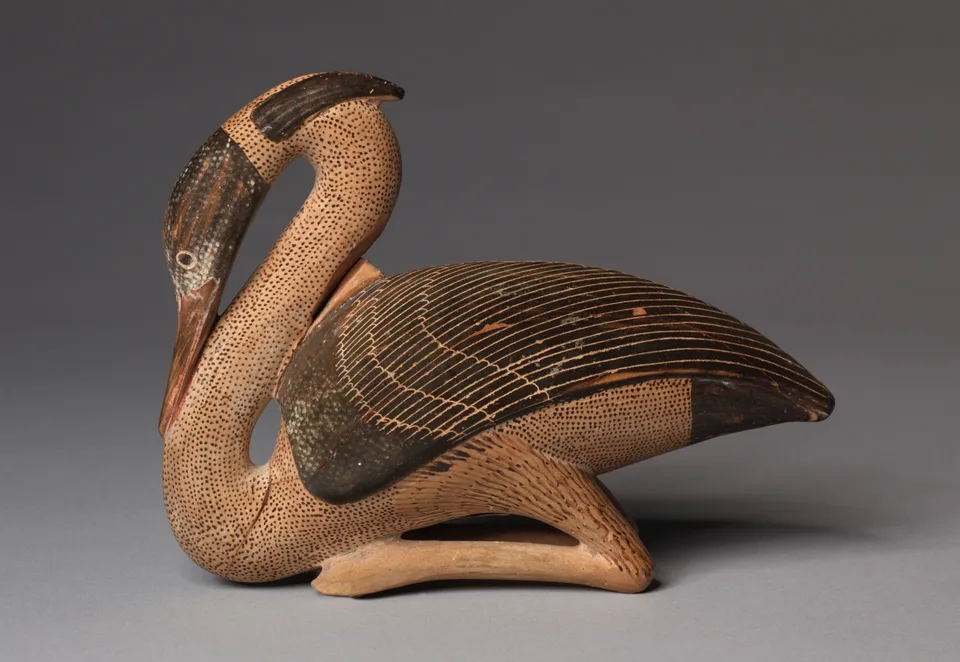
 East Greek, probably Milesian · c. 580 BCE
Heron-Shaped Figure Vase (Oil Vessel)
assigned to Robertson's Group
ceramic
Both small ceramic vessels turn a bird-like body into a container. One depicts a heron with its long neck folded back; the other joins a human head to a bird to form a siren. Compare how recognizable imagery works alongside the practical requirements of containment and handling.
East Greek, probably Milesian · c. 580 BCEassigned to Robertson's Group
ceramic
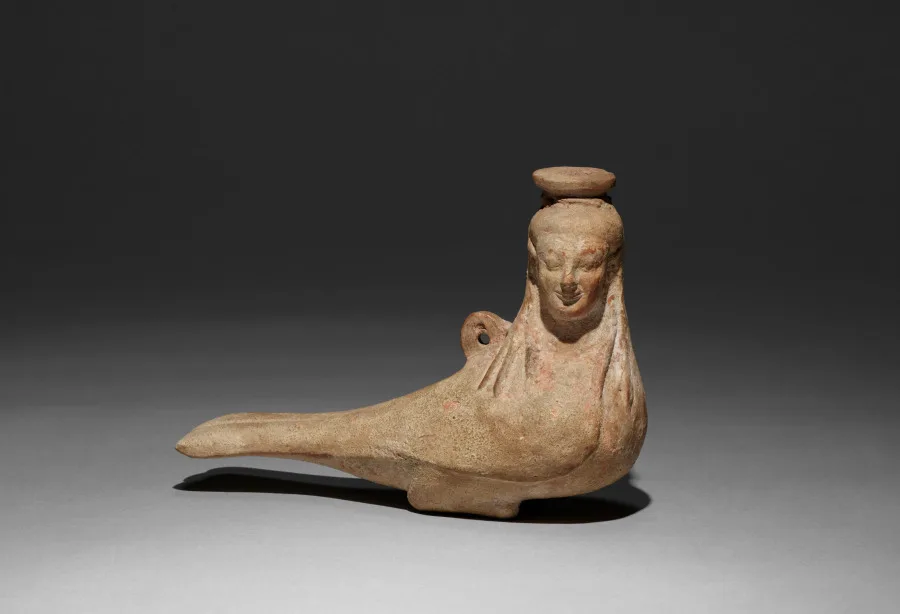 Greece · 600–480 BCE
Maker unrecorded
terracotta
The heron’s long neck folds close to its body, keeping the silhouette compact. The siren’s human face rises directly from a rounded bird body. Both reshape a familiar bodily outline, but only the siren explicitly combines human and bird forms within a mythic creature.
Fine incisions divide the heron’s dark wing into feather sections. On the siren, the projecting rim above the head makes the flask’s opening conspicuous. These details direct attention to different operations: articulating a depicted body and providing access to a container.
Dense dots distinguish the heron’s pale neck and body from its dark wing. The siren’s pierced loop provides evidence for a string used in hanging or retaining a stopper. Decorative marks and attachment hardware are both worth inspecting, but they answer different questions.
The museum identifies the heron as an oil vessel and suggests perfume for the siren. Those functions do not establish the exact original contents or users of either surviving example.
The comparison of visible choices is our own reading. Follow either artwork page for its full context, uncertainty note and image-rights record.
Six Mediterranean objects turn attention toward use and attachment.