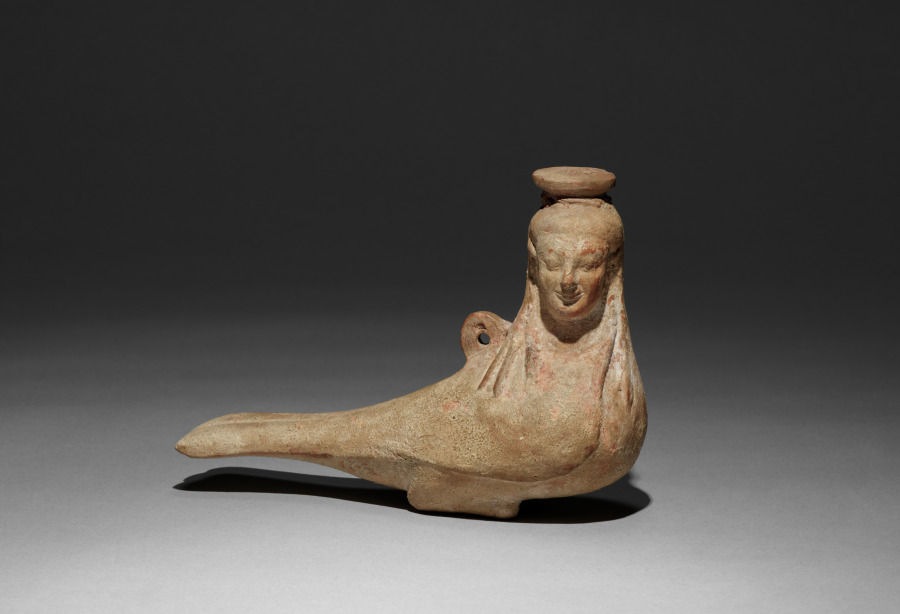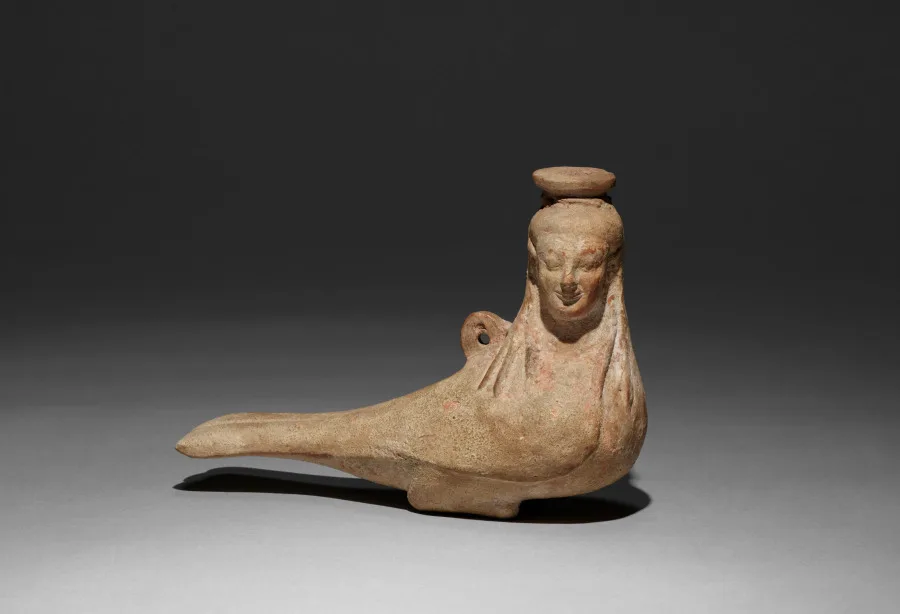
A woman's head rises from a bird's body, while a tiny opening above it reveals that this siren also held liquid.
The human head and bird body meet without pretending to be ordinary anatomy. Hair descends toward the breast, wings remain close to the sides, and the long tail stretches the container horizontally. A small opening above the head supplies another kind of information: this hybrid creature was also a flask, not simply a modeled mythical figure.
The museum identifies a siren, a being associated in Greek narrative with song that could endanger sailors. It suggests that the vessel held valuable perfumed oil. A narrow mouth limited spilling, while loops at the back could take a string for suspension or securing a stopper. These practical features help explain the object's form independently of the myth. The photograph does not identify an original owner, exact perfume or particular scene from the Odyssey. Looking at the mouth and loop prevents a familiar literary story from overwhelming the quieter evidence of how the object worked.
Perfumed oil is a likely content, not a residue identified in the cited description. The vessel represents a siren type but does not illustrate a securely identifiable moment in a particular surviving text.