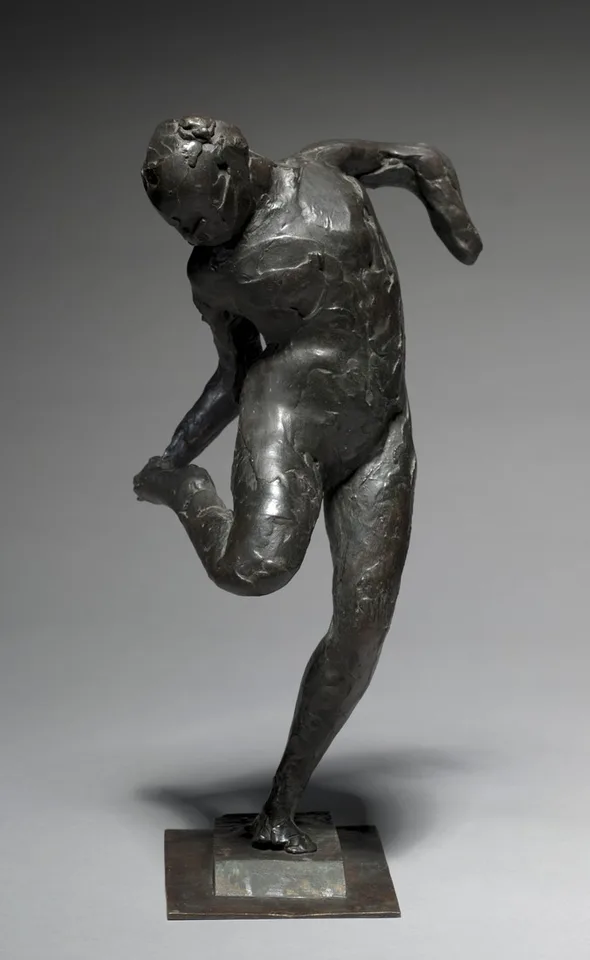
 France · 1896–97
Dancer Looking at the Sole of her Right Foot
Edgar Degas (French, 1834–1917)
bronze
These bronzes preserve bodies arranged around raised arms and shifting balance, but their casting histories differ. Compare practical action with open gesture while keeping the date of a model separate from the date of a particular bronze.
France · 1896–97Edgar Degas (French, 1834–1917)
bronze
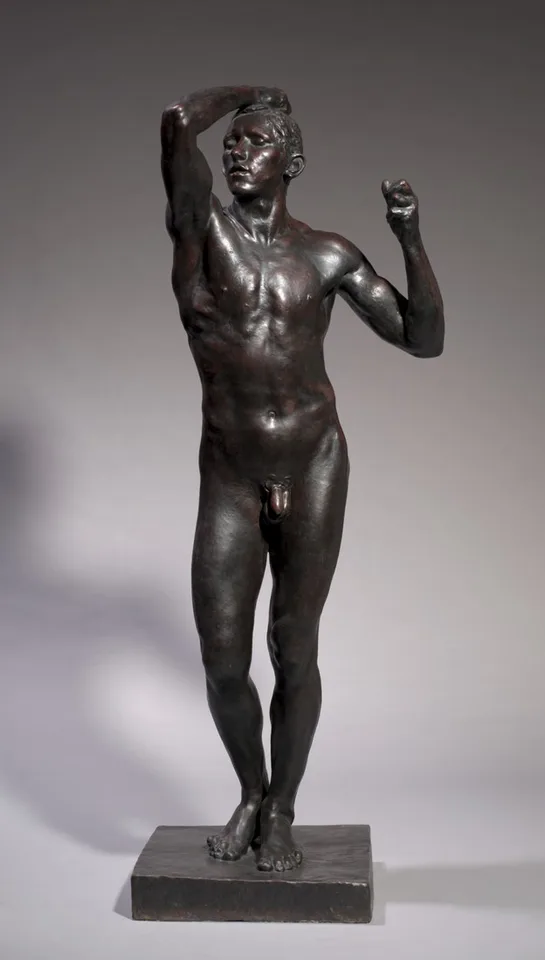 France · 1875–76
Auguste Rodin (French, 1840–1917)
bronze
Degas’s dancer grasps her raised foot, making the hand’s purpose concrete. Rodin’s lifted hand is empty because a spear was removed from the conception. One action is specified by bodily contact; the other becomes more open through subtraction.
The dancer’s long supporting leg balances a tightly gathered bent limb. Rodin distributes weight through a subtler difference between his two legs. Both figures suggest bodily responsiveness while the metal fixes their selected arrangements.
Finger marks remain conspicuous on the dancer’s torso, preserving the wax model’s handling in a posthumous cast. Rodin’s modeled body and raised arm appear in a 1916 bronze he supervised. Similar metal does not mean identical relations between maker, model, and casting.
Degas’s bronze was cast after his death; Rodin supervised this later cast of an earlier model. The photographs also supply different single viewpoints of sculptures intended for fuller viewing.
The comparison of visible choices is our own reading. Follow either artwork page for its full context, uncertainty note and image-rights record.
Balance, restraint, informality, and a turn through space.