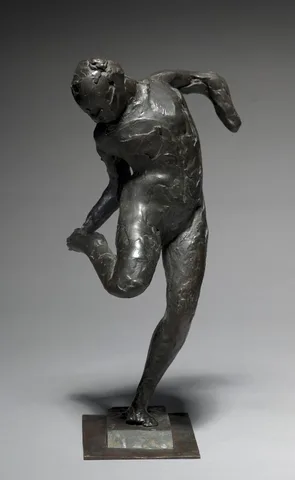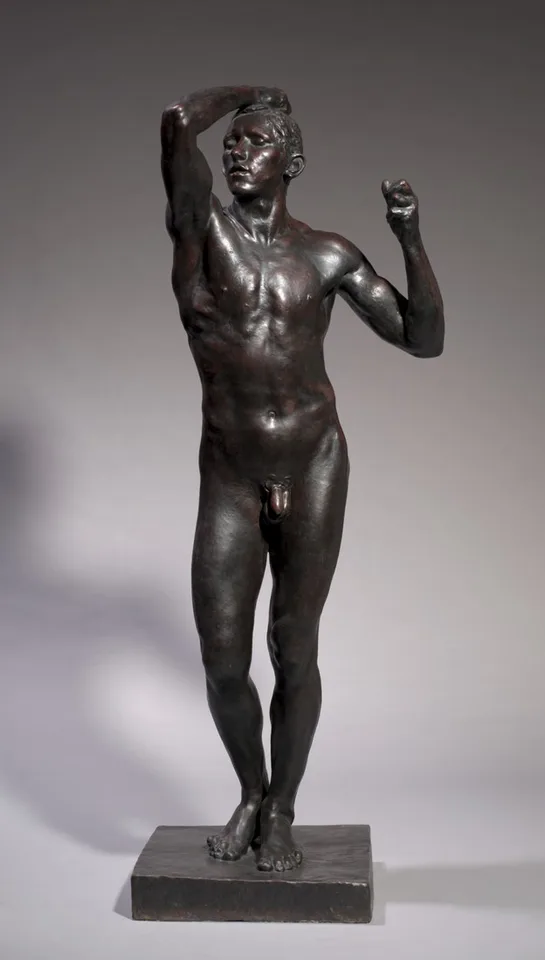
The empty raised hand leaves a question where a spear once supplied a more definite story.
The standing figure does not face us with a simple symmetrical stance. One arm crosses above the head while the other bends upward, and the legs shift the weight through a subtle lean. Light slides over the chest, abdomen, and thighs, making the body seem responsive rather than rigid. Yet the gesture remains difficult to translate into a single action.
Rodin originally gave the figure a spear, then removed it. The museum explains that this change reduced narrative specificity and intensified the sculpture’s psychological openness. Its realism even prompted false accusations that Rodin had cast directly from a living body. The dates require another distinction: the model belongs to 1875–76, while Ralph King commissioned this bronze in 1916. Rodin supervised its casting and its deep reddish patina before it reached Cleveland as a gift in 1918. This is therefore a later, artist-supervised material realization of an earlier conception.
The model date and this cast’s production date differ. The empty hand leaves the subject intentionally open, and the historical accusation of casting from life was false.