Read the
Picture
An open collection
A guided journey · 5 works

Sculpted bodies and chosen roles

A sculpted body can suggest movement, psychological openness, imposed constraint, professional identity, or mythological presence. These five objects use stance and surface differently, and their photographs preserve only selected viewpoints. Follow arms, hands, and heads while distinguishing a model’s conception from a later cast and a represented social condition from the subject’s unavailable personal testimony.

Begin the journey ↓
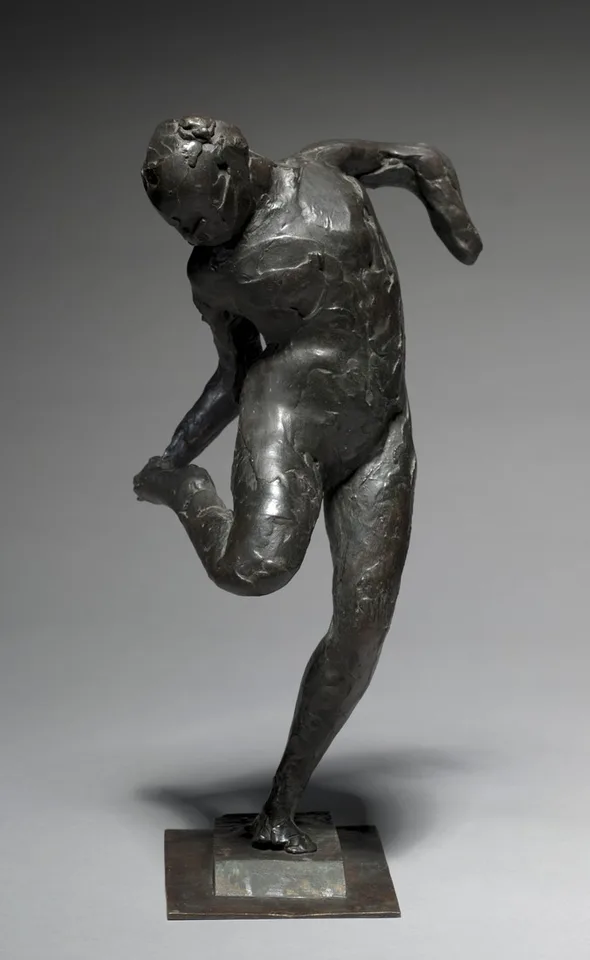
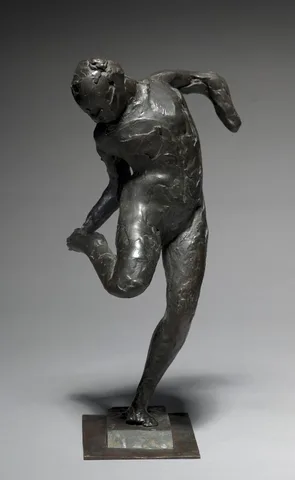
A dark bronze nude balances on one planted leg while lifting the other behind her and grasping its foot. Her torso tilts forward and her head bends down. The opposite arm curls backward. Uneven ridges catch highlights across the body, which stands on a small rectangular base against a neutral background.
01A dark bronze nude balances on one planted leg while lifting the other behind her and grasping its foot. Her torso tilts forward and her head bends down. The opposite arm curls backward. Uneven ridges catch highlights across the body, which stands on a small rectangular base against a neutral background.
Dancer Looking at the Sole of her Right Foot · 1896–97

The lifted right foot

The dancer gathers her foot for inspection, making bodily adjustment the subject. The bronze preserves a wax model’s surface through a posthumous casting history.

Carry this question: Which limbs form the most compact group?

Open the artwork ↗
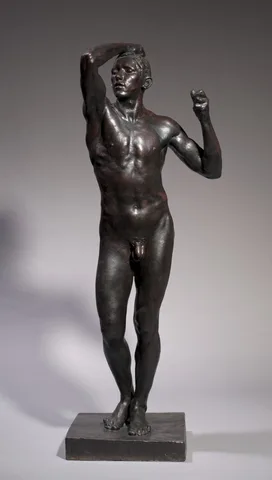
02A nude bronze man stands on a low rectangular base, one arm raised over his head and the other bent upward with a loosely closed hand. His eyes appear nearly shut, and his weight shifts through slightly bent legs. Smooth muscular surfaces catch highlights against a neutral background, with darker reddish-brown tones in the recesses.
The Age of Bronze · 1875–76

An empty raised hand

Rodin removed a spear, leaving the raised hand more open to interpretation. This artist-supervised 1916 cast realizes an earlier model rather than sharing its original conception date.

Carry this question: How would a spear narrow the possible action?

Open the artwork ↗
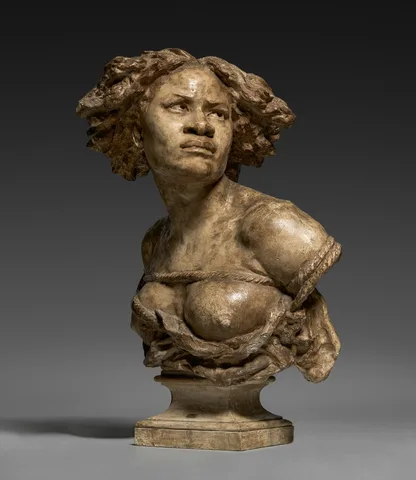
03A sculpted woman turns her head upward and to the right, her curly hair spreading around a tense face. A rope crosses her upper chest and binds her torso, while torn clothing gathers below exposed breasts. Warm brown and pale tones cover the plaster surface. The bust rests on a small integrated pedestal.
Why Born Enslaved! · 1867

The binding rope

The rope makes imposed restraint explicit beneath an upward-turning face. An abolitionist argument does not supply the unnamed woman’s own biography or direct voice.

Carry this question: How does the head’s direction oppose the rope’s constraint?

Open the artwork ↗
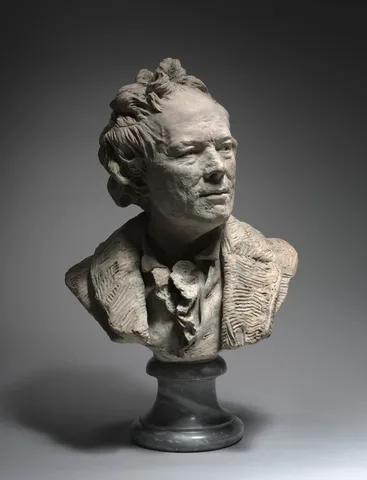
04A terracotta bust shows a mature man turning slightly to the right, with swept-back untidy hair and a furrowed, pockmarked face. His open collar and loosely gathered neckcloth expose part of his throat. Dense incised lines texture the coat lapels. The pale bust sits on a dark rounded pedestal against a neutral background.
Portrait of Christoph Willibald Gluck · c. 1775

The open collar

An open collar looks informal, yet the museum identifies it as a convention for presenting an artist. Observed facial irregularities and social staging coexist.

Carry this question: Which details feel observed, and which help present a role?

Open the artwork ↗
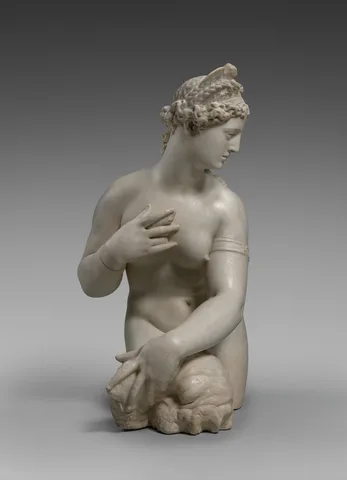
05A pale marble woman sits with her torso twisting to the right and her head turned in the same direction. One hand rests across her upper chest, while the other extends down over a rough support beside her thigh. Her hair is elaborately braided and gathered. Smooth skin contrasts with the textured base and hair.
Fata Morgana · c. 1572

The turning head

The twisting head and torso invite movement around the marble. Its fountain commission joins a spring, a legendary fairy, and a patron’s name in one specific setting.

Carry this question: What further view would you want to see next?

Open the artwork ↗
Take this with you

A persuasive body is still a constructed image, with material history and conventions that shape what it can tell us.

Try an exercise with the first work →

Find another journey →

Look at a pair more closely

Read with the sources

Historical context follows the individual museum records linked on each artwork page. These routes make original comparisons of visible form; resemblance alone is not evidence of shared meaning or direct influence.