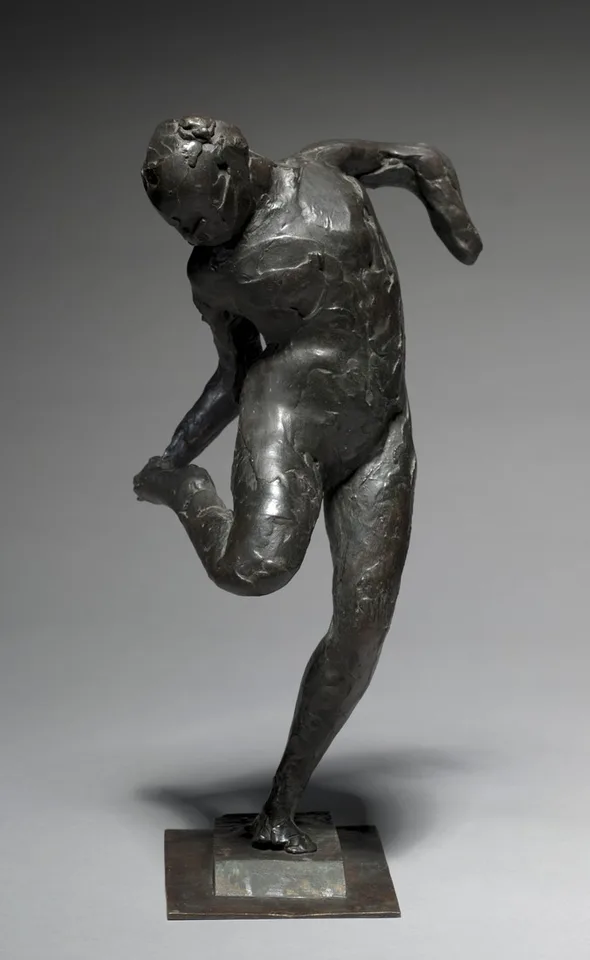
One planted foot supports an awkward inspection, while the rough bronze preserves traces of an earlier, softer material.
The dancer’s action creates a chain of bends. Her head inclines toward the raised right foot, her torso leans, and one arm reaches down to hold the lifted leg. Against these movements, the supporting leg stretches almost continuously to the base. The pose can feel unstable, yet its structure is carefully balanced through the opposition of an extended support and gathered limbs.
Degas repeatedly investigated dancers through drawing, painting, and sculpture. The museum explains that his wax models were cast in bronze after his death; the date attached to this work therefore refers to the modeled conception, not necessarily the production of this metal cast. Its surface retains marks associated with his fingers working the wax. A close view brings two kinds of bodily activity together: the dancer examining her foot and the sculptor shaping a material that could be pressed, altered, and translated into bronze.
The bronze was cast after Degas’s death from a wax model. A single photograph cannot show the entire pose or establish how the sculpture changes from every viewpoint.
What explains the sculpture’s visibly uneven surface?
Practise looking at Dancer Looking at the Sole of her Right Foot →