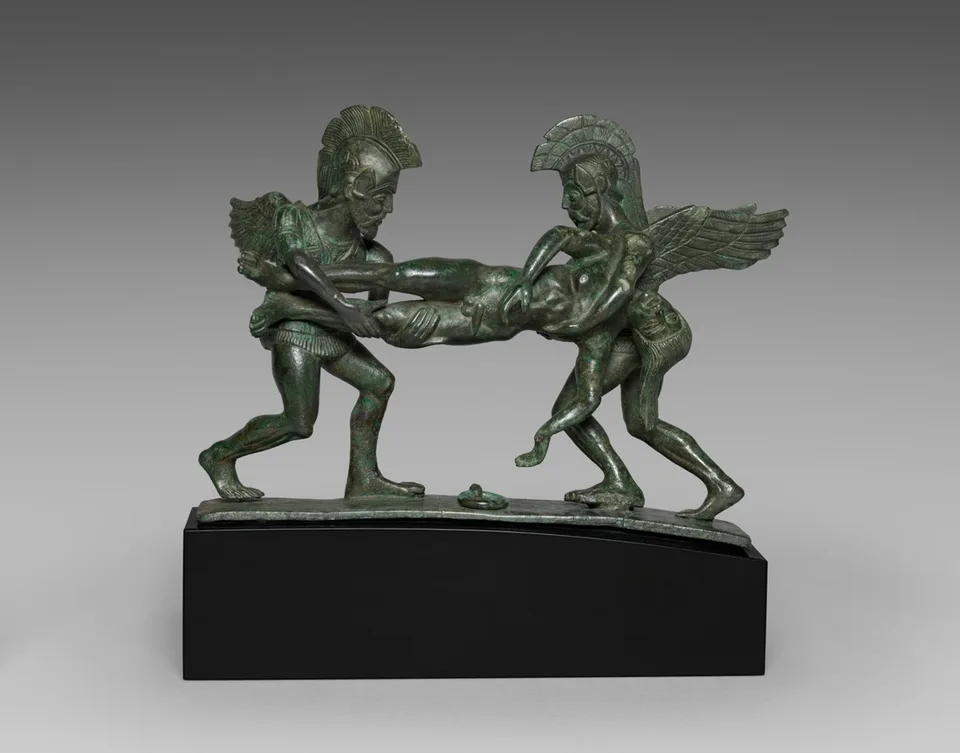
 Etruscan · 400–375 BCE
Sleep and Death Cista Handle
Maker unrecorded
bronze
Two ancient objects use bodies to make a tragic aftermath visible. Winged carriers support a fallen warrior on a bronze handle; Medea escapes above the children’s bodies on a painted vessel. Compare posture and arrangement before relying on the different narratives supplied by the museum.
Etruscan · 400–375 BCEMaker unrecorded
bronze
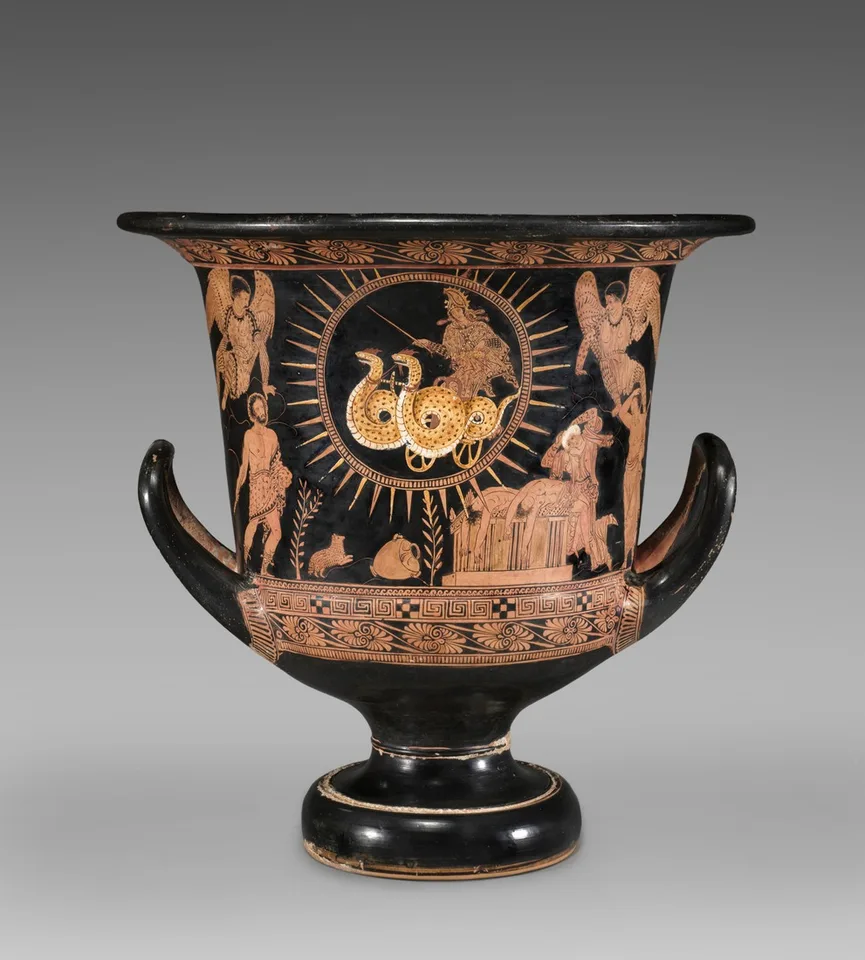 South Italian, Lucanian · c. 400 BCE
near the Policoro Painter (South Italian, Lucanian, active c. 400 BCE)
ceramic
The bronze warrior’s head tips backward while two figures support his body. On the krater, the children’s bodies occupy the lower zone beneath Medea. In each, a body’s placement contrasts with active surrounding figures, though the scenes tell different stories.
A feathered wing extends from one bronze carrier, supporting the tentative identification of Sleep and Death. Winged Furies flank Medea’s circle. Similar wings identify supernatural participants in different narratives, rather than a shared role or moral meaning.
The bronze group makes a graspable bridge across a handle. Medea’s chariot sits within a radiant painted circle. One narrative form serves the mechanics of lifting a lid; the other establishes visual hierarchy on a vessel’s curved wall.
The bronze warrior may be Sarpedon or Memnon, while the krater’s Medea scene is identified more firmly. Shared tragic subject matter does not remove that difference in certainty.
The comparison of visible choices is our own reading. Follow either artwork page for its full context, uncertainty note and image-rights record.
Six ancient figures use carrying, sitting, reaching and preparation in different ways.