Read the
Picture
An open collection
South Italian, Lucanian · Ceramic

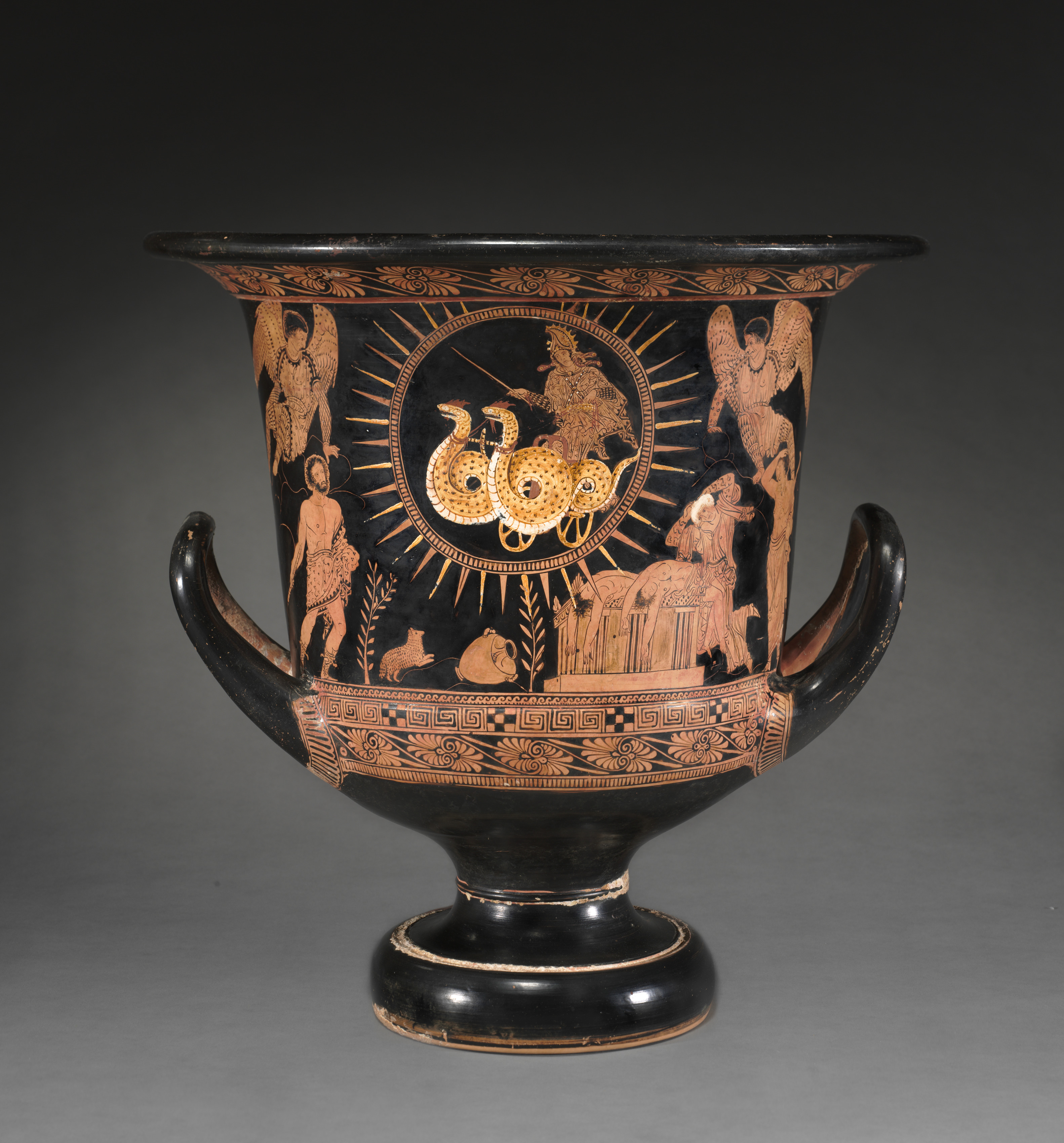
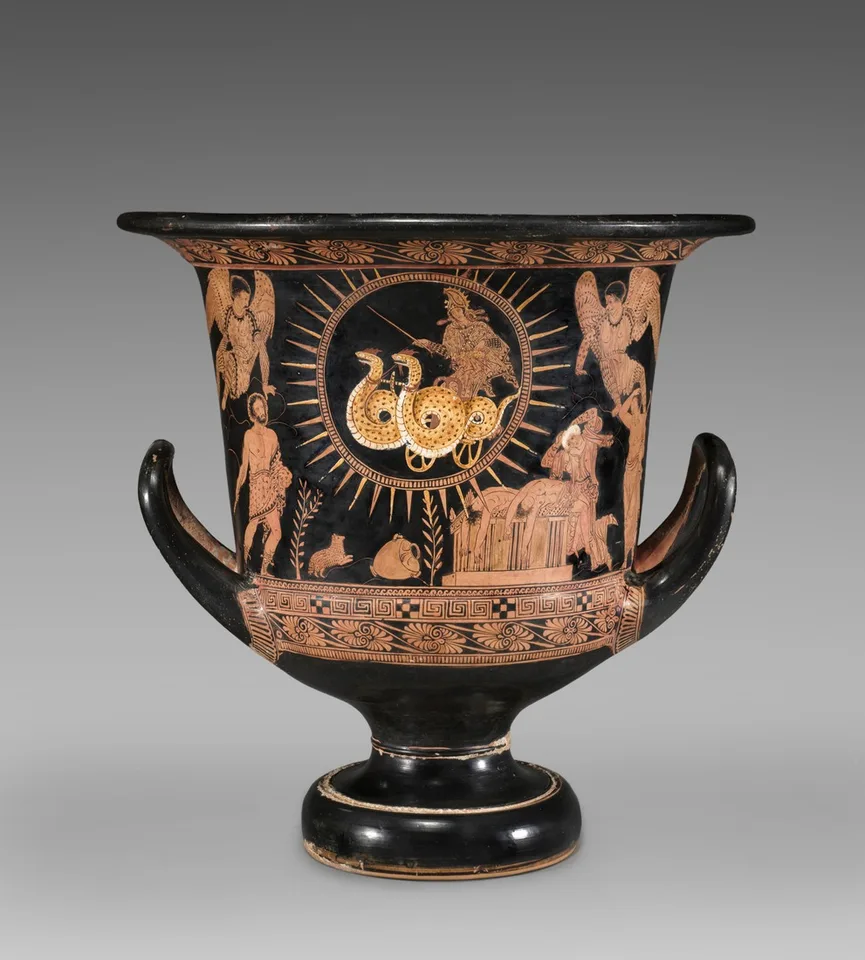
Red-Figure Calyx-Krater (Mixing Vessel): Medea in Chariot (A); Telephos with Baby Orestes (B)

near the Policoro Painter (South Italian, Lucanian, active c. 400 BCE) · c. 400 BCE

A black and reddish ceramic mixing vessel has a flared rim, two curved handles and a round foot. On its front, a woman rides a dragon-drawn chariot inside a circle of radiating lines. Winged figures flank her. Smaller people and prone bodies occupy the lower scene, framed by dense floral and geometric borders.
100%

Drag to move · Pinch or +/− to zoom · Arrow keys to pan · 0 to reset

The Cleveland Museum of Art · 1991.1 · Image: CC0Museum image ↗
A little context

A radiant circle lifts Medea above the people below, making one painted pot hold both escape and its terrible consequences.

The front of this Lucanian mixing vessel relates to Euripides’s tragedy Medea. The museum identifies Medea escaping in a dragon-drawn chariot after killing her children in revenge against Jason. A radiant circle recalls her descent from the sun god Helios. Furies flank the central image, while Jason, a nurse and a teacher approach the children’s bodies below. The painter organizes a complex narrative through differences of height, scale and framing.

The circular chariot scene attracts attention before the smaller actions beneath it. Its rays cut across the black ground, making escape seem visually separate from the altar and grieving figures. Curving handles then enclose the larger field like an additional frame. A different tragedy, Telephos, appears on the reverse and is not visible here. The pot therefore carried more than one dramatic encounter. This selected view supports a close reading of Medea’s scene, while reminding us that a rotating vessel cannot be fully experienced from one photograph.

A careful reading

The photograph shows one side of a vessel with two dramatic narratives. The painting relates to the tragedy, but does not document a particular stage performance or its scenery.
Try your eye

Which device gives Medea’s escape the strongest visual emphasis?

Where this reading begins

Our observations describe the supplied museum photograph. Historical identifications and context follow the cited collection record; interpretive limits are stated above. This is an independent guide, not a museum endorsement.

Image rights & attribution

Red-Figure Calyx-Krater (Mixing Vessel): Medea in Chariot (A); Telephos with Baby Orestes (B), c. 400 BCE. Near the Policoro Painter (South Italian, Lucanian, active c. 400 BCE). Ceramic; diameter of mouth: 49.9 cm (19 5/8 in.); overall: 50.5 cm (19 7/8 in.); diameter of foot: 22 cm (8 11/16 in.). The Cleveland Museum of Art, Leonard C. Hanna Jr. Fund, 1991.1

Individual API record marked CC0; checked 2026-11-14. CC0 1.0 dedication. Record date: 2026-11-05 13:17:25.607000. Museum print JPEG preserved unchanged in local originals; overview JPEG resized and recompressed from that same full frame; responsive WebP and zoom derivatives resized and recompressed; numbered annotation overlay separate from image.