Read the
Picture
An open collection
Etruscan · Metalwork

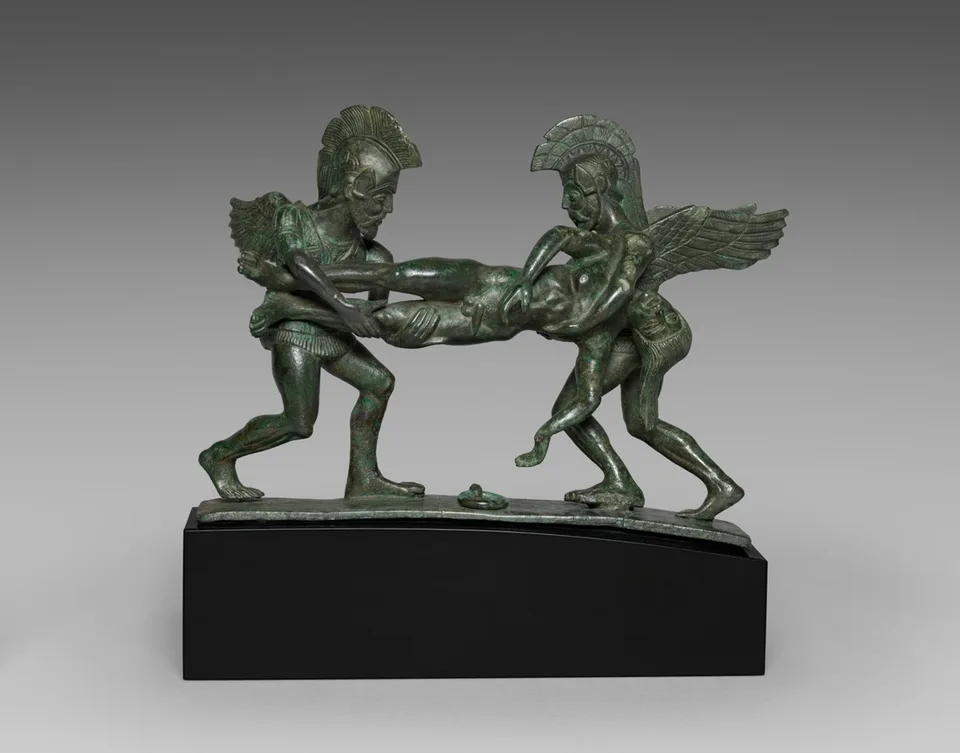
Sleep and Death Cista Handle

Maker unrecorded · 400–375 BCE

Three small bronze figures stand on a narrow curved strip. Two helmeted winged figures face inward, their bent legs set apart as they support a horizontal nude body. The central figure’s head tips backward at the right, with long locks hanging below it. A small helmet lies on the strip below, and a modern dark block supports the group.
100%

Drag to move · Pinch or +/− to zoom · Arrow keys to pan · 0 to reset

The Cleveland Museum of Art · 1945.13 · Image: CC0Museum image ↗
A little context

Two winged carriers step outward while a limp body spans the gap between them, making a handle out of a scene of a fallen warrior.

This bronze group was designed as a handle on the lid of a cylindrical box, or cista. The museum tentatively identifies the winged carriers as Sleep and Death bearing Sarpedon, the Trojan ally killed by Patroclus in Homer’s Iliad. It also allows another possibility: the fallen figure could be Memnon, killed by Achilles. The shared visual evidence is a dead or powerless warrior supported by two active supernatural carriers.

The contrast between their bodies makes the scene legible. Bent knees and planted feet give the carriers effort and direction, while the supported body stretches across their arms with its head tipping backward. Wings extend the outer silhouette, and a small helmet sits beneath the body. The figures also form a bridge that could be grasped. Narrative and utility are thus closely joined, but the missing box changes our encounter: a component once touched to open a container now appears as an independent sculptural scene.

A careful reading

The warrior’s identity is uncertain between Sarpedon and Memnon. The original cista is absent, and the modern support must not be mistaken for the ancient lid.
Try your eye

What most clearly distinguishes the carried figure from the carriers?

Where this reading begins

  • Sleep and Death Cista Handle: collection record — The Cleveland Museum of Art. Identification, qualified cultural and maker attribution, materials, object-specific historical context, provenance and stated uncertainties; photograph independently inspected for visual observations. Museum record updated 2026-11-05; accessed 2026-11-14.

Our observations describe the supplied museum photograph. Historical identifications and context follow the cited collection record; interpretive limits are stated above. This is an independent guide, not a museum endorsement.

Image rights & attribution

Sleep and Death Cista Handle, 400–375 BCE. Etruscan. Bronze; with base: 18.5 x 18.3 cm (7 5/16 x 7 3/16 in.); without base: 14 x 17.4 cm (5 1/2 x 6 7/8 in.). The Cleveland Museum of Art, Purchase from the J. H. Wade Fund, 1945.13

Individual API record marked CC0; checked 2026-11-14. CC0 1.0 dedication. Record date: 2026-11-05 13:17:24.225000. Museum print JPEG preserved unchanged in local originals; overview JPEG resized and recompressed from that same full frame; responsive WebP and zoom derivatives resized and recompressed; numbered annotation overlay separate from image.