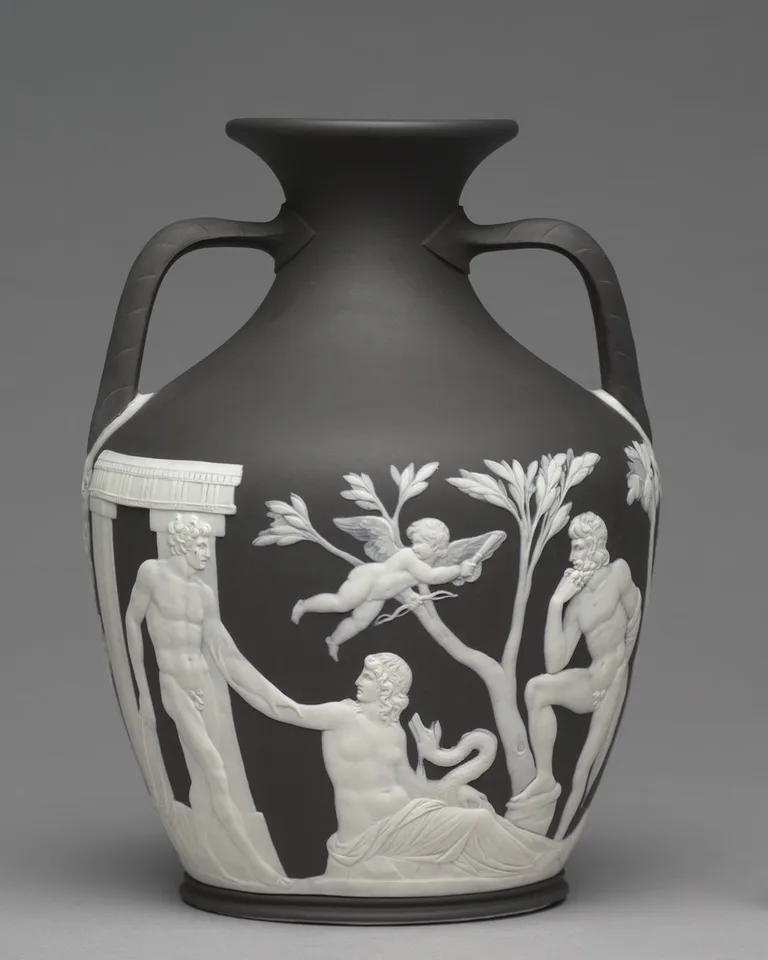
 England, Staffordshire · c.1790
Portland Vase
Josiah Wedgwood and Sons (Britain, Staffordshire, est. 1759)
jasperware with applied decoration
Two European ceramics respond to admired objects from other places and times. One closely replicates Roman glass in jasperware; the other draws on Chinese red stoneware within early Meissen experimentation and a composite mounted vessel.
England, Staffordshire · c.1790Josiah Wedgwood and Sons (Britain, Staffordshire, est. 1759)
jasperware with applied decoration
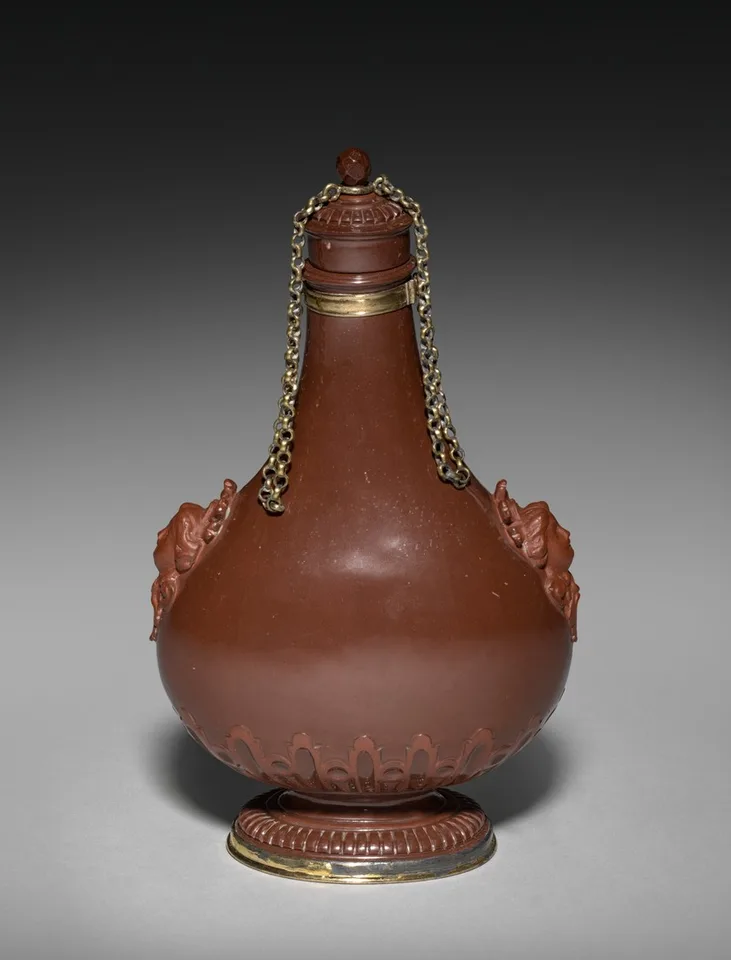 Germany, Meissen, 18th century · c. 1715
Meissen Porcelain Factory (German, est. c. 1710) (manufacturer)
polished red stoneware, silver-gilt mounts
Wedgwood’s white relief against a dark body imitates the Roman glass model’s appearance. Meissen’s polished red body can look like stone. In both, visual resemblance invites a material mistake unless the record’s identification remains central.
The Portland Vase’s plain neck and curved handles balance the crowded lower relief. The bottle’s tall neck is accompanied by chains and gilt mounts. Both guide the eye upward, but only the latter combines the ceramic with a conspicuous separate metal system.
Wedgwood’s winged child crosses a branch on the rounded body, making relief narrative wrap around a container. Meissen concentrates molded ornament at the foot. The same category of useful vessel supports very different distributions of pictorial and structural interest.
Wedgwood’s work is a close replica in a different material; Meissen’s relationship to Yixing ware is inspiration. These are distinct forms of transmission, not interchangeable copying claims.
The comparison of visible choices is our own reading. Follow either artwork page for its full context, uncertainty note and image-rights record.
A Mughal miniature, Roman glass, Chinese stoneware, and an English textile design.