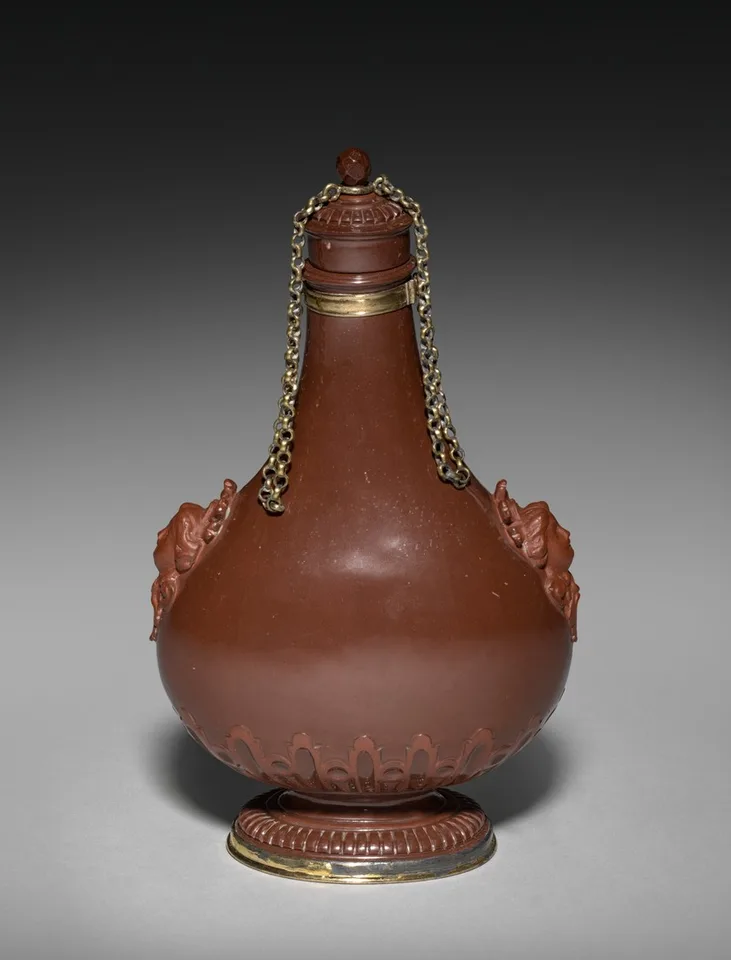
A polished ceramic body can look almost like carved stone, while chains and gilt mounts make the bottle a composite luxury object.
The bottle’s broad body narrows gradually into a tall neck, giving the silhouette a strong upward pull. Its red-brown surface is comparatively plain, so the reflected light becomes a major feature. Ornament gathers instead at the foot, shoulder attachments, and stopper, with metal chains connecting the upper and lower parts. This distribution lets material finish remain as conspicuous as modeled detail.
The museum dates the bottle to about 1715, soon after the Meissen factory’s establishment. It connects the factory’s early red stoneware with Chinese Yixing wares and explains that the dense ceramic could be polished on a lapidary wheel. The object is therefore not porcelain simply because Meissen is famous for porcelain. Its silver-gilt mounts add another material system to the polished ceramic body. Looking between those components reveals a history of technical experimentation and international inspiration, expressed through an object whose practical bottle shape also served conspicuous display.
The body is red stoneware, not porcelain or carved stone. Chinese Yixing inspiration does not make this a Chinese-made object, and the title alone does not prove actual pilgrimage use.