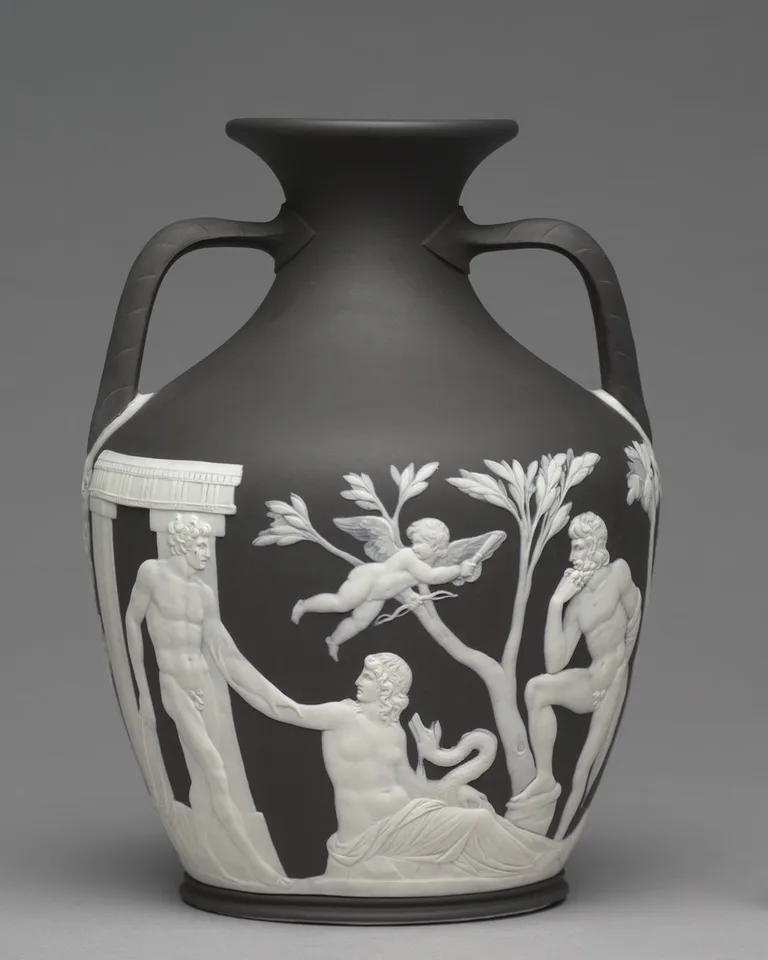
White figures stand against a dark body in a ceramic vessel that deliberately translates a celebrated Roman glass original.
The white relief figures form a bright band around the vase’s lower body. Their limbs, drapery, and nearby trees remain easy to distinguish against the dark surface, while the plain neck gives the crowded narrative room to breathe. The handles connect the upper opening with the decorated body, framing the scene without becoming its main attraction.
This is Wedgwood jasperware, not ancient Roman glass. Around 1790, the Duke of Portland lent the Roman Portland Vase to Wedgwood so that ceramic replicas could be made. The museum identifies Cleveland’s example as one of the early editions. The object therefore preserves a close encounter with antiquity through a change of material and production method. Its value is not exhausted by calling it a copy: the applied pale decoration and dark ceramic body required a successful technical translation. The photograph shows only part of the continuous relief, reminding us that the story extends around a vessel.
This is an eighteenth-century ceramic replica, not the Roman glass original. The photograph shows one side, and the museum’s description does not securely identify every mythological figure in the relief.